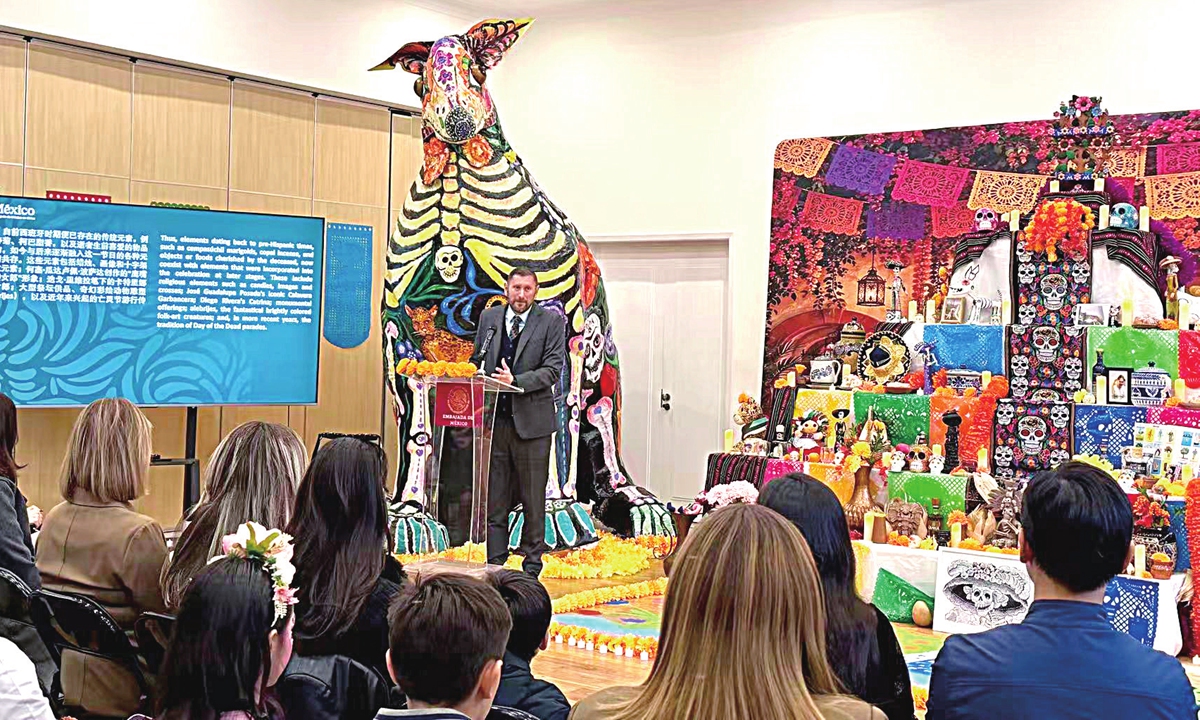
Sergio Kwiatek, chargé d'affaires at the Mexican Embassy in China, gives a speech at the event in Beijing on November 2, 2026. Photo: Dong Feng/GT
The Embassy of the United Mexican States in China, together with full house of members of the expatriate community and culture enthusiasts, explored and celebrated the rich cultural elements featured in the movie Coco in Beijing on November 2.The event showcased Mexican folk dance, traditional music, art and photography exhibitions, and a display of alebrijes - vibrant, fantastical animal sculptures. The photography exhibition was presented in collaboration with the National Autonomous University of Mexico's (UNAM) representative office in China.
In his remarks, Sergio Kwiatek, chargé d'affaires at the Mexican Embassy in China, said the Day of the Dead, which was the main topic in the movie Coco, is one of the best-known Mexican traditions in China.
Kwiatek noted that the holiday shares many similarities with China's Qingming Festival, or Tomb-Sweeping Day, as both reflect values deeply cherished by the people of both Mexico and China: respect for ancestors, remembrance of departed loved ones, and the honoring of the lives and contributions of those who came before us.
"Despite the great distance between our two countries," Kwiatek stated, "these shared values foster a sense of mutual recognition, bring us closer together, and forge a strong connection between us."
Day of the Dead Altar, which is one of the must-have in every household in Mexico, was inaugurated at the Mexican Embassy in China during the event with folkloric dances, traditional music, and art exhibitions.
A photography exhibition, organized in collaboration with the UNAM's China office, and art exhibitions featuring thematic paintings and alebrijes, brightly colored Mexican folk art sculptures that depict fantastical, dreamlike chimeric creatures combining parts from different animals, were also presented at the embassy.
The altar will be open to the public for guided tours throughout November.
Cultural and Tourism Attaché Azucena Cardosa gave a presentation on the origins and significance of the Day of the Dead, as well as the symbolism behind traditional elements of the altar, such as flowers, water, and salt.
Azucena explained that the Day of the Dead encompasses various cultural expressions beyond the altar itself, including the elaboration of pan de muerto (a sweet yeast bread, or pan dulce, topped with a sugary orange glaze baked for Day of the Dead celebrations), and calaveritas, humorous and ironic literary compositions traditionally associated with this celebration.
The evening featured traditional dances from the Mexican states of Veracruz and Jalisco, performed by a dance group led by Mexican dancer David Nájera.
The performers wore traditional regional costumes and makeup inspired by this festivity.
Additionally, two paintings by renowned Mexican artist Karla de Lara were exhibited. Using the Day of the Dead as their thematic backdrop, the works highlight the similarities between Mexican and Chinese cultures.
Animated film Coco is a deep dive into Mexican culture, centering on the holiday Día de Muertos (Day of the Dead). The movie draws heavily from Mexican traditions. One of the staff member from the Embassy told the Global Times that the film Coco 2 is expected to be on screen.
To Chinese children, Mexican traditions mean the impressive experiences of using colorful paper to make artworks. Among the visitors to the event, some Chinese children from the Chen Hong Art Studio were so happy when they saw their own works showcased. Chen's studio has been fostering cultural exchange and artistic creativity between Mexico and China.
RELATED ARTICLES