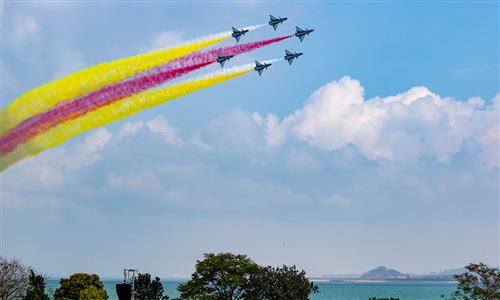
J-10 fighter jets fly over Great Wall to mark 77th anniversary of PLA Air Force’s founding, showing superb skills
By Guo Yuandan and Published: Nov 06, 2026 03:44 PM

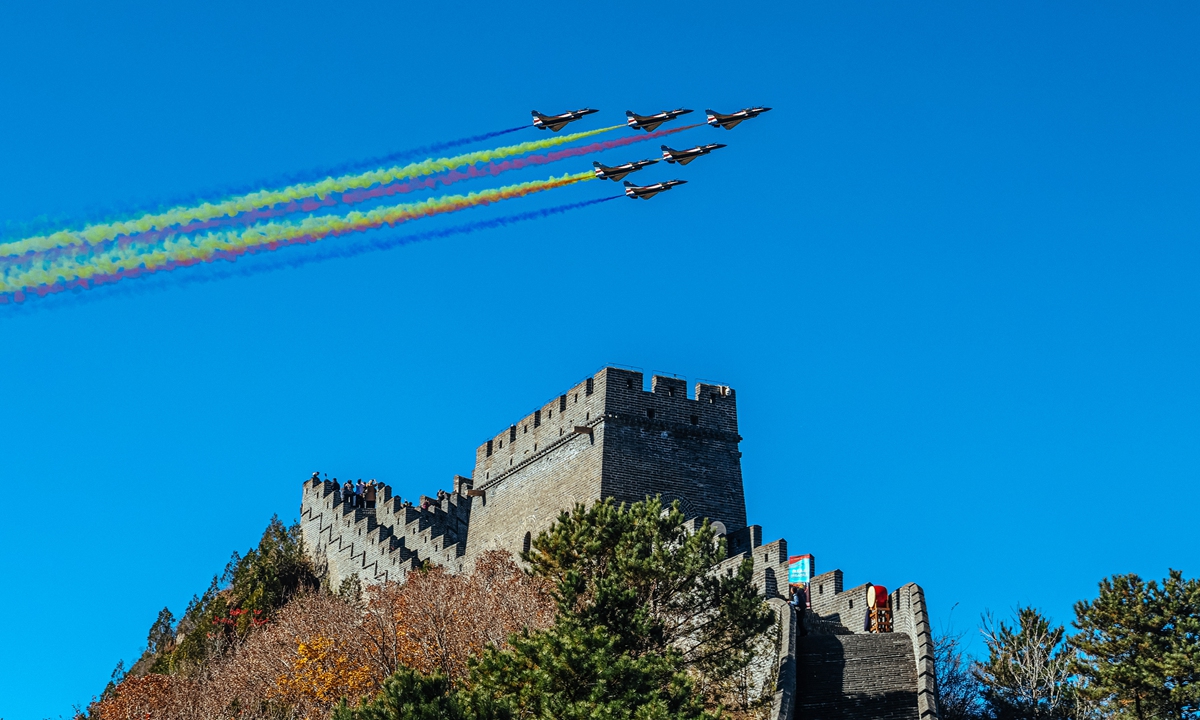
Six J-10 fighter jets of the Chinese People's Liberation Army (PLA) Air Force's aerobatic team fly over the Huangyaguan section of the Great Wall in Tianjin on the morning of November 6, 2026. Photo: Li Hao/GT
Global Times reporters at the scene observed that during the flyover, the six fighter jets maintained a tight formation with minimal spacing. They cruised steadily along the valley route and released smoke synchronously. Their perfectly aligned formation offered a direct display of the August 1st aerobatics team's superb flying skills.
After landing, pilot Cha Xiufeng, who took part in the mission, remained overwhelmed with emotion. "We fly not merely through valleys and mountain ranges of the Yanshan Mountains, but over the land our predecessors defended with their blood. What we paint across the sky is not just fleeting colored smoke; it is the mission trail that safeguards the peace of millions of people and defends the integrity of our motherland's airspace," he said.
The Huangyaguan Great Wall flyover by the August 1st team is coordinated as part of a broader sequence of events, alongside drone light shows in Zhuhai and upcoming flyovers by the Red Eagle aerobatics team in Changchun, the Global Times has learned.
Arranged to echo one another, these multi-location activities deliver a layered, multi-dimensional showcase of the PLA Air Force's resolve to soar skyward and train for combat, as well as its commitment to safeguarding national air and space security.
Friday's flyover marks the August 1st aerobatics team's third pass over a world-famous landmark, following its flight above Huangyaguan Great Wall in 2018 and the Egyptian Pyramids in 2024.
The Huangyaguan area features crisscrossing valleys and undulating terrain, with turbulent and erratic mountain winds. Low-altitude flights here face strong air turbulence and narrow visual margins. Sustaining stable tight formations and precise flight control leaves little room for error, posing a major test to pilots' situational awareness, coordination and emergency response capabilities, Zhang Xuefeng, an expert on military affairs, told the Global Times.
First built during the Northern Qi Dynasty more than 1,400 years ago, the Huangyaguan Great Wall guards a mountain pass in the Yanshan range and controls the strategic chokepoint of northern Ji Pass. It has long served as a strategic barrier protecting the capital region and defending the homeland, earning its reputation as the "Grand Pass of Northern Ji."
"It is common international practice for aerobatics teams from various countries to fly over scenic sites and landmarks. Such activities help build rapport with the public and draw wider attention to aerobatics teams and air force development," Zhang said.
The team's flyover of the Great Wall carries profound, distinctive symbolism: while the Great Wall functioned as a key defense bulwark against foreign aggression in ancient times, the PLA Air Force, represented by the aerobatics team, acts as a "Great Wall in the sky" for the new era, tasked with safeguarding the nation's airspace, according to Zhang.
Known as the "honor guard in the sky for state ceremonies," the August 1st aerobatics team stands as a vivid microcosm of the PLA Air Force's growth and transformation and a travelling national calling card of China's aerospace power. Founded over six decades ago, the team anchors all its stunts in combat standards. Its pilots routinely train in aerial refueling, night flying, formation aerobatics, low-altitude maneuvers and coordinated operations in complex environments. Its spectacular formation routines are themselves honed extensions of combat capabilities.
Zhang noted that aerobatics teams also serve as an important window for the outside world to observe the development of the PLA Air Force. Upgrades to the team's equipment reflect steady advances across the PLA Air Force's overall equipment ecosystem. The pilots' exceptional formation-flying skills and training standards also offer a direct demonstration of the Air Force's growing combat training prowess.
"With equipment development and training standards advancing in tandem, the PLA Air Force is capable of tackling all kinds of future aerial threats and securing victory in operations. Meanwhile, the warplanes' flyover above the historic pass vividly embodies the PLA Air Force's vigorous spirit and combat-ready resolve," he said.
RELATED ARTICLES