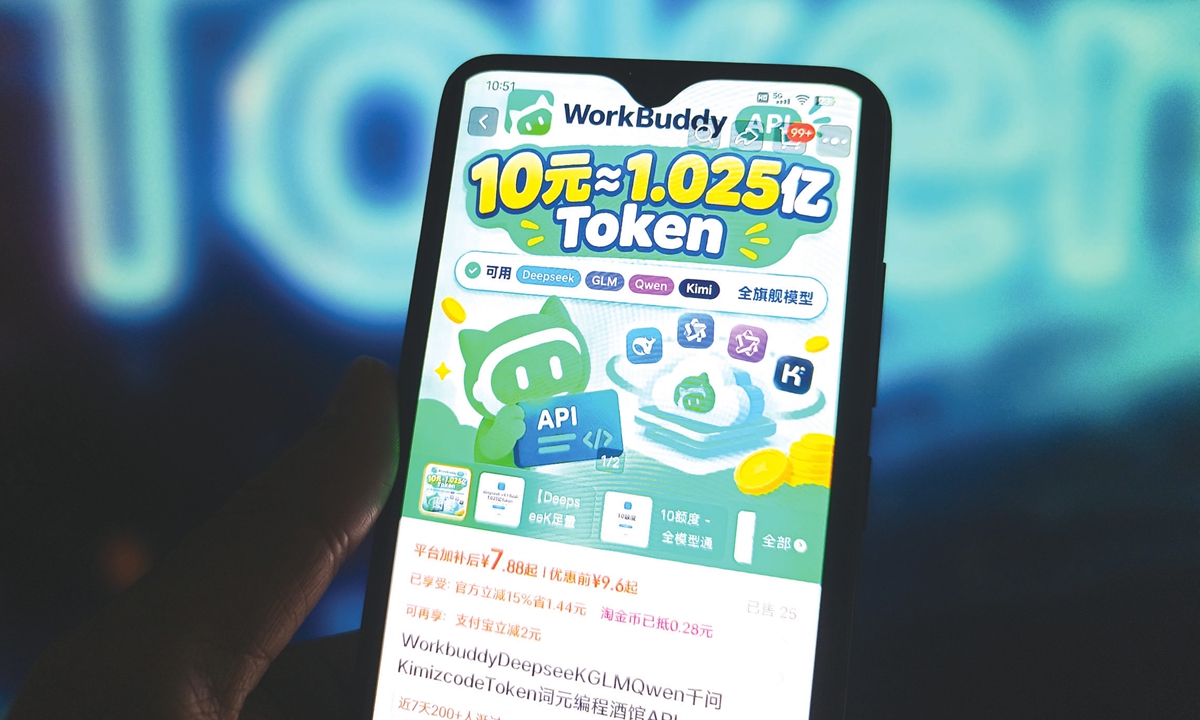
A Chinese e-commerce platform sells tokens on November 3, 2026. Photo: VCG
For years, computing power was something that ordinary consumers never had to think about. They paid for internet access, software subscriptions and digital services, while the computing resources behind them remained largely invisible. This year's Singles' Day, also known as Double 11 in China, however, has put a new item on consumers' shopping lists - AI tokens.
One of the festival's most unusual new offerings, discounted tokens have emerged as a product that many consumers seem to be eager to get their hands on.
From AI video creators stocking up on computing credits to office workers buying packages for writing and presentation-making, tokens are increasingly being treated as a consumable resource rather than merely a technical billing unit used by AI companies.
The shift is reflected in the emergence of dedicated token sections on major e-commerce platforms. On November 2, livestreaming sales host Austin Li, widely known as the "Lipstick King," sold nearly 100,000 monthly memberships for Alibaba's QwenWork office AI service within half an hour, representing about 2 trillion tokens in usage allowances, according to Chinese media reports.
Getting to shopping cart
The change has been accompanied by new retail channels for AI services. Since September 3, when Tmall launched its token recharge center, the platform has brought together offerings from major AI providers, including DeepSeek, Alibaba Cloud, Zhipu AI and Moonshot AI. MiniMax has also opened its first flagship store on the platform, followed by QwenWork and StepFun.
The timing coincides with this year's Singles' Day promotions, with AI companies offering discounted token packages to attract individual buyers and small businesses. For example, a monthly Qwen AI Lite package priced at 60 yuan ($8.99) on its official website was offered at 39 yuan during the promotional period. The discounts drive AI computing resources to be more accessible to consumers who previously had to use developer interfaces or pay according to actual model usage.
Alibaba said that sales of token packages on its platform rose 450 percent on October 20, the first day of the Singles' Day shopping festival sales campaign, compared with the previous month, according to media reports. The buyers are largely individuals and small businesses, including students, researchers and small businesses.
The development comes as generative AI adoption expands rapidly in China. The country's generative AI users exceeded 700 million at the end of June 2026, accounting for about half of the country's population, according to a report released by the China Internet Network Information Center in September.
As AI tools become part of everyday life, consumers are increasingly buying prepaid token allowances to access AI services. This gives users greater flexibility in choosing how much AI computing capacity they need and how much they want to spend.
For frequent AI users, buying tokens in advance is becoming a practical consideration, particularly when their work involves repeated or complex model calls.
A 29-year-old short-video creator surnamed Sun told the Global Times that he had stocked up on tokens during the shopping festival to improve the quality of his videos. He is currently turning cartoon characters he has drawn himself into AI-generated short videos, with each episode running about 10 minutes. The computing costs for producing one episode can exceed 1,500 yuan, he said.
Not every AI-generated shot is suitable for the final video, Sun explained, adding that complex scenes often require multiple rounds of generation and adjustments before obtaining the desired results. While simple video production consumes relatively few tokens, more elaborate scene construction and action sequences can quickly drive up usage and costs.
Sun produces videos as a hobby, while professional creators producing content at scale may face much higher token costs.
Buying spree for tokens
Wang Zimin, an AI video production professional in Beijing, told Xinhua that his monthly token expenditure reached 30,000 to 40,000 yuan. He prefers purchasing tokens through official channels or e-commerce platforms.
For developers, the attraction lies in another set of everyday tasks. AI models such as DeepSeek can assist with writing and debugging code, explaining technical problems and generating scripts. Repeated rounds of questions, code revisions and troubleshooting can quickly add to token consumption.
Office users are also finding more applications for AI tools, from organizing research materials and drafting reports to preparing PowerPoint presentations and summarizing documents. For individuals who use such tools regularly, token packages offer a way to manage spending while avoiding interruptions caused by insufficient credits.
And, small businesses tend to buy tokens. Wang Daoxing, executive director of Daoxing Super (Chongqing) Artificial Intelligence Technology, told Xinhua that his company uses AI for software development, presentation preparation and promotional materials, with monthly token spending exceeding 2,000 yuan. He purchased a 12-month Qwen AI membership during the shopping festival to take advantage of the discounts.
Tian Feng, president of the Fast Think Institute and former dean of the Intelligence Industry Research Institute at SenseTime, told the Global Times that the emergence of tokens as consumer products reflects AI's growing reach beyond professional developers and large enterprises to individual users and small businesses.
Tian said the trend reflects a broader shift in China's AI market. By bringing tokens onto established e-commerce platforms, AI providers are making computing resources easier to purchase and compare, while China's mature digital payment and retail infrastructure could help accelerate the adoption of AI services in everyday work and business activities.
Unlike conventional digital subscriptions, each token consumed carries computing costs, including GPU operations, electricity and equipment depreciation, Tian said. As more providers bring tokens directly to consumers, pricing transparency will become increasingly important.
Notably, some consumers have noted that token allowances and billing rules differ across AI models and providers, making direct price comparisons difficult. Tian said that as AI services move toward large-scale commercialization, clearer and more standardized billing rules are needed. He suggested disclosing prices per million tokens, model versions, validity periods and arrangements for unused allowances.
Tian said that the real test of consumer demand lies not in promotional sales figures, but in how many purchased tokens are actually used and how many customers renew their subscriptions. Over time, AI computing services could become a regular expense for households and small businesses, much like electricity or mobile data.
RELATED ARTICLES