Record number of 40 US agricultural firms display at CIIE as Chinese expert urges Washington to deliver on tariff cuts for two-way trade
By Ma Jingjing, and Chen Zishuai in Shanghai Published: Nov 06, 2026 11:24 PM

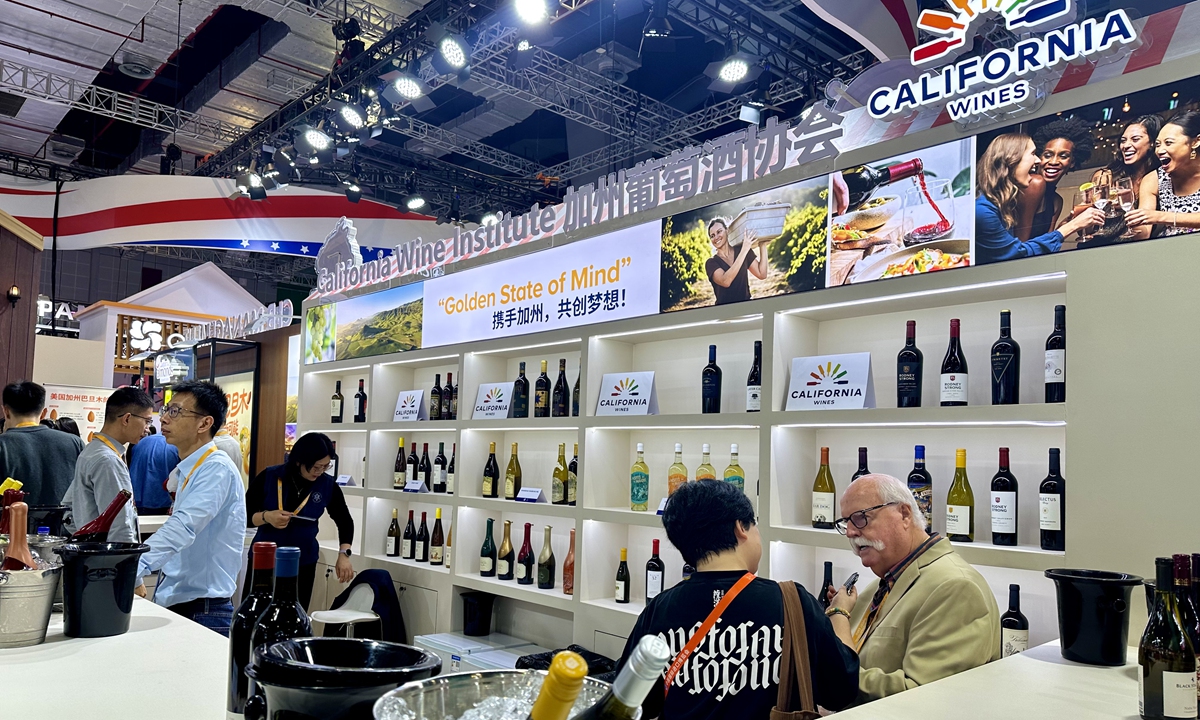
View of the booth of California Wine Institute at the American Food and Agriculture Pavilion at the ninth China International Import Expo in Shanghai on November 6, 2026. Photo: Ma Jingjing/GT
A record number of more than 40 US food and agricultural trade associations and companies attended the 9th China International Import Expo (CIIE) in Shanghai, showcasing a wide range of products from soybeans and wine to poultry and ginseng as they seek to maintain their long relationship with Chinese partners and further explore the vast Chinese market following the recent meeting between the heads of state of the US and China.Early at 9 am on Friday, the American Food & Agriculture Pavilion at the CIIE held a launch ceremony, with various US exhibitors offering tastings of flaxseed butter, nuts and wine from California, and Wisconsin ginseng water to the audience. At the US Soybean Export Council booth, a soybean-shaped mascot greeted the audience, while staff warmly offered free gifts to those who had come to taste soybean-made products. At the start of the ceremony, several people in cowboy outfits sang Take Me Home, Country Road. The whole scene brought to life the down-to-earth and welcoming character of US farmers in one of their most important markets.
Active participation
Spanning 400 square meters, the American Food & Agriculture Pavilion brought together a record number of more than 40 trade associations and companies this year, compared with 19 exhibitors at the 8th CIIE last year.
US exhibitors closed six deals worth more than $650 million at the Pavilion's signing ceremony on Friday. The largest came from Illinois-based Hang Tung Resources, which closed three deals for sorghum and wheat worth about $600 million. Other highlights included $51 million in beef sales by New York-based CLB Management and a $1.5 million contract signed by Idaho-based animal nutrition company Dynamite, according to a press release the American Chamber of Commerce in Shanghai sent to the Global Times.
"This year's record turnout speaks for itself, as does the scale of the deals signed on the first day," said AmCham Shanghai President Eric Zheng. "American food and agriculture companies see real opportunity in the Chinese market. Practical business cooperation like this is what strengthens ties between our two countries, and it is how we get to a constructive relationship of strategic stability based on respect, fairness and reciprocity," Zhang said.
Brady Holst is a US farmer and vice chairman of the Illinois Soybean Association. It is the first time for him to come to China, and his first time attending the CIIE.
"We have spent a lot of time and years developing relationships with different buyers and people in China. They are good partners and friends. When they buy our soybeans, they know someone is actually growing them for them. This personal connection between a farmer and a buyer is what has been very positive," Holst told the Global Times at the expo on Friday.
He said that he expects to meet more people who are interested in buying US agricultural products, growing that relationship and friendship between the two countries and farmers and buyers.
Holst's wish, in many ways, reflects a much bigger picture. Agricultural trade remains an important component of the China-US economic and trade relationship, and has drawn a great deal of attention following the recent meeting between the two countries' heads of state.
Pragmatism urged from Washington
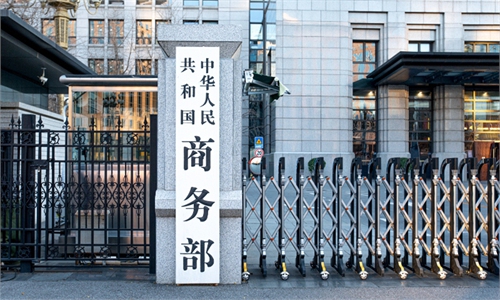
China has always been open to expanding its purchases of agricultural products from the US, but with the precondition that the two sides' arrangement for a $30 billion reciprocal tariff reduction is implemented, a spokesperson with China's Ministry of Commerce (MOFCOM) said on Thursday.
Huang Ling, the MOFCOM spokesperson, expressed the hope that the US side can work with China to create more favorable conditions for agricultural trade between the two countries by jointly reducing tariffs, cutting non-tariff barriers and expanding market access.
Maintaining the stable development of China-US economic and trade relations serves the interests of both countries and peoples, and is also beneficial for global economic development. The two sides should meet each other halfway, adhere to the principle of mutual benefit and win-win results, and promote the sustained, stable and sound development of China-US economic and trade relations, Chinese Foreign Ministry spokesperson Guo Jiakun said on Friday, responding to a media inquiry on whether China will not begin fulfilling the US$17 billion agriculture pledge until the tariffs are cut.
China and the US held the eighth round of their economic and trade consultations in New York and Washington, DC in September. In the consultations, the two sides agreed to reduce tariffs on about $30 billion worth of goods imported from each other on a reciprocal basis, with tariffs on around 90 percent of the covered products to be lowered to most-favored-nation rates. These reductions will be implemented simultaneously after each side completes domestic legal procedures.
Earlier media reports suggested that many US farmers have experienced a hard time over the past several years due to the US administration's tariffs and other multiple factors. According to a Reuters report in February 2026, former US agriculture officials and top Republican senators warned that US farmers were suffering heavy losses, while more than two dozen former industry leaders sounded the alarm about the risk of a "widespread collapse of American agriculture."
"China's market has genuine demand for US agricultural products, but economic and trade cooperation has never been a one-way street," Huo Jianguo, former head of the Chinese Academy of International Trade and Economic Cooperation under MOFCOM, told the Global Times.
The US side should move in the same direction with China, take concrete steps on tariff relief, and continue to expand the scope of exemptions while reducing non-tariff barriers. As long as the two sides uphold reciprocal benefit and mutual respect, China-US economic and trade cooperation still has broad room to grow, Huo said.
On the industry front, those expectations are already playing out on the exhibition floor. "It's our first time to attend the CIIE and it's been productive. We hope to take this platform as a stepping stone for building long-term relationships with our Chinese partners, bringing Amza products such as Toasted Flaxseed Butters and Purple Barley Bites to China's stores and e-commerce platforms," Jolma Ren, CEO of Oregon-based Amza Superfoods, told the Global Times on Friday.
China is a very important market for US rice. For many years, the USA Rice Federation has been deeply engaged in promoting US rice in the Chinese market, and this year marks the fourth time that USA Rice has participated in the CIIE.
USA Rice has long sought mutually beneficial partnerships with China's rice industry and hopes to offer Chinese consumers a wider variety of rice. This year, Mollie Buckler, Senior Director of Grower & International Relations at USA Rice, came to the CIIE with great enthusiasm, hoping to help the US rice industry establish connections with Chinese rice counterparts and continue to raise awareness of US rice in the Chinese market.
"Trade is built on relationships, and CIIE gives us the chance to strengthen ours in person," Buckler told the Global Times on Friday. "USA Rice is committed to win-win cooperation with Chinese importers, processors, and retailers, and we're eager to explore how US rice can meet the needs of Chinese consumers."
Chinese analysts said Chinese companies have always made purchasing decisions based on market demand, prices and commercial considerations. Amid changes in the US trade environment and tariff measures in recent years, many Chinese importers are also diversifying their suppliers.
The US should work with China to advance reciprocal tariff reductions as reciprocal implementation of trade commitments is essential to creating stable conditions for bilateral agricultural trade, Chinese analysts said.
RELATED ARTICLES