CIIE becomes vital platform for BRI partner countries to tap China’s mega market
Import expo becomes vital platform for Belt and Road partners to tap China’s mega market
By Ma Jingjing, and Chen Zishuai in Shanghai Published: Nov 06, 2026 11:30 PM

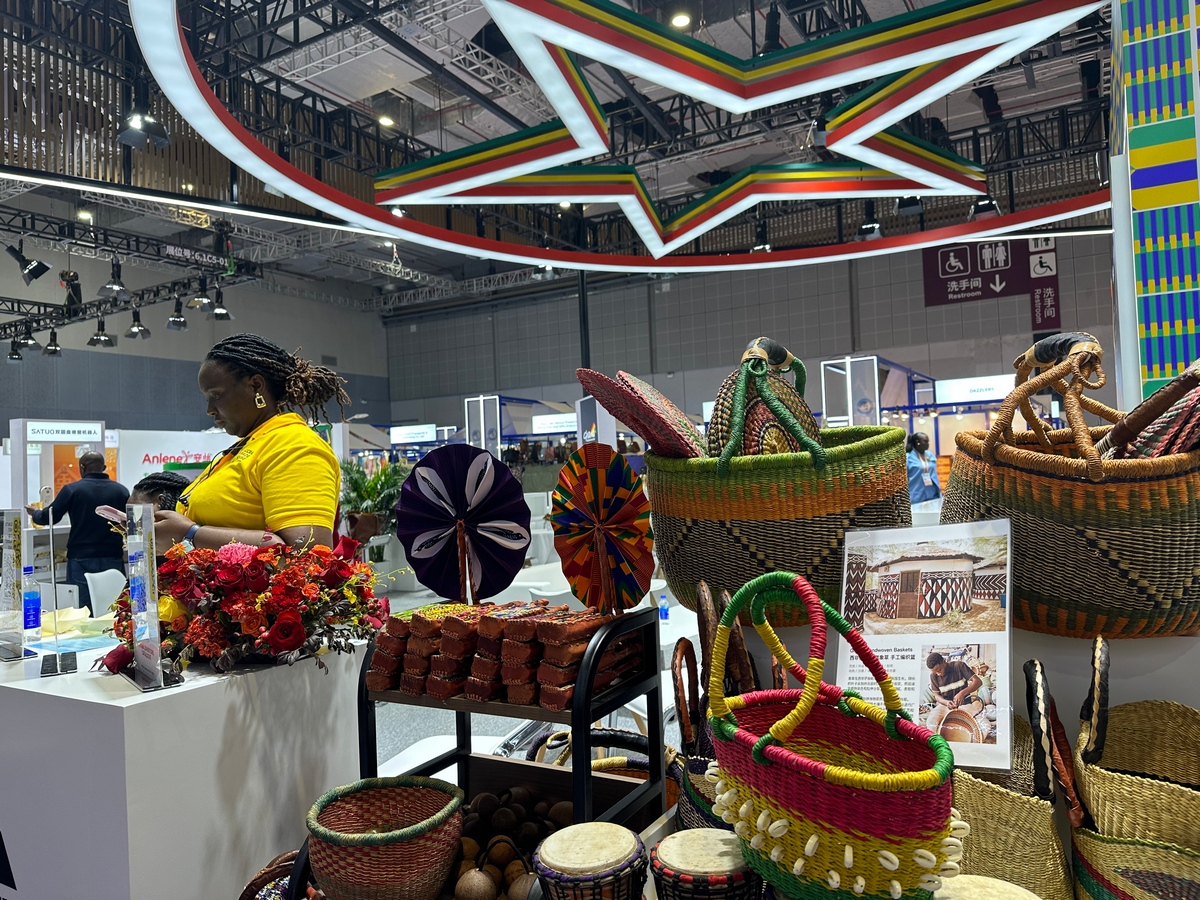
An exhibitor stands at the Ghana booth at the 9th China International Import Expo in Shanghai on November 5, 2026. Photo: Ma Jingjing/GT
Dried mango and roselle powder from Ivory Coast, honey from Rwanda, seaweed products from Tanzania…A rich array of local specialties from Belt and Road partner countries catches attention at the ongoing ninth China International Import Expo (CIIE) in Shanghai.
The CIIE is an international public good and a shared platform that China provides to the world and that is shared by all. It keeps multiplying the dividends of jointly building the Belt and Road Initiative (BRI).
Active participation
“Through initiatives such as CIIE, we are enabling African businesses to access new markets and participate more meaningfully in global value chains,” said Luthando Vuba, head of international trade at South Africa’s Standard Bank Group Business and Commercial Banking division.
Marking its ninth consecutive year participating in the expo, Standard Bank Group leads a delegation of 20 African businesses from seven countries to this year’s CIIE, seeking to connect African exporters with Chinese buyers, investors and business partners. The delegation includes companies from South Africa, Ghana, Nigeria, Kenya, Malawi, Tanzania and Uganda, covering sectors such as agriculture and food processing, with products ranging from coffee, cocoa and tea to wine, avocados and cashews.
During the past eight years, many African companies have secured substantial export orders through the CIIE platform. A Ugandan coffee exporter, for instance, secured three export orders worth more than $650,000 at the 2023 expo, while a Mozambican macadamia exporter shipped six containers of nuts to China in 2024, valued at more than $350,000, according to the bank.
These results are not isolated trade wins. They show how BRI-driven trade facilitation is turning the CIIE from a showcase into a working corridor of the BRI, where goods from inland Africa reach Chinese households through smoother logistics and clearer market access.
In the meantime, as a leading Thai food and beverage giant, TCP Group regards the CIIE as a dual platform that serves both as an “innovation accelerator” and an “investment window.” In recent years, the group’s cumulative investment in China has exceeded 4.36 billion yuan ($653 million). It has built modern Red Bull production bases in Southwest China’s Sichuan Province and South China’s Guangxi Zhuang Autonomous Region, and keeps strengthening local manufacturing and supply chain development.
“China’s ultra-large market combines robust domestic demand with strong growth prospects, creating rich opportunities for global businesses. Upgrading consumption is driving companies to broaden supply and innovate together. As China advances high-standard opening-up, global quality goods and services flow into its market more smoothly, opening wider horizons for multinationals,” Saravoot Yoovidhya, CEO of TCP Group, told the Global Times.
TCP Group’s story also points to a subtler shift taking place on the expo floor: the CIIE is no longer just where overseas brands come to test Chinese people’s rising demand, but where they commit capital, build factories, and localize supply chains. That evolution – from exhibiting products to embedding operations – is precisely what turns a trade fair into a long-term cooperation engine.
This year, Moldova hosts its national pavilion at the CIIE for the first time, showcasing its national image and high-quality specialty products. It hopes to use the CIIE platform to raise its profile and steadily expand exports to China.
China is Moldova’s second-largest trading partner. Moldova has confidence in the future of its bilateral economic and trade ties and looks to enhance cooperation with China in areas such as agriculture, tourism, and civil aviation. Chinese companies are welcome to invest in Moldova, and the Moldovan government will create a fair and transparent business environment, Claudiu Năsui from the Ministry of Economic Development and Digitalization said during a meeting with Chinese officials in Shanghai on Wednesday, according to a statement posted on China’s Ministry of Commerce website.
Sharing dividends
“The CIIE, the world’s first national-level expo dedicated to imports, demonstrates China’s commitment to building an open economy and sharing development opportunities with the rest of the world,” Song Wei, a professor at the School of International Relations and Diplomacy at Beijing Foreign Studies University, told the Global Times on Wednesday.
Under the BRI framework, China has become a major trading partner and export market for many participating countries. Through open platforms such as the CIIE, China facilitates direct connections between products from Belt and Road partner countries and Chinese consumers. Measures such as tariff reductions will further support imports, creating opportunities for those countries to benefit from China's expanding market, Song said.
The policy-supported openings do not just move goods across borders; they create the conditions for companies to build deeper, innovation-driven ties on the ground.
“To companies, the CIIE is not only a channel to expand market reach, but also an opportunity to explore technology applications and new business innovation. Having participated for nine consecutive years, we have seen first-hand that open cooperation is about building a virtuous cycle among innovation, industry and the market,” Xia Jun, a partner at global accounting and consulting firm EY, told the Global Times.
EY has confirmed its participation in the 10th CIIE, and will continue to leverage its global network and local professional expertise to help enterprises turn the opportunities of openness into innovation momentum and long-term development capacity, Xia said.
From a Ugandan coffee exporter’s orders to a Thai business giant’s factories in Guangxi, the CIIE shows that BRI dividends are no longer a promise – they are being delivered. As the expo floor fills with new faces each year, one truth shines through: when China opens its market, the Belt and Road grows longer, stronger, and more shared.
RELATED ARTICLES