China, US top trade officials hold video call as Beijing raises serious concerns over restrictions; Washington urged to honor leaders' consensus
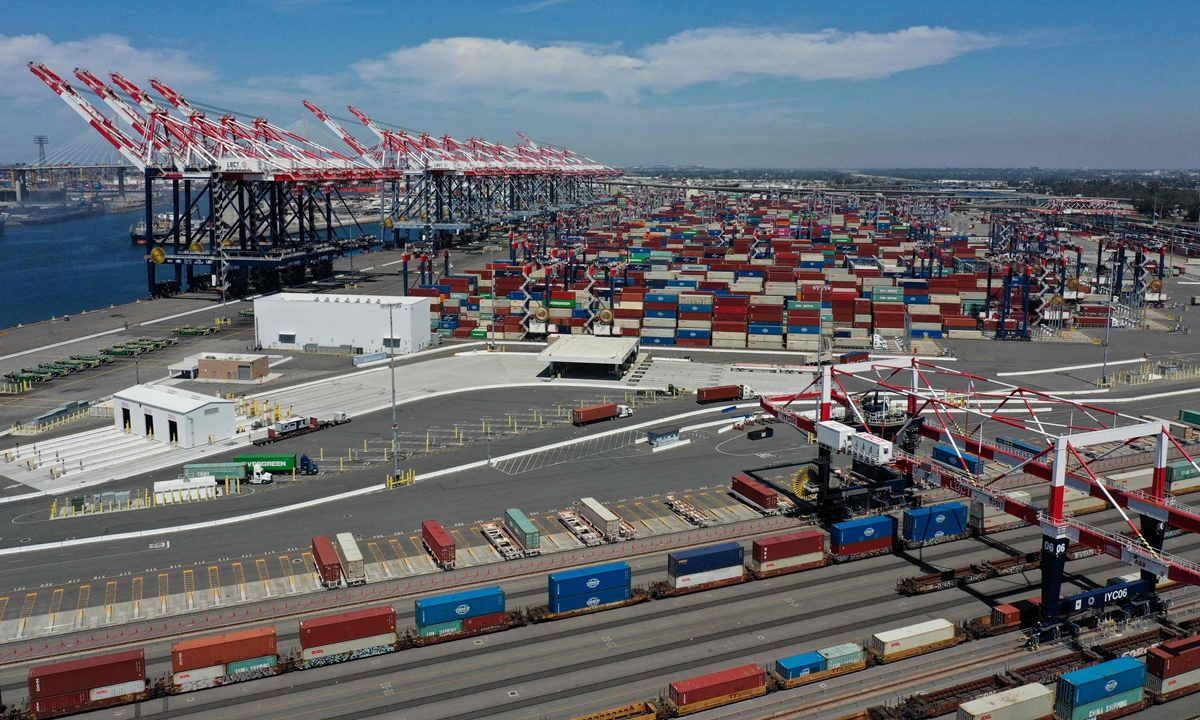
An aerial image shows cargo shipping containers and cranes as cargo containers sit stacked on freight trains at the Port of Long Beach in Long Beach, California on April 10, 2025. Photo: VCG
The lead officials for China-US economic and trade affairs held a video call on Friday, focusing on implementing the important consensus reached by the two heads of state and the outcomes of bilateral economic and trade consultations, Xinhua News Agency reported on Saturday. During the call, the Chinese side expressed serious concerns over recent US economic and trade restrictions against China.
A Chinese expert noted that the latest dialogue showed that both sides still have an incentive to stabilize trade relations despite persistent friction, but Washington needs to take concrete steps to uphold the consensus reached by the two leaders.
Chinese Vice Premier He Lifeng, also China's lead person for China-US economic and trade affairs, held a video call on Friday with US Treasury Secretary Scott Bessent and US Trade Representative Jamieson Greer, Xinhua reported.
The two sides held candid, in-depth, and constructive exchanges on implementing the important consensus reached between the two heads of state at their meetings in Beijing and Washington and the outcomes of economic and trade consultations, and on key economic and trade issues of mutual concern, Xinhua said.
Both sides agreed that under the strategic guidance of the two heads of state, they would further leverage the China-US economic and trade consultation mechanism, continuously strengthen cooperation and properly manage differences so as to promote the stable and positive development of China-US economic and trade relations, and contribute to building a constructive China-US relationship of strategic stability based on respect, fairness and reciprocity, according to Xinhua.
Despite persistent friction, the latest dialogue showed that both China and the US still have a strong incentive to stabilize bilateral trade relations, providing an important basis for further engagement through the economic and trade consultation mechanism, Li Yong, a senior research fellow at the China Association of International Trade, told the Global Times on Saturday.
"By maintaining high-level dialogue, both sides are showing a continued willingness to resolve differences and follow through on the consensus reached by their leaders," Li said, noting that such engagement is crucial to keeping bilateral trade relations stable.
The latest video call came as the two countries were working to implement the outcomes of the eighth round of their economic and trade consultations in New York and Washington from September 20 to 23.
During September's consultations, China and the US reached a series of agreements on tariff reductions, trade and investment mechanisms, and the extension of existing trade arrangements. Yet Washington has since imposed or proposed new restrictions on Chinese businesses, including measures involving technology firms, outbound investment and biotechnology.
The latest case came on Thursday, when the US State Department imposed new Cuba-related sanctions, including on two Chinese companies accused of supplying electronic and security equipment to the Cuban military.
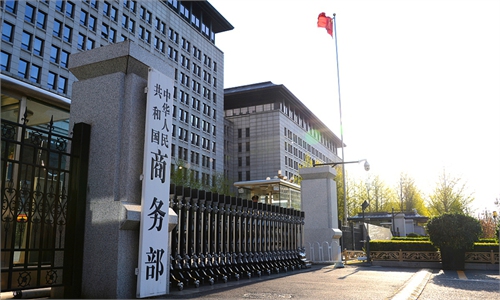
China's Ministry of Commerce (MOFCOM) on Saturday firmly opposed the move, saying the US has imposed unilateral sanctions on Chinese companies on the grounds of their involvement with a third party, in violation of international law and basic norms of international relations.
MOFCOM said the US had recently intensified sanctions and pressure on China, rapidly rolling out a series of discriminatory and restrictive measures. These measures have seriously harmed the rights and interests of Chinese companies, run counter to the important consensus reached by the two heads of state, and undermined the stability of China-US economic and trade relations.
On Friday, Foreign Ministry spokesperson Guo Jiakun said that China firmly opposes illicit unilateral sanctions that have no basis in international law or lack UN Security Council authorization, as well as the so-called "long-arm jurisdiction." He reaffirmed China's opposition to US attempts to disrupt and sabotage China-Cuba cooperation and said China would take all necessary measures to protect Chinese companies' legitimate rights and interests.
Li said Washington's practice of dragging Chinese companies into geopolitical disputes involving third countries and imposing sanctions through so-called "long-arm jurisdiction" lacked justification.
“The US continues to create problems, though this has not derailed bilateral economic and trade ties. Both sides are still making efforts to keep the relationship on a normal track,” Li said. However, he stressed that these restrictive measures have caused significant harm to current China-US economic and trade relations.
“The US has long championed free trade and fair treatment, but its economic policies toward China remain heavily influenced by politicization and an overstretched concept of national security,” Li added.
By contrast, China has remained rational and restrained in its response to unjustified US restrictions, and has sought to manage differences through established economic and trade consultation and dispute-resolution mechanisms rather than escalating tensions, according to the expert.
Under the September agreements, the two sides plan to hold another AI dialogue by the end of November and their agricultural working group's first meeting by the end of 2026. They also agreed to extend the Kuala Lumpur economic and trade consultations arrangement until January 10, 2027, while continuing discussions toward a mutually agreed solution, according to the MOFCOM’s website.
Li said China remained committed to advancing cooperation through mechanisms such as the trade and investment councils. "Both sides should approach economic and trade cooperation from the perspective of making the pie bigger," he said. Washington, for its part, needs to move beyond politicizing trade and overstating national security concerns, and focus on implementing the consensus reached by the two countries’ leaders and building stable economic ties.
RELATED ARTICLES