IN-DEPTH / IN-DEPTH
China’s Xiamen joins the bid to host High Seas Treaty secretariat: Why this race matters to the Global North and South
Toward better ocean governance
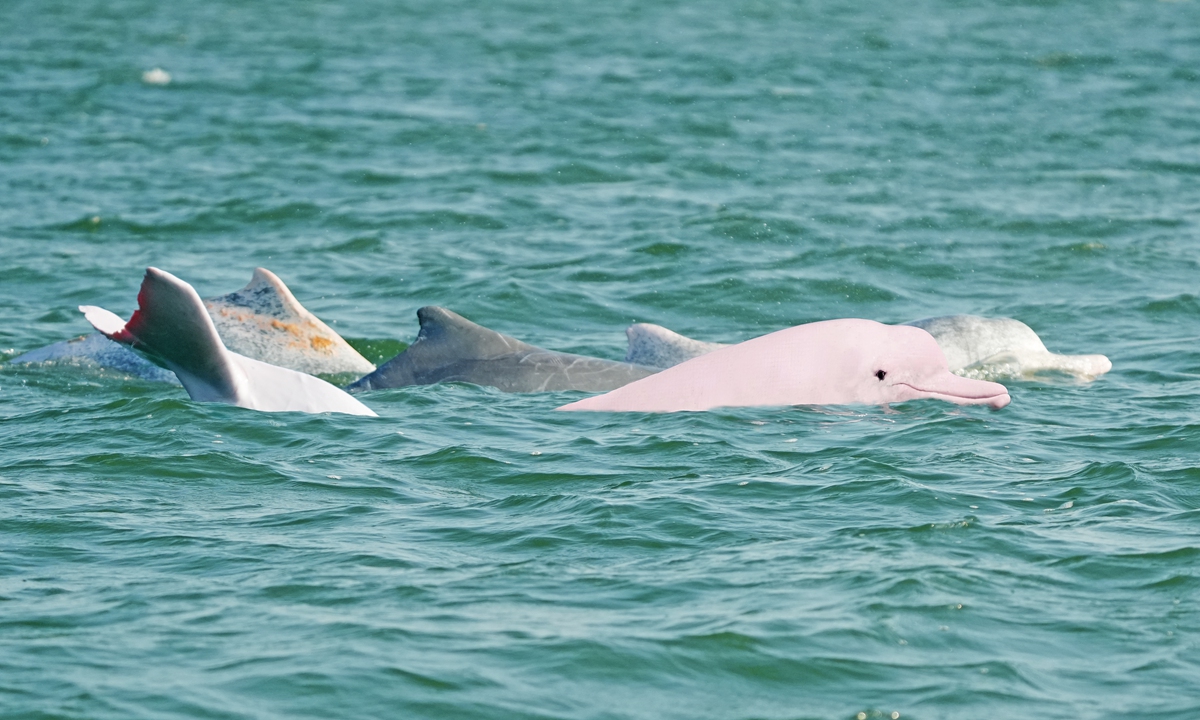
Chinese white dolphins, a national first-class protected wild animal species, appear on the sea surface, swimming and chasing the waves in Qinzhou, South China's Guangxi Zhuang Autonomous Region, on January 9, 2026. Photo: VCG
Beside the Mazu Cultural Square in Xiamen, East China's Fujian Province, a modern high-rise building surrounded by greenery and overlooking the sea has been prepared for a special purpose: to serve as the headquarters of the secretariat of the UN treaty on marine biodiversity in areas beyond national jurisdiction (BBNJ Agreement), also known as the High Seas Treaty.On January 17, the landmark treaty entered into force after nearly two decades of negotiations, marking a new chapter in global ocean governance. As its first Conference of the Parties (COP) approaches, competition to host the secretariat is heating up, with Xiamen, Brussels in Belgium and Valparaiso in Chile vying for the role.
Why has a treaty on marine biodiversity attracted such international attention? And why are three countries competing to host its permanent secretariat? Against the backdrop of growing tensions over high-seas ecological conservation and resource development worldwide, the future implementation of this international system and its implications for global governance have drawn widespread attention.
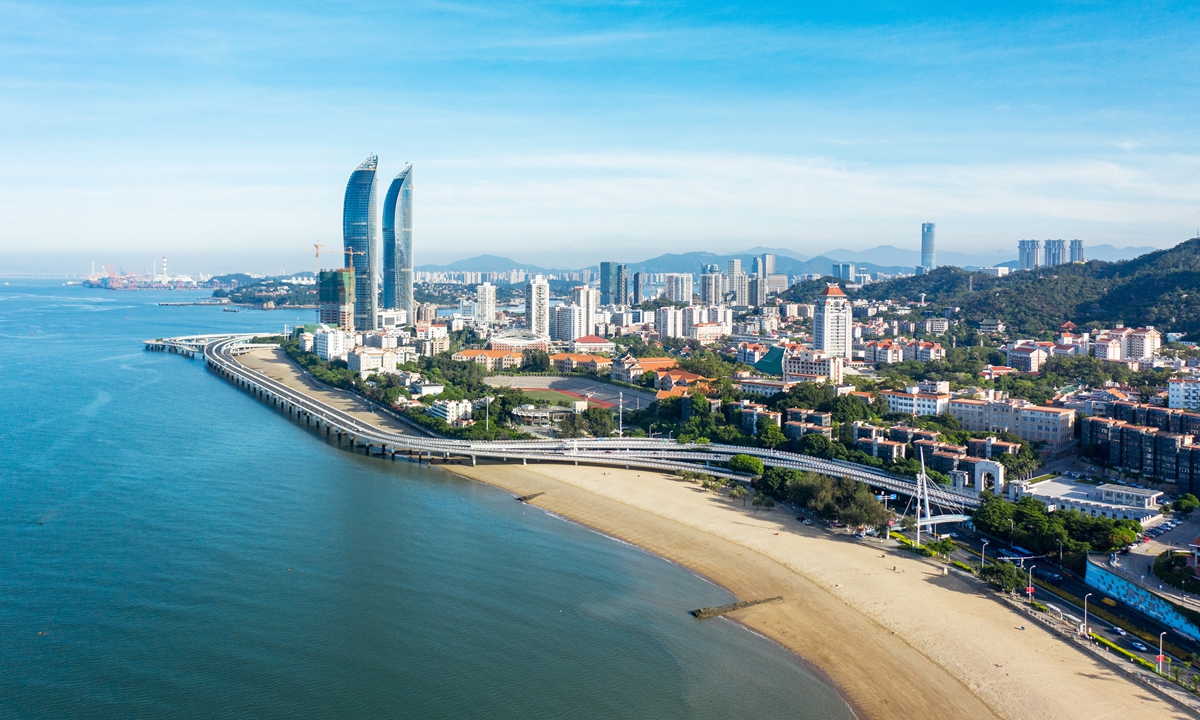
The urban coastline in Xiamen, East China's Fujian Province Photo: VCG
New rules for the high seas
The high seas, covering roughly 60 percent of the world's oceans, contain vast marine resources shared by humanity. Yet significant gaps have long existed in the governance of areas beyond national jurisdiction.
A report titled "The BBNJ Agreement: Status, Functions, Prospects and China's Role" released on November 5 by the China Institute for Marine Affairs under China's Ministry of Natural Resources, argues that the UN Convention on the Law of the Sea (UNCLOS) alone is no longer sufficient to address emerging challenges.
Take the much-discussed seabed mineral mining in recent years as an example. In January, the US National Oceanic and Atmospheric Administration revised procedures under the Deep Seabed Hard Mineral Resources Act to streamline permit applications. A US subsidiary of a Canadian metals company subsequently applied for combined exploration and commercial recovery rights covering approximately 65,000 square kilometers of international seabed between Hawaii and Mexico. Meanwhile, US authorities advanced seabed mining-related activities near American Samoa and the Northern Mariana Islands.
This move carries a tangible risk of issuing commercial mining permits by bypassing the multilateral framework of the International Seabed Authority under the United Nations. It has drawn criticism from deep-sea conservation coalitions, multiple developing countries and some developed nations, which argue that it violates the principle of the "common heritage of mankind," seeks to privatize resources in the international seabed area, and undermines the multilateral governance order.
"Deep-sea microorganisms may become sources of new medicines and materials. But how should the benefits of scientific discoveries be shared? Who should protect ecologically important areas on the high seas? And who should assess and prevent environmental damage?" Zheng Miaozhuang, a researcher at the China Institute for Marine Affairs and contributor to the aforementioned report "The BBNJ Agreement: Status, Functions, Prospects and China's Role," told the Global Times. Although UNCLOS established fundamental principles, including freedom of the high seas and the common heritage of humankind, rapid technological advances and expanding ocean activities have created new governance challenges, Zheng explained.
The BBNJ Agreement seeks to fill these gaps through four pillars: marine genetic resources and benefit-sharing; area-based management tools, including marine protected areas; environmental impact assessments; and capacity-building and marine technology transfer.
"This is a genuine institutional breakthrough," Zheng said. The Agreement establishes, for the first time, a benefit-sharing arrangement for deep-sea genetic resources and their "genetic data," provides a legal basis for establishing protected areas on the high seas and in the international seabed area for the first time, and also refines environmental assessment, capacity-building and technology transfer.
But reaching the agreement was far from easy. Negotiations were repeatedly challenged by differences over benefit-sharing, marine protected areas and the transparency of environmental impact assessments. Nevertheless, countries eventually reached compromises to address challenges that transcend national boundaries.
Developing countries were particularly concerned about fairness, Zheng noted. They wanted to ensure that deep-sea research and resource development would not be dominated by a handful of technologically advanced nations, while most countries, including China, supported stronger protection of vulnerable marine ecosystems.
"Who can explore the deep sea, use its resources and share the benefits is not just a technological question, but one of fairness in global governance," Xu Heyun, deputy director of the China Institute for Marine Affairs under China's Ministry of Natural Resources, told the Global Times. She said the BBNJ Agreement promotes equitable participation through information sharing, scientific cooperation, financial support and technology transfer, helping bridge differences among countries.
China played an active role throughout the negotiations, according to the report, working to bridge North-South differences, promote equitable benefit sharing from marine genetic resources, strengthen marine biodiversity protection and improve the transparency of environmental impact assessments.
"China advocated a package solution to the four major issues, balancing conservation with sustainable use. Marine protected areas must not become 'paper parks,' while developing countries need not just assistance, but the capacity to develop independently," Xu said. China signed the treaty on September 20, 2023, its opening day for signature, and deposited its instrument of ratification on December 15, 2025, demonstrating its commitment to implementation.

The proposed office premises for the BBNJ secretariat in Xiamen, China. Photo: Fan Wei/Global Times
Why is China bidding to host the secretariat?
Turning the treaty into an operational system requires permanent institutions. Under the BBNJ Agreement, the COP serves as the highest decision-making body, while the secretariat provides administrative, logistical and meeting support and manages the clearing-house mechanism for information exchange. As implementation advances, the secretariat will also support cooperation on marine genetic resources, marine protected areas, environmental assessments and capacity-building for developing countries.
"The secretariat is not a 'world government' governing the high seas," Zhao Chang, a researcher at the China Institute for Marine Affairs, told the Global Times. "It has no independent enforcement authority and cannot make decisions on behalf of the parties. Rather, it is an essential institution connecting governments, research organizations and international bodies."
According to previously announced arrangements, the first COP is scheduled for January 11-22, 2027, at the UN Headquarters in New York, with the location of the secretariat among the major decisions to be made. Xiamen, Brussels and Valparaiso each bring different advantages to the competition.
For China, the bid is primarily about assuming long-term responsibilities as a host country and supporting more inclusive ocean governance. Major international marine institutions have traditionally been concentrated in Europe. Hosting the secretariat in Asia, home to numerous maritime nations and a rapidly growing blue economy, could improve geographical representation and make participation more accessible to developing countries, according to Zheng.
Zhao stressed that China's bid is not intended to secure special decision-making powers.
"Global ocean governance should not be dominated by the voices of a few countries," he said. "We must protect the oceans while respecting countries' legitimate needs for scientific research and development."
Xu also placed the bid in a broader historical context. "More than 600 years ago, Zheng He's voyages promoted exchanges and friendship through the oceans. Today, China remains committed to both marine conservation and sustainable use, and hopes to deepen international maritime cooperation through this bid," Xu said.
What can China bring to global ocean governance?
Hosting an international treaty secretariat requires more than political commitment or suitable office facilities. Zheng noted that these include whether office and meeting venues are well-equipped, whether international transportation and personnel exchanges are convenient, whether legal status and privileges and immunities are guaranteed, whether funding support can be sustained, and whether there is room for long-term development - all of which are important factors for the parties to assess a bid proposal.
Zheng said China's strengths lie in its marine research capabilities, conservation experience, international partnerships and capacity to assist developing countries.
According to the report "The BBNJ Agreement: Status, Functions, Prospects and China's Role," China has established an integrated ocean research system comprising research vessels, manned deep-sea submersibles and marine observation facilities. Equipment such as the Jiaolong and Fendouzhe submersibles has strengthened China's capacity to explore deep-sea environments and study marine biodiversity.
China has also conducted joint marine research with countries including Bangladesh, provided deep-sea research opportunities for partners such as Indonesia and led international scientific initiatives covering digital deep-sea habitats and ocean data sharing.
These efforts could provide scientific support for identifying conservation priorities, monitoring biodiversity and developing area-based management tools.
In marine conservation, China has established 353 marine protected areas and implemented 194 major marine ecological restoration projects, according to the report. It is also among the few countries to have achieved a net increase in mangrove coverage.
China has accumulated experience in environmental impact assessments through marine surveys in the western Pacific and northern Indian Ocean, providing data and technical expertise that could help developing countries meet their treaty obligations.
Capacity-building is another priority. China has signed marine cooperation agreements with more than 50 countries and international organizations, invested approximately 200 million yuan ($28 million) in over 100 livelihood-oriented marine cooperation projects, and provided marine scholarships to 345 professionals from 47 countries and regions.
Through joint training platforms, including cooperation with the International Seabed Authority, China has also trained more than 6,000 young researchers and officials from developing countries.
Xiamen itself offers advantages as a coastal city with established research and international cooperation networks. It hosts Xiamen University, the Third Institute of Oceanography under the Ministry of Natural Resources, and platforms including the APEC Marine Sustainable Development Center and the China-ASEAN Marine Cooperation Center.
"More importantly, China has proposed a concrete long-term support package for the secretariat, covering office and conference facilities, legal and administrative arrangements, financial support and capacity-building cooperation," Xu said.
The BBNJ Agreement's entry into force marks a beginning rather than an endpoint.
According to the report, China is ready to take its bid as an opportunity to deepen exchanges with other countries in marine biodiversity conservation, marine scientific research, capacity-building and marine technology cooperation, and to support science-based and cooperation-driven global ocean governance.
RELATED ARTICLES