China's ocean governance efforts win international recognition as Xiamen hosts World Ocean Week

Participants take selfies in front of China's Jiaolong manned submersible during the 2026 World Ocean Week in Xiamen, East China's Fujian Province, on November 5, 2026. Photo: Courtesy of the organizers of the 2026 World Ocean Week in Xiamen
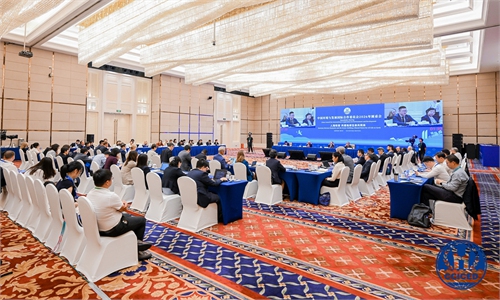
Xiamen, a coastal city in East China's Fujian Province, brought together government officials, representatives of international organizations and marine experts from around the world on Thursday as the 2026 World Ocean Week opened, with discussions focusing on ocean conservation and sustainable development.
As the Agreement on Marine Biodiversity of Areas beyond National Jurisdiction (BBNJ Agreement) entered into force this year, global ocean governance has moved into a new phase of implementation. China has been actively involved in advancing international marine conservation, including bidding to host the BBNJ Secretariat, promoting the establishment of marine protected areas in Antarctica, and cooperating with island countries on issues such as climate change.
International guests at the event praised China's contributions. José María Figueres, former president of Costa Rica, told the Global Times on Thursday that he welcomed China's efforts, citing its role in global biodiversity initiatives and its proposal for a marine protected area in the Cosmonauts Sea near East Antarctica.
Figueres noted China's contribution to the Kunming-Montreal Global Biodiversity Framework (GBF), which sets a global target of effectively conserving and managing at least 30 percent of terrestrial and inland water areas, as well as coastal and marine areas, by 2030. He also praised China's proposal for marine protection in Antarctica, describing the region as one of the world's most pristine and delicate environments.
These efforts, alongside China's recent steps to strengthen environmental protection at home, demonstrate its engagement with international efforts to protect the ocean and biodiversity, he said. In Figueres' view, they also position China well to host the BBNJ Secretariat.
Manal Khaled Sayed Ahmed, an Egyptian participant at the event, also welcomed the international cooperation on display at the event. She said she was pleased to see people of different nationalities coming together around the shared goal of protecting the ocean and safeguarding marine resources for future generations.
China has played a significant role in demonstrating how the ocean and its resources can contribute to future development and investment, Ahmed said. She added that China had set an example by encouraging countries to make effective use of their own resources.
Alongside the international discussion, Xiamen's own approach to marine conservation and sustainable development has also attracted attention.
Grethel Aguilar, director general of the International Union for Conservation of Nature (IUCN), described Xiamen as a particularly appropriate place for discussions on ocean issues, noting its vibrant blue economy and the close connection between the sea and the city's development, economy, food systems and residents' well-being.
Xiamen and Fujian have a long record of working with the sea rather than against it, Aguilar said, pointing to coastal wetland and mangrove restoration, as well as advances in marine science at the Fujian Ocean Innovation Center. She described this combination of practical action and science-based approaches as the kind of work needed to address global ocean challenges.
The opening ceremony also saw the launch of the "Xinghai-BBNJ" ecological data service, developed by a national key laboratory for satellite-based marine monitoring. It integrates six datasets covering sea surface temperatures, global ocean temperature and salinity, Lagrangian eddies, nitrate, chlorophyll and dissolved oxygen, alongside the Mazu ecological coupling model. The seven products can help establish ocean environmental baselines, track ecosystem changes and simulate future scenarios, supporting scientific assessments and long-term monitoring of marine protected areas on the high seas.
Turning international commitments into effective protection, however, requires more than agreements and institutional arrangements. It also calls for stronger scientific understanding and closer coordination between research and policymaking.
Dai Minhan, a chair professor of marine environmental science at Xiamen University and an academician of the Chinese Academy of Sciences, said the implementation of the BBNJ Agreement faces challenges including gaps in scientific knowledge, uneven access to marine data and fragmentation in existing governance systems.
Large areas of the ocean remain poorly understood, while available data are unevenly distributed across regions, Dai noted. At the same time, marine ecosystems are constantly changing under pressures such as acidification and pollution. These dynamics make it difficult for policymakers to rely on static information or respond only after environmental damage has occurred.
Dai called for a shift beyond simply supplying scientific information toward developing what he described as "policy-level science" - a closer, ongoing interaction between scientific research and policymaking. Under this approach, scientific evidence, policy discussions and feedback would form a continuous process, allowing decisions to adapt as knowledge and environmental conditions evolve.
He also emphasized the importance of international cooperation built around joint design, involving countries in defining research priorities, coordinating ocean observations, sharing data and models, and strengthening the scientific and technical capacities of developing countries.
Xiamen University has established a support system integrating scientific research, observation, technological innovation and international cooperation since 1983, Dai said. Its research platforms and international networks could help connect scientific knowledge with practical governance needs and contribute to international cooperation.
The challenge now is to ensure that global commitments translate into measurable improvements in ocean health. As the BBNJ Agreement enters its implementation phase, Xiamen's experience offers a local perspective on how marine conservation, scientific research and international partnerships can reinforce one another.
The task of protecting the ocean goes far beyond the efforts of any single country or city. Turning shared commitments into effective action will depend on sustained cooperation, accessible scientific knowledge and the collective ability to respond to challenges that cross national boundaries, experts noted.
RELATED ARTICLES