ARTS / CULTURE & LEISURE
China reiterates support for live-action micro-dramas, vows to regulate AI productions as actors seek new opportunities amid industry shifts
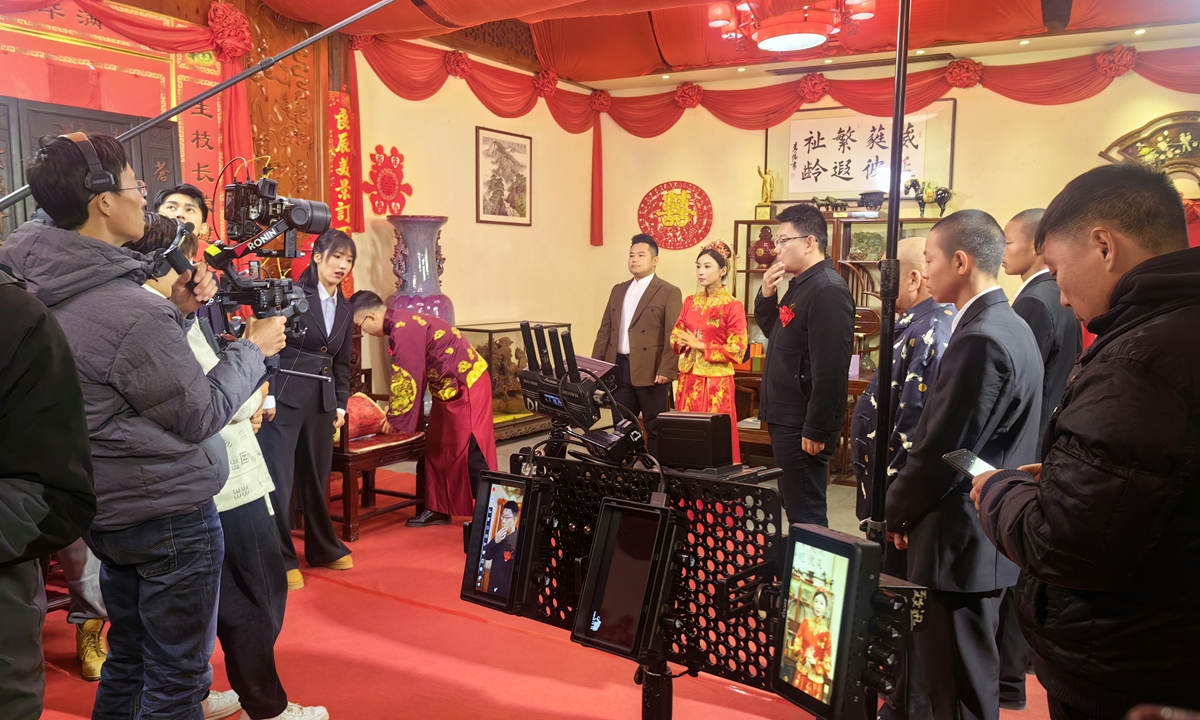
A short drama crew films a wedding-themed scene at a traditional residence in Yuanqiao village. Photo: Courtesy of Yuanqiao village
China's National Radio and Television Administration (NRTA) has recently reiterated its commitment to supporting live-action micro-dramas while regulating AI-generated productions. It has called on platforms to ensure that all content is reviewed before release and undergoes full human review, and pledged to step up efforts to crack down on AI-assisted plagiarism, unauthorized remakes and the unauthorized use of individuals' likenesses and voices.At the 2026 Conference on Creation of High-Quality Product in Radio and Television of China, an NRTA official said AI is bringing more than just lower production costs and greater efficiency to micro-dramas. It is driving systemic changes in production methods, industry structures and development models. The entire industry chain, from scriptwriting and filming to distribution and overseas operations, is being reshaped.
The official stressed that AI should serve as a tool to support high-quality content creation and drive innovation, while people must remain at the center of the creative process. Technology should not replace human thought and creativity. The official noted that while AI can generate images, it cannot generate lived experience; it can assist creation, but it cannot replace independent thinking. Human actors' emotional expression and creativity remain essential to micro-drama production.
For actors on the front lines, AI is reshaping job opportunities and career choices. Yin Jiaxuan, 25, entered the micro-drama industry in mid-2024 after working as a theme park character at tourist attractions. Once moving from one production to the next, he now takes on more work at tourist attractions and live performances as filming opportunities continue to decline.
"In recent years, some actors with film and television experience and solid acting skills have begun moving to cultural tourism attractions and commercial live performances. Some attractions also prefer to hire actors with screen experience because they are better equipped to handle spontaneous interactions with visitors," Yin told the Global Times.
"This shift also reflects how actors are exploring new career paths as opportunities in film and television production become less frequent," he said.
However, Yin said the decline in acting opportunities cannot be attributed solely to AI-generated micro-dramas. A broader contraction in investment across the film and television industry, fewer productions entering filming and changes in platform policies have also affected demand for live-action micro-drama actors, while AI-generated productions have added to the pressure faced by some performers.
"AI-generated and live-action micro-dramas each have their own audiences, and actors with strong professional skills are relatively less affected," Yin said. "AI and human performances are not necessarily in opposition, as audiences can distinguish between the two forms. I would also consider authorizing AI companies to use my likeness in their productions."
Similar to Yin, Zhang Peng, a cultural researcher and associate professor at Nanjing Normal University, told the Global Times that the impact of AI-generated micro-dramas on live-action actors was more likely to be structural than a replacement of human performances.
"The rapid growth of AI-generated micro-dramas is largely driven by lower production costs and changing audience demand. Generative AI has significantly reduced expenses for filming, post-production and special effects, while shortening production cycles. This has made content creation accessible even to small teams and individual creators," Zhang said.
"At the same time, demand for fast-paced storytelling with highly dense plot developments is growing on short-video platforms. Genres such as fantasy and time-travel stories, which require good visual effects, are particularly well suited to AI production," he noted.
Zhang also said that AI-generated micro-dramas could develop into a new content category, creating market opportunities in niche areas such as customized advertising, interactive dramas and IP spin-offs, while encouraging human-AI collaboration in production.
"This means AI will not only reduce the need for some traditional production jobs, but also reshape the division of labor in content creation and the structure of the industry," he said.
As AI-generated content becomes increasingly integrated into film and television production, the changes facing actors also extend to the protection of their personal rights.
"If the use of celebrities' likenesses in AI-generated content is not subject to clear restrictions, it could raise issues concerning control over the use of their likeness and the distribution of revenue. Without clear rules, the technology could also place greater pressure on ordinary actors," Zhang said. "The industry needs clearer rules on the scope of authorization, the duration of use and revenue-sharing arrangements."
As the NRTA official emphasized, the regulator has pledged to continue cracking down on AI-assisted plagiarism, unauthorized remakes and the unauthorized use of individuals' likenesses and voices.
RELATED ARTICLES