ARTS / CULTURE & LEISURE
China’s first fully AI-generated feature film to hit cinemas on Friday
By Published: Oct 21, 2026 07:41 PM

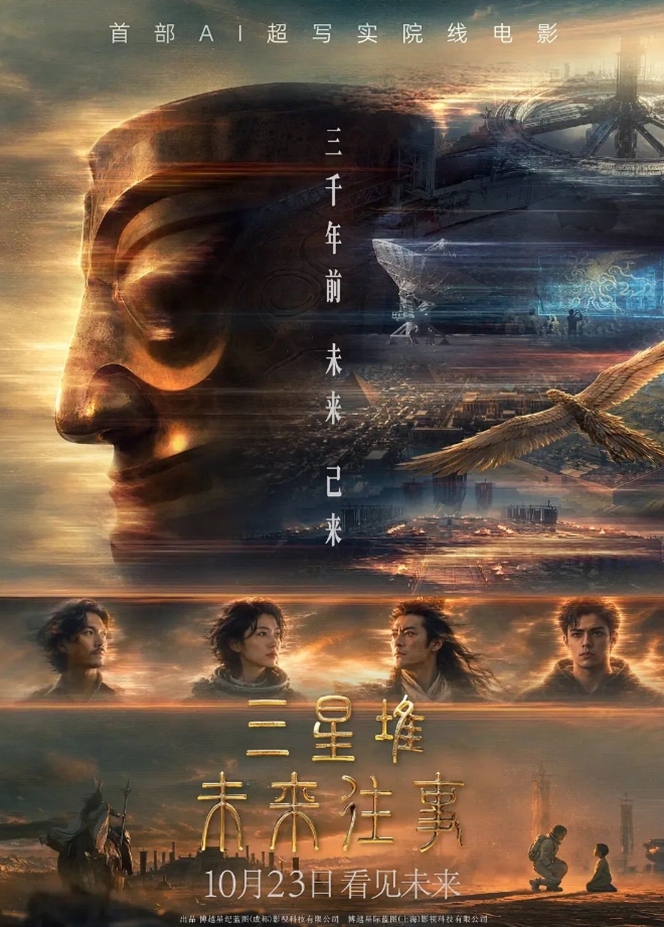
Promotional material for China's first fully AI-generated feature film Sanxingdui Photo: Courtesy of Bona Film Group
China's first fully AI-generated feature film to receive a theatrical release permit is set to hit cinemas on Friday, a trial run for an industry wrestling with how to embrace new technology without losing moviegoers.The film Sanxingdui draws on the mysteries of the ancient Chinese civilization to tell a story spanning the past and a future shaped by AI.
The film's creators told the Global Times that its release marks an early attempt to bring AI-generated filmmaking from short online videos and dramas to the big screen, where audiences and regulators apply more demanding standards to storytelling and production quality.
The project is not simply a matter of entering a prompt and letting a machine produce a movie. Developed over more than two years, it involved generating more than 1.2 million preliminary images and making more than 100 full-film iterations before reaching its final form.
"We hope to make the audience feel that these 100 minutes are worth it," Qu Jixiaojiang, the film's producer, told the Global Times.
The challenge reflects a broader question facing an entertainment industry increasingly experimenting with generative AI: As the technology makes visual production more accessible, what will persuade audiences to pay for the finished work?
The filmmaker revealed that the film cost over 10 million yuan ($1.5 million) to make, but whether it will recoup its investment is also a question the industry is watching closely.
Online reactions to the film's trailer have included skepticism about the value of AI-generated content, with some netizens questioning why they should buy cinema tickets for images that can seemingly be created at little cost.
Qu responded that she understood the reservations, including among people who instinctively resist AI-generated entertainment. The team plans to judge its efforts by the responses of people who actually watch the film, she said, adding that both positive and negative feedback would be valuable.
She also drew parallels with earlier technological shifts in cinema, when the arrival of motion pictures faced resistance from theater advocates and the transition from film to digital cameras prompted concerns that the art form was losing its soul.
"Those who move early are not necessarily the luckiest," Qu said. "They may be the ones who have to bear the most pressure."
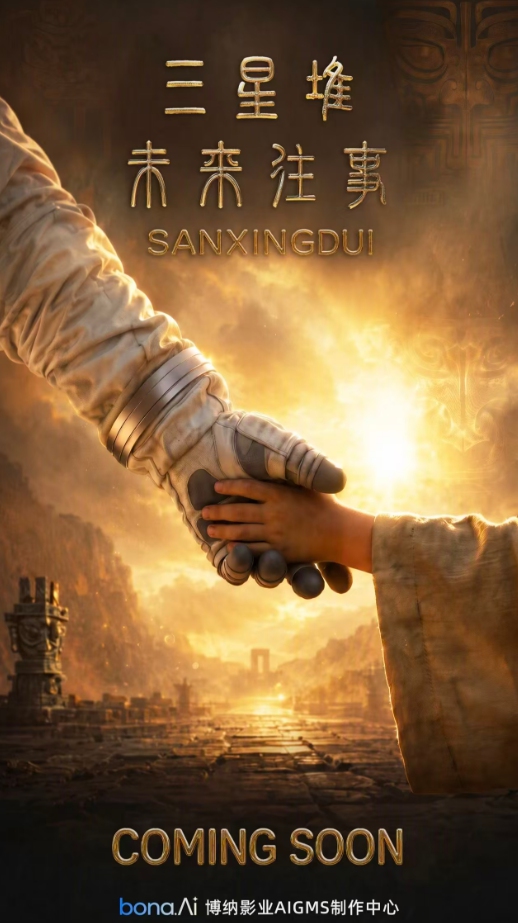
Promotional material for China's first fully AI-generated feature film Sanxingdui Photo: Courtesy of Bona Film Group
Jiang Defu, the film's producer and COO of the Bona Film Group, told the Global Times that a common misconception is that AI films can be generated almost instantly. In practice, the team followed a film-industry production process, with specialized roles covering screenwriting, directing, production, art design, cinematography, lighting, sound and editing.Working in a virtual production environment, the team divided responsibilities across 17 professional functions, seeking to turn the unpredictable output of generative models into images that reflected the creators' intentions.
The process required repeated screening, revision and selection. Images that looked acceptable on a mobile phone did not necessarily withstand scrutiny on a cinema screen, Jiang said, adding that different groups of reviewers examined the film frame by frame to identify problems and determine where further work was needed.
Some netizens also questioned the quality of AI films considering that, due to the rapid advancements in the industry, by the time a feature film is finished after months or years of production, the techniques used to make it may already appear outdated.
Qu said the team has substantially reworked the film from beginning to end at least five times. Early efforts focused on whether particular scenes could be created at all; later improvements allowed the filmmakers to concentrate more on how to make them convincing.
The film has received the required Chinese film release approval, distinguishing it from online AI videos and short-form productions. Its creators said the approval reflects the need to meet both technical and artistic standards before a work can reach theatrical audiences.
The story takes inspiration from the Sanxingdui ruins site, an archaeological site in Southwest China's Sichuan Province known for its striking bronze masks, sculptures and other artifacts associated with the ancient Shu civilization. Many aspects of the culture remain the subject of scholarly inquiry, making it fertile ground for speculative storytelling.
Qu introduced that the film uses mysterious symbols engraved on Sanxingdui bronzes as a narrative link between an ancient civilization and a future confronting the rise of superintelligent AI. Its original digital characters are not replicas of real actors, and the production draws on archaeological research to reconstruct the ancient world while building a fictional vision of what may lie ahead.
"We consulted Sanxingdui experts during development, particularly on how to distinguish established archaeological evidence from unresolved academic questions and cinematic imagination," said Qu.
For the filmmakers, the ancient symbols offer a way to connect China's cultural heritage with a technological debate that extends far beyond its borders: how humans can preserve independent thought and personal agency in an era increasingly shaped by powerful intelligent systems.
That combination could also help the film find audiences overseas. It has already been presented at the Cannes Film Festival, where an international trailer was released.
Qu added that the team is pursuing overseas distribution, with Malaysia also planned to release the film on Friday, while discussions are under way in markets including Russia and France.
The producers see two potential draws for international audiences: the distinctive visual world of the ancient Shu civilization and a feature-length production demonstrating how a Chinese team has used emerging AI tools to realize an ambitious cinematic vision.
Ultimately, the creators said technical novelty alone will not determine the film's success. Their goal is for viewers to become absorbed in the characters and plot rather than spend the screening identifying which images were generated by AI.
"AI has leveled the playing field in terms of tools, but it has widened the gap between creators," Qu said. "Even as production methods change, audiences still expect a story worth watching."
RELATED ARTICLES