Southern travelers head north for snow as China's ice-snow tourism heats up early
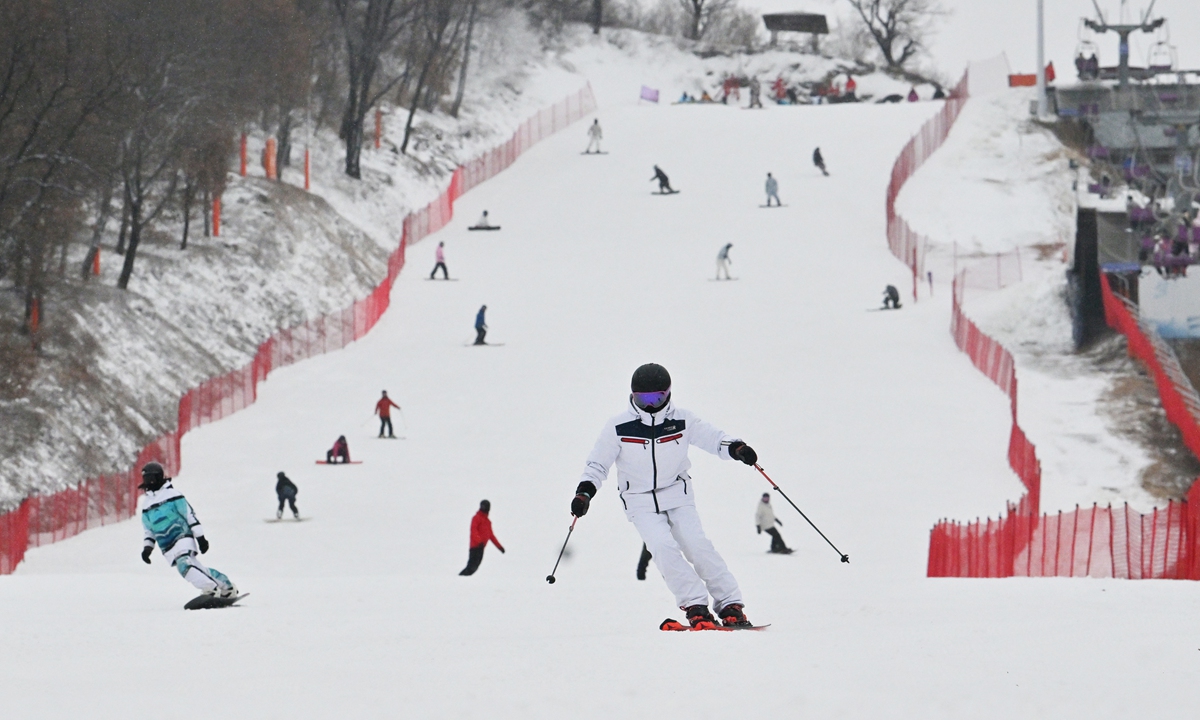
Skiers ski down a slope at a resort in Changchun, Northeast China's Jilin Province, on November 6, 2026, as the resort officially opens for the season. China aims to develop its ice and snow economy as a new economic driver, targeting a total market size of 1.2 trillion yuan ($179.3 billion) by 2027 and 1.5 trillion yuan by 2030, according to an official guideline. Photo: VCG
Since ski resorts in northern China began opening in early November, the country's new ice-snow tourism season has started to gain momentum earlier than usual, according to major online travel agencies and industry experts on Sunday.
Bookings for popular ice-snow travel routes on online travel agency Qunar covering more than 2,000 kilometers, with departures scheduled from November 2026 to before the 2027 Spring Festival, have increased twofold year-on-year, data from the platform showed.
The data also showed that 65 percent of travelers booking these routes are from southern China and the country's eastern coastal regions. Meanwhile, flight bookings for children aged 12 and under were up 91 percent year-on-year, while bookings for popular family-friendly hotels increased 42 percent.
In terms of destinations, traditional ice-snow tourism hotspots such as Harbin in Northeast China's Heilongjiang Province and Altay in Northwest China's Xinjiang Uygur Autonomous Region continue to attract strong interest, according to Qunar.
Bookings for direct flights from Shenzhen in Guangdong Province to Altay for the new snow season surged 11.1-fold year-on-year. School holiday arrangements have also brought additional visitors to some destinations. Following Jilin Province's introduction of a five-day snow holiday for primary and secondary school students across the province, hotel bookings in Changchun, Yanbian and Baishan all ranked among China's top 10 popular ice-snow tourism destinations, Qunar data showed.
The early kickoff underscores the staying power of China's "ice-snow economy," a sector propelled by the 2022 Winter Olympics legacy and government efforts to turn winter sports from a niche pastime into a mass consumption engine, experts noted.
Xu Xiaolei, a marketing manager of China Youth Travel Service Holding Co, told the Global Times on Sunday that bookings for winter tourism products have been made noticeably earlier this year, a trend seen in both domestic and outbound travel. Experienced snow sports enthusiasts and family travelers are among the key groups driving the trend. As quality accommodation and other resources, such as ski lifts, are relatively limited in popular destinations in Northeast China and Xinjiang, some people are planning their trips in advance and securing key resources to ensure a better travel experience, Xu said.
Xu also said that southern provinces such as Guangdong, Zhejiang and Fujian remain important source markets for ice-snow tourism. For travelers from these regions, visiting Northeast China and Xinjiang to experience snow and ice activities offers a distinctive appeal, as it provides a contrast to the warmer conditions at home. As consumer demand becomes more diversified, travelers are no longer satisfied with simply viewing snow, and are showing growing interest in specialized activities such as skiing, he said.
The boom now extends well beyond skiing itself, spilling over into winter festivals, equipment rental and family-oriented vacation packages, creating a longer consumption chain across China.
Local cultural and tourism authorities are also making early preparations for the winter tourism season. According to a notice released by the Liaoning Provincial Department of Culture and Tourism on November 6, the province's 2026-27 ice-snow season will begin in late November and run through March 2027. The program will feature activities across all 14 cities in the province and 100 key winter cultural and tourism products, covering ski resorts, hot springs, snow parks, cultural performances and sporting events. The activities will also serve as a warm-up for the 15th National Winter Games.
Ice-snow tourism is expanding beyond the traditional winter peak season until later in the year, with some travelers choosing to take trips earlier to avoid peak-season crowds, Song Ding, director of the Tourism and Real Estate Research Center at the China Development Institute in Shenzhen, told the Global Times on Sunday. The trend toward earlier bookings, however, is not solely driven by the desire to avoid crowds; it also reflects growing demand for ice-snow tourism and sustained interest in related products and experiences, Song said.
The effects of the Beijing Winter Olympics in promoting public participation in ice and snow sports continue to be felt, providing long-term support for the development of the ice-snow tourism market, Song added.
To make ice-snow tourism less dependent on the winter season and regions with natural snow and ice resources, the industry needs to develop a wider range of offerings. Song said that indoor ski resorts and snow-themed parks in southern cities provide new options for regions lacking natural snow and ice resources.
These projects, however, face relatively high investment and operating costs, making it difficult to achieve a balance between investment and returns through ticket sales alone. Related businesses need to integrate ice-snow experiences with tourism, retail and other forms of consumption, extend their industrial chains and explore more diversified revenue sources, he said.
RELATED ARTICLES