ARTS / CULTURE & LEISURE
China’s first joint archaeological project in Greece uncovers ancient urban remains, artifacts
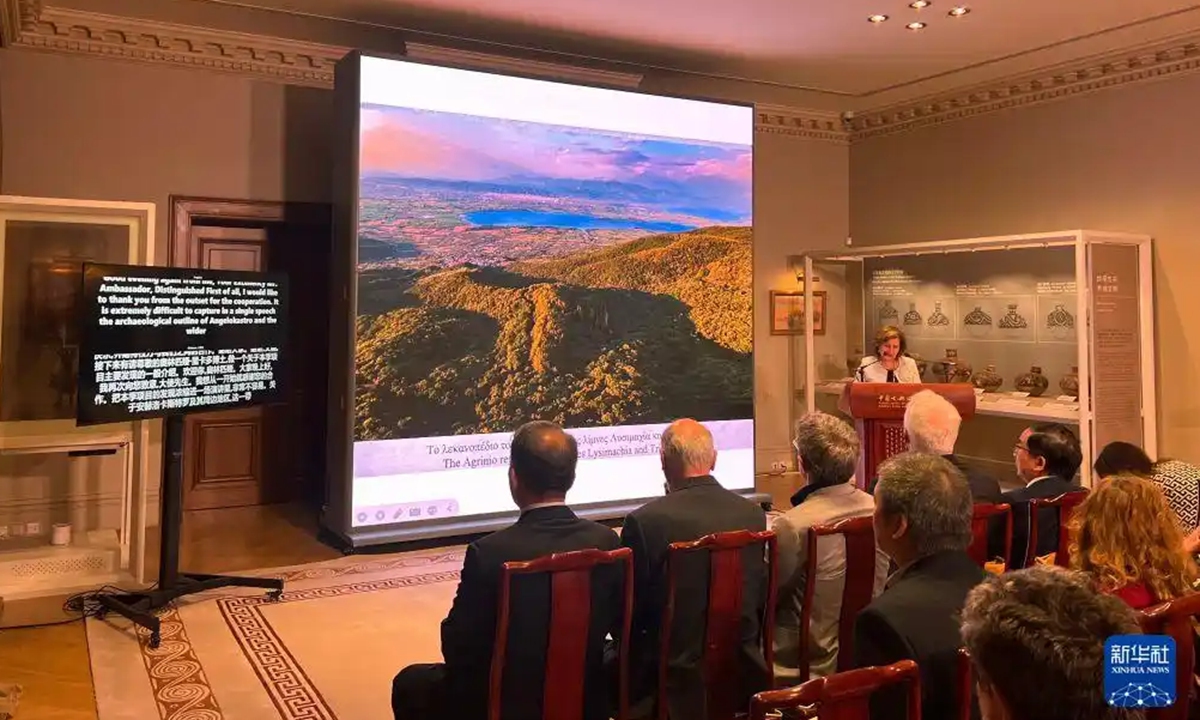
China's first joint archaeological project in Greece has made progress, with the Chinese-Greek archaeological team completing this year's fieldwork at the Angelokastro site in western Greece. Archaeologists have uncovered roads, architectural remains, courtyards and other structural features, as well as a considerable number of artifacts, the Chinese School of Classical Studies at Athens announced at its recent 2026 annual meeting and archaeological findings presentation in Athens, Greece. Photo: Xinhua
China's first joint archaeological project in Greece has made progress, with the Chinese-Greek archaeological team completing this year's fieldwork at the Angelokastro site in western Greece. Archaeologists have uncovered roads, architectural remains, courtyards and other structural features, as well as a considerable number of artifacts, the Chinese School of Classical Studies at Athens announced at its recent 2026 annual meeting and archaeological findings presentation in Athens, Greece.
Located in the Aetolia region, the Angelokastro site is important for studying urban development and social life during the Hellenistic period. Having officially begun field excavations in May, the project has now moved into indoor documentation and data processing, artifact conservation and multidisciplinary research, according to the Chinese School of Classical Studies.
Fotini Saranti, director of the Ephorate of Antiquities of Aetolia-Acarnania and Lefkada under the Hellenic Ministry of Culture, said this year's fieldwork focused on two areas in the southeastern part of the site, one to the north and the other to the south. Archaeologists have uncovered roads, architectural remains and courtyards, and used digital techniques and multidisciplinary research to conduct preliminary analyses of the site's spatial layout and architectural features.
Further details released by the Greek Ministry of Culture in October revealed that excavations were carried out in an area known as "Kakavaria," focusing on an important building that had been partially excavated previously. The latest findings indicate that it was a carefully constructed square building with a peristyle courtyard, bearing traces of alterations and successive phases of use. The excavation also yielded archaeological materials including roof tiles, clay ridge tiles, pottery, bronze coins and animal remains. These materials are currently undergoing conservation and study, with further identification and dating to follow.
"The value of joint archaeological research lies not only in discovering and preserving ancient remains, but also in reconstructing historical settings through scientific excavation and multidisciplinary research, and in understanding how different civilizations emerged, developed and interacted," Zhang Yin of the Society for East Asian Archaeology told the Global Times.
Zhang said that such exchanges, grounded in material evidence and academic research, could broaden understanding of ancient Mediterranean civilizations and provide a more concrete and solid historical basis for mutual understanding between different civilizations.
For archaeologists like Zhang who work across national borders, joint fieldwork offers an opportunity to bring together different academic perspectives and research traditions, while building a shared understanding of the past through firsthand archaeological evidence.
The Chinese School of Classical Studies at Athens was established in November 2024. The first research institution devoted to classical civilizations to be established by an Asian country in Greece, it aims to promote in-depth research by Chinese scholars into Greek civilizations across different historical periods, as well as other civilizations around the world, the Xinhua News Agency reported.
The project is being jointly carried out by the Greek Ministry of Culture's General Directorate of Antiquities and Cultural Heritage, the Ephorate of Antiquities of Aetolia-Acarnania and Lefkada, and the Chinese School of Classical Studies at Athens.
RELATED ARTICLES