IN-DEPTH / IN-DEPTH
How Chinese people view Brazil: China-Brazil relations a model of Global South solidarity and cooperation: Global Times Institute survey

A view of the coastline of Rio de Janeiro, Brazil. Photos on this page: VCG
Chinese President Xi Jinping on October 27 extended congratulations to Luiz Inacio Lula da Silva on his re-election as president of Brazil. Lula, the incumbent president and candidate of Brazil's Workers' Party, won re-election on October 25 local time.
This year marks the 52nd anniversary of the establishment of diplomatic relations between China and Brazil and the China-Brazil Year of Culture. A recent public opinion survey titled "How Chinese people view Brazil," conducted by the Global Times Institute, found that most Chinese respondents have a favorable impression of Brazil, regarding it as a friendly country or a strategic partner.
Respondents are optimistic about the prospects for China-Brazil relations and look forward to greater cooperation in agricultural products and food supply chains, trade and investment, tourism, and people-to-people exchanges. Brazil's international and regional influence is also widely recognized.
The survey was conducted from August 6 to 20, among members of the general public aged 18 to 69 across 31 provincial-level regions in China. A total of 2,124 valid questionnaires were collected, with sampling support provided by professional market research company Data 100. The results were weighted according to the gender and age composition of China's internet users as presented in the 57th Statistical Report on Internet Development in China, released by the China Internet Network Information Center in February 2026.
Positive public perceptions
The survey showed that more than 80 percent of the 2,124 respondents had some degree of familiarity with Brazil, including 35 percent who said they knew the country "very well" or "relatively well." More than 90 percent held a positive or neutral attitude toward Brazil, with 61 percent expressing a clearly favorable impression.
Soccer was the first thing that came to mind for Chinese respondents when Brazil was mentioned, selected by 73 percent, followed by agricultural products and food at 44 percent.
In 2024, China and Brazil elevated their bilateral relationship to a China-Brazil community with a shared future for a more just world and a more sustainable planet, laying a firmer political foundation for mutual understanding and closer ties between the two peoples. The survey showed that mainstream Chinese public perceptions and assessments of China-Brazil relations were positive.
More than 70 percent of respondents described bilateral relations as "very good" or "relatively good," while 66 percent regarded Brazil as a "friendly country" or a "strategic partner."
Over 90 percent believed that harmonious and friendly China-Brazil relations were "very important" or "relatively important" to China's future development. More than 70 percent were optimistic about the prospects for bilateral relations.
GT
Wang Peng, research fellow at the Institute of Latin American Studies, Chinese Academy of Social Sciences, said three main factors underpin Chinese public perceptions of Brazil. First is trade. The two countries have a large volume of bilateral trade, with China being Brazil's largest trading partner. Second is Brazil's national image. As a Global South country, Brazil has consistently spoken up for the interests of the Global South.
Third, both countries are BRICS members and are jointly working to enhance the influence of the Global South, which has helped strengthen mutual identification between their peoples.
Song Junying, director and associate research fellow in the Department for Latin American and Caribbean Studies, China Institute of International Studies, believes that Brazil's China policy is likely to remain stable following Lula's re-election. China-Brazil relations are expected to maintain steady development, providing a solid foundation for broader cooperation between China and Latin America.
Cooperation achievements highly recognized
Over the more than five decades since the establishment of diplomatic relations, China and Brazil have signed cooperation documents covering a range of fields while practical cooperation has continued to expand and deepen. More than 90 percent of respondents recognized the achievements of China-Brazil cooperation, with 70 percent describing it as "highly effective" or "relatively effective."
Song noted that China-Brazil cooperation is comprehensive, covering a broad range of fields and delivering tangible benefits to people's livelihoods in both countries. In traditional economic and trade cooperation, Brazilian soybeans, iron ore, beef and other products have continued to enter the Chinese market steadily. The rapid growth of bilateral trade has generated a substantial trade surplus for Brazil, directly contributing to improvements in people's livelihoods. At the same time, high-quality Brazilian agricultural products have helped meet the increasingly sophisticated consumption demands of Chinese consumers.
Wang said China and Brazil have carried out numerous mutually beneficial projects. For example, State Grid Corporation of China has applied China's independently developed ultra-high-voltage (UHV) technology to projects in Brazil, helping the country build transmission networks connecting inland hydropower stations with southeastern coastal cities. State Grid has also participated in electricity distribution projects in several Brazilian cities, while China Three Gorges Corporation operates multiple hydropower stations in Brazil, with positive results.
Wang Youming, a research fellow at the China Institute of International Studies, said the Salvador-Itaparica Bridge, which began construction in July and is being built by Chinese companies, will be the largest cross-sea bridge in Latin America. Once completed, it will reduce travel time between the two locations to 15 minutes. Chinese electric vehicle manufacturer BYD has also invested in manufacturing facilities in Brazil, with the design, quality and intelligent features of its vehicles gaining popularity among Brazilian consumers.
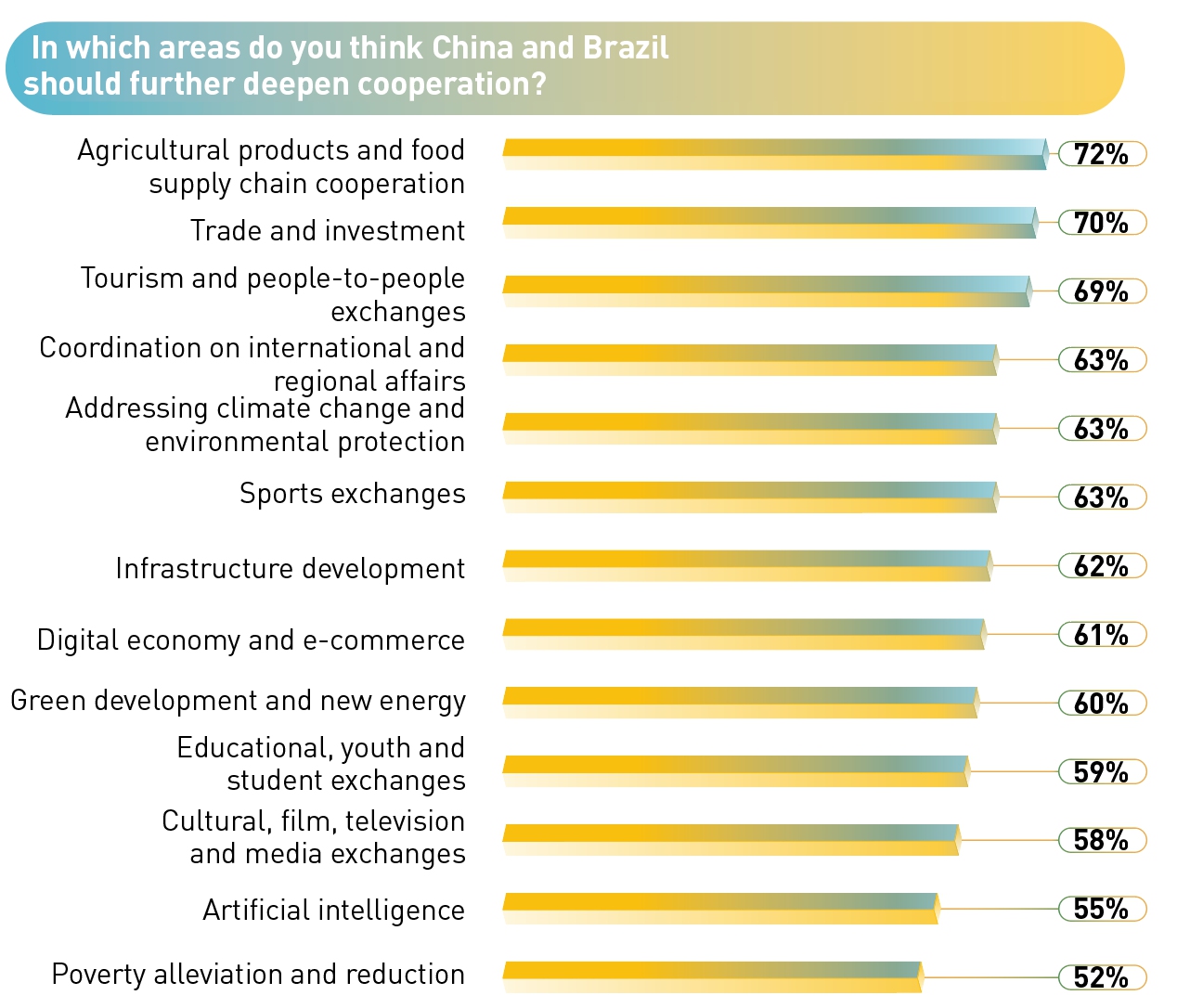
There are high expectations for further deepening China-Brazil cooperation. Among potential areas of cooperation, agricultural products and food supply chains (72 percent), trade and investment (70 percent), and tourism and people-to-people exchanges (69 percent) were considered the most important.
Strong foundation, great potential
Since the establishment of diplomatic relations, cultural exchanges and cooperation between China and Brazil have continued to develop. The survey showed that 97 percent of respondents looked forward to further deepening people-to-people and cultural exchanges between the two countries. Improvements in tourism-related services and local payment policies in Brazil topped the list of expectations, selected by 64 percent, followed by sports exchanges (52 percent) and two-way exchanges involving young scholars, think tanks and university students studying abroad (43 percent).
The year 2026 marks the China-Brazil Year of Culture, during which the two countries have organized a wide variety of cultural activities. Respondents showed considerable willingness to participate in Brazilian cultural exhibitions, tourism promotion events and film weeks held in China. Interest was highest in "in-person cultural experiences" and "tourism promotion activities," with more than 70 percent saying they were "very willing" or "relatively willing" to participate in each.
GT
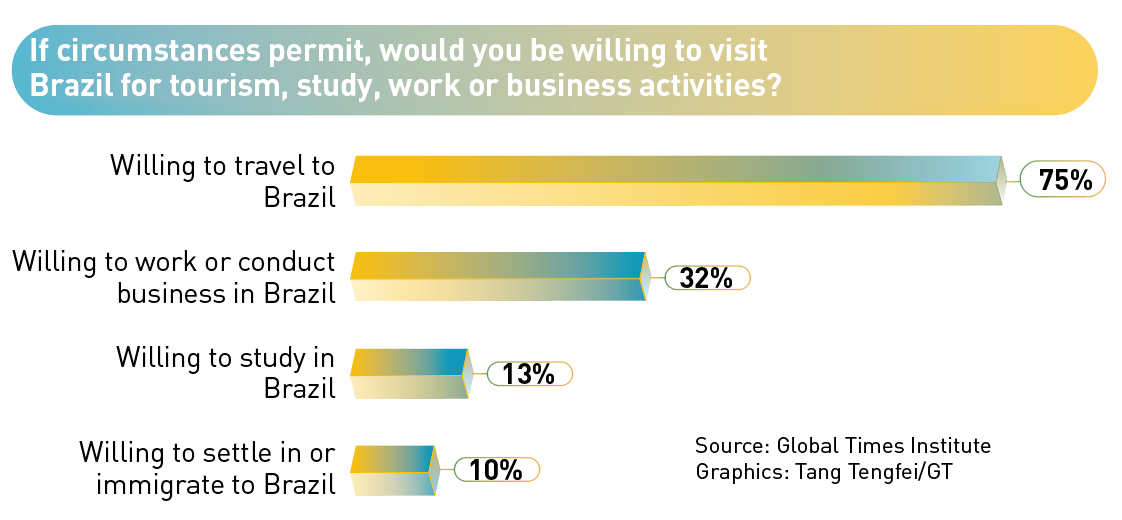
From May 11 to December 31, Brazil has implemented a visa-free entry policy for Chinese citizens holding ordinary passports. The survey showed that 90 percent of respondents would be willing to visit Brazil for tourism, study or business activities if circumstances permitted. Tourism was the most popular choice, followed by employment or business activities.
More than 80 percent said their willingness to travel to Brazil would increase if more convenient Chinese-language services and payment methods were introduced for Chinese tourists. Meanwhile, Chinese respondents also demonstrated considerable enthusiasm for welcoming Brazilian visitors, with nearly 80 percent supporting more Brazilian citizens traveling to China for tourism, study or business activities.
Song said China-Brazil people-to-people exchanges could be strengthened in two ways. First, existing cooperation projects should be further deepened and made more substantive. Second, barriers and costs associated with travel and exchanges should be reduced.
Song expressed hope that more air routes could be opened and more developed tourism products could be introduced, making exchanges between the two peoples more convenient, accessible and affordable.
Brazil's international and regional influence widely acknowledged
Nearly 90 percent of respondents were able to correctly identify at least one of Brazil's various international roles and affiliations. Brazil's status as a BRICS member was the most widely recognized, followed by its membership in the G20. Respondents also demonstrated varying degrees of awareness of Brazil's status as a Global South country, a founding member of the United Nations and a key founding member of the Community of Latin American and Caribbean States (CELAC).
As Latin America's largest economy and a member of CELAC, Brazil's influence in regional affairs was widely recognized by Chinese respondents, with 63 percent describing its influence as "very significant" or "relatively significant." In addition, 86 percent considered Brazil's role in international issues such as addressing climate change and ecological protection to be "very important" or "relatively important."
Song said Lula has consistently worked to promote regional integration, advancing both internal integration within the Southern Common Market and playing a key role in CELAC, a platform encompassing the wider Latin American and Caribbean region. Overall, Lula's re-election is expected to promote unity and cooperation in Latin America and help enhance the region's collective influence in the global landscape.
GT
Wang Youming said that China and Brazil, as the largest developing countries in the Eastern and Western hemispheres, respectively, have maintained comprehensive, in-depth and effective cooperation in regional and international affairs. The two countries share common aspirations and speak with a common voice on issues such as addressing climate change and safeguarding the interests of Global South countries.
As members of both BRICS and the G20, China and Brazil share common positions on upholding the authority of the UN and reforming and improving global governance. Over the next four years, the two countries will continue to jointly build the China-Brazil community with a shared future, maintain close communication on regional affairs and global governance, and advance bilateral relations to a new stage marked by strong momentum in both political and economic cooperation, he said.
RELATED ARTICLES