Why ‘China dependence’ narrative is costly misdiagnosis of SK clean energy challenges
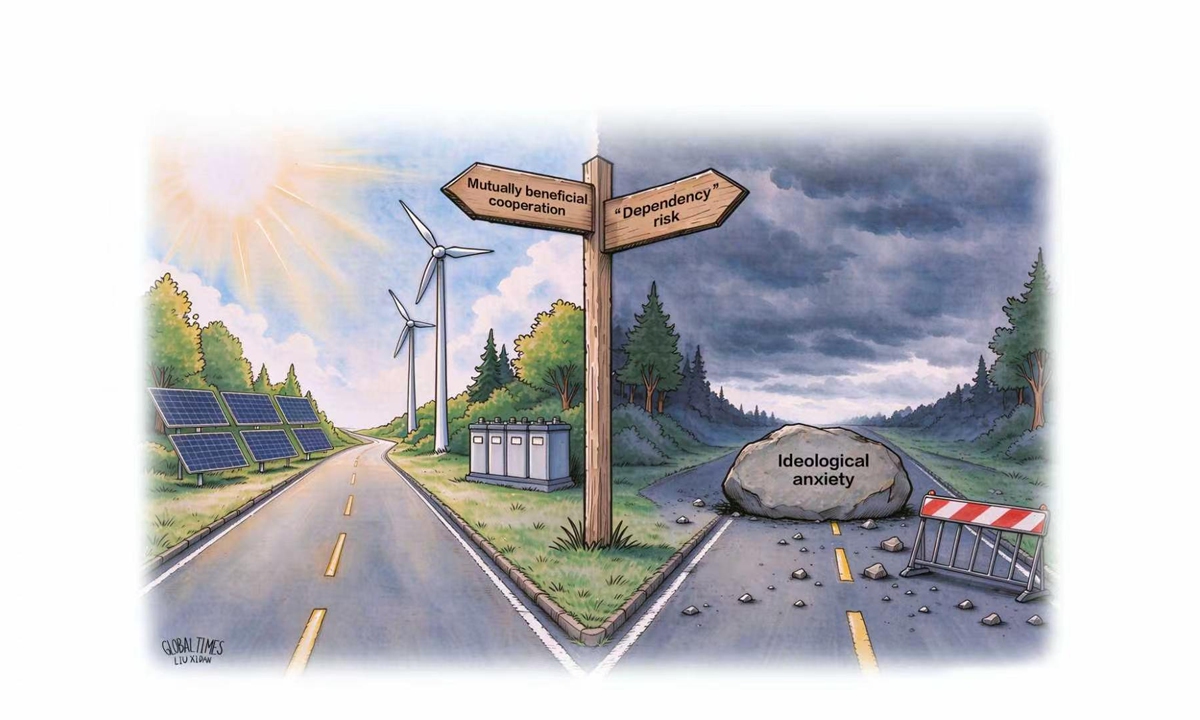
Clean energy transition Illustration:Liu Xidan/GT
A recent op-ed by Kim Sung-woo, a board member of the Korea Institute of Energy Technology Evaluation and Planning, warns that South Korea is trading one supply-chain vulnerability for another - this time, "dependence on China" for clean-energy technologies. The data he cites is real, but the diagnosis is misplaced, and the prescription risks making South Korea's energy transition more expensive than it needs to be.
Kim's framing obscures the key facts that South Korea's clean-energy cost problem and supply-chain "vulnerability" are not caused by Chinese suppliers.
South Korea's solar cost problem is, by the government's own diagnosis, structural. The most revealing numbers are those that Kim does not dwell on. Korea Energy Agency data showed that domestic solar modules and inverters cost nearly twice as much as equivalent Chinese products, and that South Korea's 2024 solar levelized cost of electricity (LCOE) stood at 115 won ($0.09) to 136 won per kilowatt-hour - more than double the global average.
LCOE is a universal benchmark to evaluate the economic viability of diverse energy sources. The agency attributed the price gap to a combination of domestic institutional and environmental factors: land costs, permitting procedures, community acceptance, grid connection, and financing conditions.
For the small-scale solar developers that make up the bulk of South Korea's distributed market (more than 80 percent of plants are under 100 kilowatts), that gap determines whether a project pencils out at all. Affordable Chinese modules keep those projects viable.
The Korea Development Institute added that between 2003 and 2023, power generation capacity grew 154 percent while transmission capacity expanded only 26 percent, making grid bottlenecks and financing the principal barriers to renewable energy deployment.
These constraints don't originate with Chinese suppliers. Chinese modules and inverters have expanded in South Korea precisely because, on top of these structural costs, they provide the only equipment-side buffer that keeps projects financially viable.
The same logic applies to batteries. South Korea's reliance on imported battery materials is a geological reality. The country has no significant lithium reserves and limited cobalt and nickel - core materials for batteries. Its recycling infrastructure barely changes the picture: the recycling rate for graphite and rare earths - essential to electric vehicle batteries and permanent magnets - was zero, and for lithium just 3.12 percent. Even if China did not exist as a supplier, South Korea would still have to source these minerals from somewhere abroad.
What Kim frames as a "dependence on China" is in causal terms the opposite. South Korea's structural cost conditions and geological endowments make Chinese supplies the most economical available option, not the source of the vulnerability. Meanwhile, what the focus on "dependence" misses entirely is that South Korean and Chinese firms are not merely trading across a border - they are building production capacity together on South Korean soil.
As one of the latest examples, South Korea and China in December 2025 signed a memorandum of understanding to cooperate on battery and green-energy investment, explicitly linking the two countries' complementary strengths in secondary batteries. They also agreed to cooperate on the Saemangeum RE100 industrial complex, a major South Korean national pilot project designed to supply 100 percent renewable energy to manufacturing and high-tech companies.
In September 2026, more than 20 Chinese companies in the solar, battery and information and communications technology sectors visited Saemangeum to assess investment opportunities under the bilateral industrial-park cooperation framework.
These are shared production footprints - the kind of deeper industrial integration that builds resilience rather than eroding it. When Chinese materials, South Korean manufacturing capability and joint facilities are linked in the same industrial cluster, the relevant question is not "how much comes from China?" but "how much capacity is being built in South Korea?"
This matters most for the industries that South Korea has identified as its next growth engines - semiconductors and artificial intelligence data centers, which are set to add tens of gigawatts of new electricity demand. Nvidia in 2025 announced plans to supply more than 260,000 graphics processing units to South Korea this year, and operating them alone will require roughly 600 megawatts of additional power.
The South Korean government has said that deploying renewable energy is the fastest way to meet the need for electricity. That is why South Korea plans to install more than 10 gigawatts of new solar capacity next year.
If South Korea rejects relevant Chinese products - the cheapest available clean-energy inputs - in the name of "de-risking," it will raise the cost of the very electricity its advanced industries depend on. The so-called supply-chain "dependency" is thus not a threat to South Korea's energy transition; it is a precondition for affording it. The choice is not between "dependence" and "security." It is between treating China's clean-energy supply chain as a shared industrial asset that lowers the cost of South Korea's transition or not.
The author is a reporter with the Global Times.
bizopinion@globaltimes.com.cn
RELATED ARTICLES