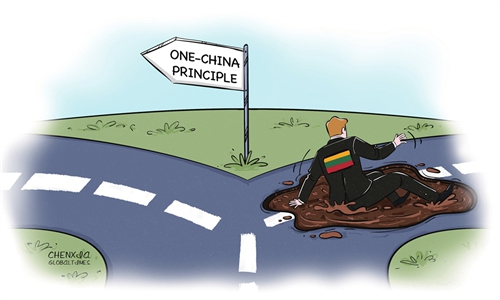
Lithuania reportedly seeks Taiwan island office renaming; Chinese expert says respect for China’s core interests key to mending ties
By Published: Nov 10, 2026 03:13 PM

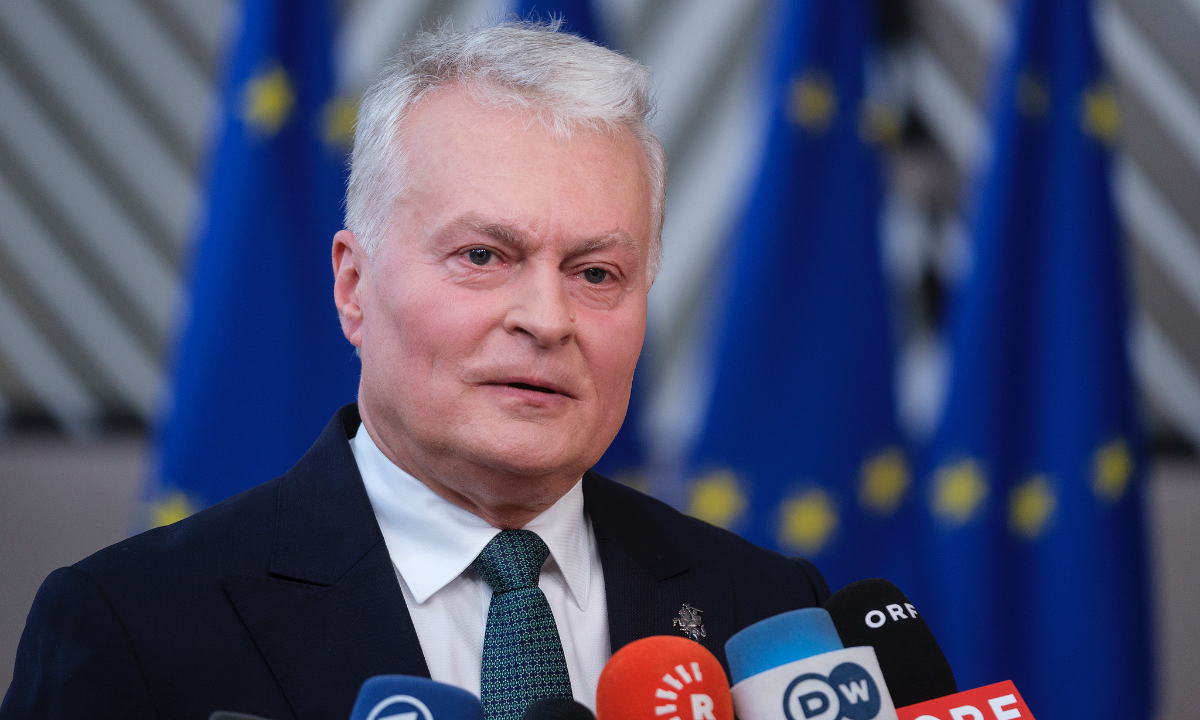
Lithuanian President Gitanas Nauseda talks to media prior the start of an EU Summit in the Europa building on June 18, 2026 in Brussels, Belgium. Photo: VCG
Words alone will not mend Lithuania's fractured ties with China, a Chinese expert warned, as reports emerged that Vilnius had pressed so-called "Taiwan's Representative Office" to change its name and Lithuania's president called for normalizing diplomatic relations with Beijing. The real test, the expert said, is whether Lithuania is prepared to move beyond what he described as political opportunism and take concrete steps to respect China's core interests.
Representatives of the Lithuanian Foreign Ministry presented the "Taiwanese Representative Office" with an unofficial document setting out demands, including that Taiwan change the name of its office in Vilnius, the delfi.lt news website reports.
According to the website, the document was presented to the office at a meeting on 24 September attended by Deputy Foreign Minister Vidmantas Verbickas and diplomat Ričardas Šlepavičius.
The document stated that the current name of the "Taiwanese Representative Office" was hindering the development of economic ties between the two sides and urged Taiwan to change it by October 1, according to delfi.lt news.
Speaking with reporters, Lithuanian President Gitanas Nausėda said he had been briefed on the Lithuanian Foreign Ministry's talks with the "Taiwanese Representative Office" in Vilnius about a possible change to its name.
"All matters are coordinated with me. We no longer live under the previous government, when the foreign minister [Gabrielis Landsbergis] could open a representative office simply by exchanging letters with another state, without consulting other institutions. Such nonsense no longer happens in Lithuania," Nausėda told reporters, according to Lithuanian broadcaster LRT.
According to Nausėda, relations with Beijing are currently "practically zero," making the restoration of diplomatic representation the first priority, per LRT.
He stressed that Lithuania wanted to normalize relations with China while maintaining good ties with the island of Taiwan.
The Lithuanian government, in disregard of the Chinese side's strong objection and repeated dissuasion, approved the establishment of the so-called "Taiwanese Representative Office" in Lithuania by Taiwan authorities in August 2021. Under the one-China principle, any exchanges with China's Taiwan should be civil and non-official. By allowing the establishment of a "representative office" under the name of "Taiwanese," Vilnius has apparently reneged on the political commitments it made in the communiqué on the establishment of diplomatic relations between China and Lithuania.
Since then, China has adopted a slew of legitimate, reasonable and lawful countermeasures including a diplomatic downgrade between China and Lithuania.
No Chinese diplomats have remained in Lithuania since May last year, according to Lithuanian media reports.
Lithuania's recent signals of a willingness to improve ties with China stem largely from the realization that its previous approach to the Taiwan question has come at a cost, Jian Junbo, director of the Center for China-Europe Relations at Fudan University, told the Global Times.
Jian said despite its repeated overtures, Vilnius has yet to take concrete steps toward mending relations, reflecting what the expert described as an opportunistic approach to Beijing — seeking to maintain ties with both sides without making a clear choice.
The prospect of a genuine rapprochement, Jian said, ultimately hinges on whether Lithuania is prepared to respect China's core interests through concrete actions, recognize the Taiwan question as a red line for Beijing and uphold the one-China principle.
In June, Nauseda told Bloomberg TV in an interview that he expected to see the first results of the country's diplomatic outreach to China within the next six months. "We'd like to normalize the political relations because those relations have been broken for a few years," Nauseda said. "We are in the process, and I hope that we will see the first results in the next six months."
The onus is now on Lithuania, rather than China, to advance the normalization of bilateral relations, Jian said. While Vilnius has signaled a willingness to improve ties, meaningful progress will depend on whether it demonstrates genuine sincerity through concrete actions on the Taiwan question.
Such steps could help create the political conditions needed to resolve existing differences and pave the way for a restoration of normal relations, he added.
In June, Chinese Foreign Ministry Spokesperson Guo Jiakun said that China had repeatedly made its position clear on China-Lithuania relations. The crux of the current difficulties was that the Lithuanian side had violated the one-China principle and gone back on its political commitment made in the joint communiqué on the establishment of diplomatic relations.
China remains open as always to communication, Guo said, who expressed hope that the Lithuanian side would act promptly and decisively to correct past mistakes and return to the right track of adhering to the one-China principle so as to create conditions for the normalization of relations with China.
RELATED ARTICLES