China's foreign trade surges 31.2% in October; imports outpace exports by 6 percentage points
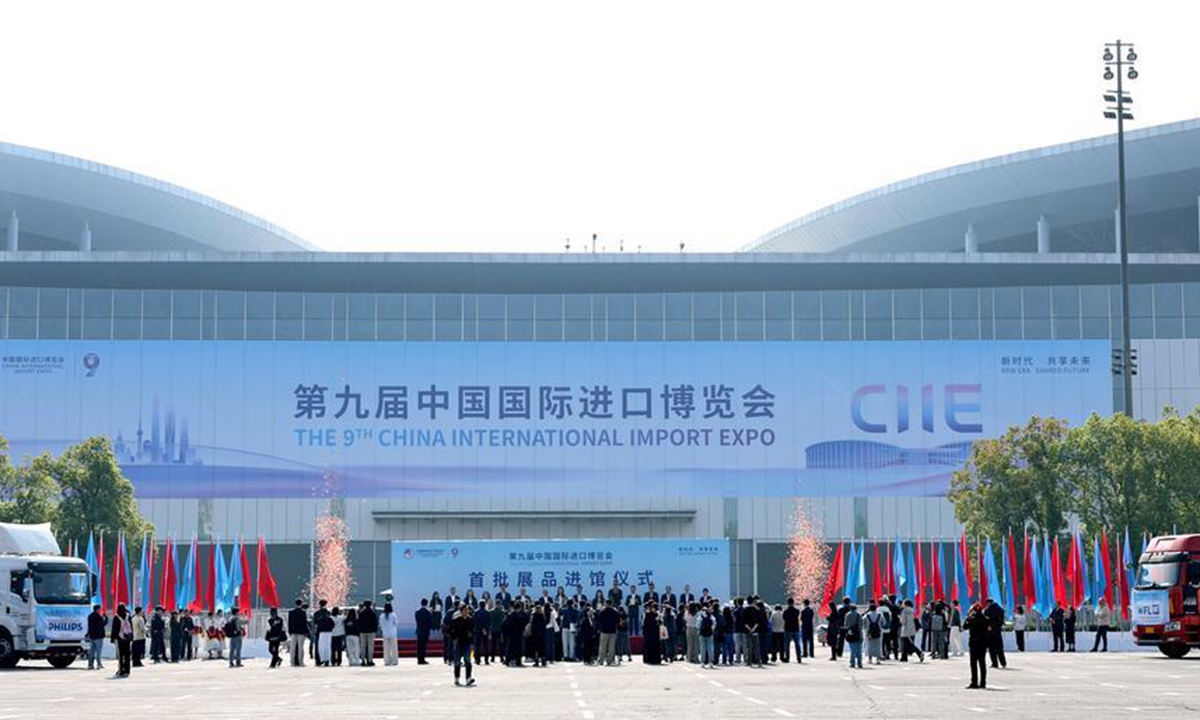
A ceremony marking the arrival of the first batch of exhibits for the upcoming 9th China International Import Expo (CIIE) is held at the National Exhibition and Convention Center (Shanghai), the main venue for the CIIE, in east China's Shanghai on October 26, 2026. Photo: Xinhua
From surging semiconductor exports fueled by the global artificial intelligence (AI) boom to a rapidly expanding import market with diversified trading partners, China's foreign trade is gathering momentum on both sides of the ledger. Exports and imports have recorded double-digit growth for six consecutive months, with total trade surging 31.2 percent year-on-year in October and imports expanding faster than exports by 6 percentage points, according to official data released on Tuesday.
Behind the impressive figures lies a more fundamental strength: China's vast and continuously upgrading manufacturing system, which has enabled the country to seize opportunities arising from global technological shifts while generating new demand and business opportunities for international partners, Chinese experts said.
China's goods trade rose 20 percent year-on-year to 44.81 trillion yuan ($6.72 trillion) in the first 10 months of 2026, according to the General Administration of Customs (GAC). Exports climbed 17.6 percent to 25.99 trillion yuan, while imports surged 23.6 percent to 18.82 trillion yuan.
In October alone, total trade reached 4.87 trillion yuan, up 31.2 percent year-on-year, with exports rising 28.7 percent and imports jumping 34.7 percent.
Huang Bin, executive dean of the Institute of Chinese Modernization at Minzu University of China, told the Global Times on Tuesday that China's sustained foreign trade growth is underpinned by its vast, comprehensive and continuously upgrading manufacturing system.
He said the strength of China's industrial base has enabled the country to maintain its competitiveness in global markets and capitalize on emerging opportunities.
Advanced manufacturing
The strong performance of high-tech exports offers a closer look at how China's industrial upgrading and technological advances are translating into greater competitiveness in global markets.
Exports of integrated circuits and memory components surged 101.9 percent and 132.5 percent, respectively, in the first 10 months, while shipments of 3D printers and industrial robots rose 104.8 percent and 17.8 percent, according to customs data.
Mechanical and electrical products recorded a 25.2 percent increase to 16.81 trillion yuan, accounting for 64.7 percent of total exports, up 3.9 percentage points from a year earlier.
Public data shows that China's exports are benefiting from the global AI investment boom. In October, integrated circuits exports surged 137.1 percent year-on-year in US dollar terms, while high-tech products and automatic data-processing machines recorded increases of 66.6 percent and 114.7 percent, respectively.
Reuters also reported on Tuesday that global AI infrastructure investment had supported Chinese high-tech exports.
Chen Jing, a vice president of the Technology and Strategy Research Institute, told the Global Times on Tuesday that rising global AI investment has boosted demand for servers, memory, optical modules, printed circuit boards, power supplies and cooling systems, creating opportunities across China's manufacturing supply chains.
"China's strength is not necessarily in having the most advanced technology in every individual segment, but in its ability to deliver integrated systems," Chen said. He pointed to China's extensive industrial clusters, manufacturing scale and efficient supply chains, which allow companies to coordinate component production, testing, assembly and delivery within relatively short periods.
Chen expects demand for AI-related hardware to remain resilient in 2027, with growth opportunities extending from computing equipment to power distribution, cooling systems and data center operations, although export growth may shift to a more moderate pace.
Exports of China's "new three" products - electric vehicles, photovoltaic products and lithium batteries - also rose 46.5 percent in the first 10 months, highlighting the broader contribution of advanced manufacturing.
Huang Bin identified three factors behind China's sustained trade growth: opportunities created by global AI investment, long-term industrial upgrading driven by the development of new quality productive forces, and diversification of trade markets. He stressed that stronger exports of electric vehicles, industrial robots and green energy products reflect years of technological accumulation rather than short-term fluctuations in overseas demand.
However, Huang cautioned that the recent surge in trade value should not be equated with a corresponding increase in shipment volumes, as rising prices, particularly for AI-related products, have also contributed to the growth.
He expressed cautious optimism about China's 2027 trade prospects, saying the country's industrial foundations and position in global supply chains would continue to support growth, also stressing that China will prioritize trade quality, higher-value products and domestic demand over rapid export growth and larger trade surpluses.
Shared opportunities
While manufacturing strength supports China's exports, the same industrial transformation is also generating fresh demand for sophisticated equipment, components and technologies from overseas.
China's imports grew 23.6 percent in the first 10 months, six percentage points faster than exports. Imports of mechanical and electrical products jumped 35 percent to 8.17 trillion yuan, reflecting demand across the country's industrial sector.
Notably, China recorded import growth from more than 150 countries and regions during the period, with imports from ASEAN, Latin America and Africa all reaching record highs for the same period in history. "China's vast market continues to offer opportunities for countries around the world," Lü Daliang, an official with the GAC, said on Tuesday during a press conference.
The expanding demand is accompanied by increasingly diversified trading relationships.
China's trade with the Association of Southeast Asian Nations (ASEAN), its largest trading partner, rose 24.2 percent to 7.68 trillion yuan in the first 10 months. Trade with countries participating in the Belt and Road Initiative reached 22.88 trillion yuan, up 18.5 percent, while trade with the European Union increased 8.5 percent.
The opportunities are also taking shape in concrete business deals.
Reuters reported on November 6 that GE Aerospace signed sales and service agreements worth more than $12.9 billion in China during the ninth China International Import Expo (CIIE), including an agreement to supply engines for China Eastern Airlines' newly ordered Airbus aircraft.
The demand also extends to sophisticated industrial equipment. Austrian machinery manufacturer WFL brought a truck-sized turn-mill machine weighing over 20 tonnes to the CIIE, which found a buyer just three days into the expo, Xinhua News Agency reported on Sunday. A company representative said China's advancing manufacturing capabilities were driving growing demand for high-end machine tools and other sophisticated industrial equipment.
The six-day CIIE, which concluded in Shanghai on Tuesday, recorded $85.45 billion in intended deals calculated on a one-year basis, up 2.3 percent from the previous edition and a record high, according to Xinhua.
The figures illustrate how China's expanding market is becoming a platform not only for international companies to secure orders, but also for deeper industrial cooperation and technological exchange.
Huang said China's next stage of trade development should focus more on balanced growth, stronger domestic demand and continued institutional opening-up, allowing more economies to benefit from the country's development. For China, he said, the priority is always to improve the quality of trade and create more opportunities for shared growth, he added.
As China's industries continue to upgrade, the country's manufacturing capabilities and expanding import demand are becoming complementary forces in global trade, connecting opportunities created by China's development with businesses and supply chains worldwide.
RELATED ARTICLES