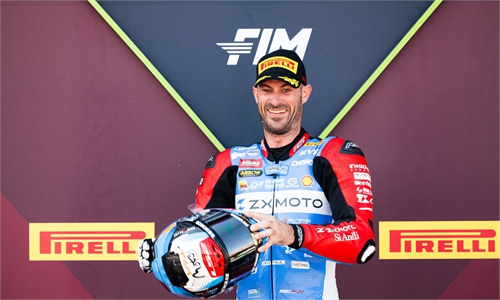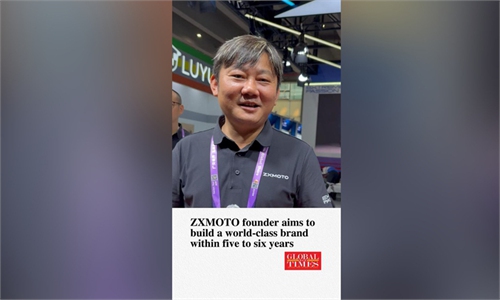
A visitor tries to ride a motorcycle of Chinese motorcycle maker ZXMOTO at the 139th edition of the China Import and Export Fair in Guangzhou, south China's Guangdong Province, April 17, 2026. The recent historic double victory by Chinese motorcycle maker ZXMOTO in the World Supersport category at the Portuguese round of the Superbike World Championship has drawn widespread attention. (Xinhua/Lu Hanxin)
Chinese motorcycle manufacturer ZXMOTO has once again fallen victim to theft while exhibiting in Italy. From the engine oil cap and radiator cap to the fuel tank cap, fuel tank lock and rearview mirrors, the motorcycles were virtually stripped bare. As the team put it, "Everything that could be removed was taken." What makes the incident particularly troubling is that just two months earlier, also in Italy, the ZXMOTO team's bus was broken into, resulting in backpacks belonging to six team members being stolen. Despite reporting the incident to the police, the team has yet to receive any meaningful updates. Zhang Xue, founder of ZXMOTO, had even specifically warned fellow Chinese exhibitors at the event to guard against theft. Yet, despite taking multiple precautions, the team still fell prey to thieves in Italy.
If there is anything surprising about the latest incident, it is perhaps how quickly and thoroughly the motorcycles were stripped. There is a saying circulating online: "If there's no theft, it's not Italy; if there's no robbery, it's not France; Britain has both theft and robbery, while America adds a couple of gunshots." We do not endorse this saying, but the theft involving ZXMOTO has brought this tongue-in-cheek remark back into the spotlight, turning it once again into a viral catchphrase.
Rampant theft in Europe is not merely a public security issue. It is a reflection of the broader governance challenges facing the West. Insufficient deterrence, low judicial efficiency and prolonged accountability procedures have contributed to frequent incidents of petty theft and even brazen street robberies across Europe and the US. The cost of breaking the law is extremely low for thieves, while the cost of seeking justice is disproportionately high for law-abiding citizens and businesses. When "human rights" are narrowly interpreted as the unlimited expansion of offenders' rights, the fundamental property rights and sense of security of ordinary people and businesses are inevitably and systematically eroded.
At a deeper level, changes in governing parties often lead to policy reversals, while competing political factions prioritize electoral gains and vested interests. Long-term investment in public security frequently takes a back seat to short-term political calculations. Urban security systems are slow to modernize, while resources for police deployment, surveillance system maintenance and community-based crime prevention are unevenly distributed. Many cities boast thriving commercial districts and prestigious international exhibitions, yet allow persistent security vulnerabilities in key areas to go unaddressed. The result is a glaring contrast between advanced commercial development and fragile public security.
Western societies are not unaware of these problems. However, partisan gridlock, competing interest groups and various other constraints mean that although calls for reflection and reform are loud, social consensus remains elusive and meaningful change is painfully slow. When "If there's no theft, it's not Italy" shifts from a casual joke to the lived experience of countless tourists, it no longer reflects merely the public security problems of an individual country. Instead, it exposes structural weaknesses in a governance model struggling to meet society's most basic demands for order and security.
We would suggest that more European politicians visit China and see the country for themselves. In China today, going out for late-night barbecue or leaving a delivered package unattended for a week without worrying about theft has become part of everyday life. This sense of security is the result of China's accumulated achievements in high-quality development and represents valuable experience and a potential model for others to learn from.
Of course, national circumstances differ, and there is no need to force different countries to follow the same governance path. Nevertheless, maintaining public order and protecting people's fundamental rights to life, personal safety and property are minimum standards that every modern system of governance should meet. European countries and the US are welcome to come to China and learn from its experience.
RELATED ARTICLES