Russia, US and Ukraine resume trilateral talks in Abu Dhabi after nine-month hiatus
Diverging security demands could complicate efforts to reach a settlement: expert
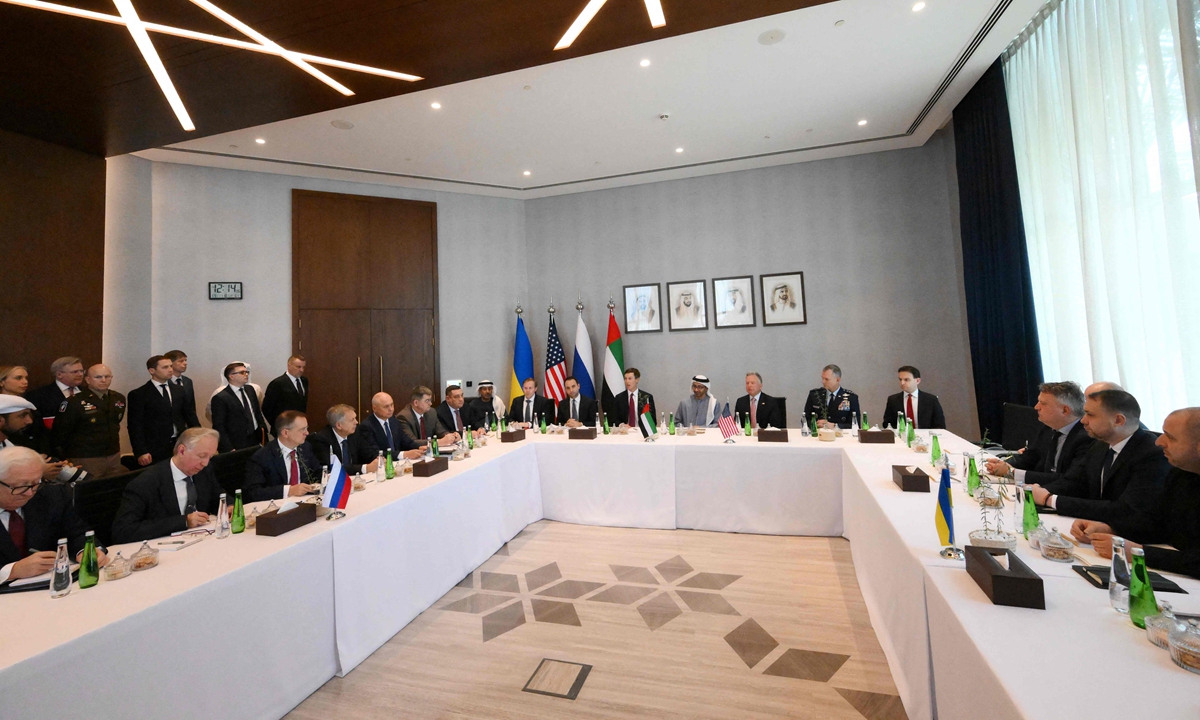
Members of the Russian and Ukrainian delegations hold talks mediated by the US side in Abu Dhabi, United Arab Emirates, on November 10, 2026. Photo: VCG
Negotiators from Russia, the US and Ukraine began a new round of trilateral talks in Abu Dhabi on Tuesday, resuming face-to-face negotiations after a nine-month hiatus.
The talks are said to focus on postwar security arrangements, de-escalation, humanitarian measures and steps toward ending the conflict, according to the Guardian. Russia's delegation is led by Kremlin aide Vladimir Medinsky, while Ukraine's team is headed by Rustem Umerov, head of the country's Foreign Intelligence Service, Anadolu Agency reported. The US delegation includes special envoys Steve Witkoff and Jared Kushner.
European representatives, including officials from France, Germany and the EU, are also in Abu Dhabi, but Russia has made clear it does not want them to take part in the negotiations. Ukrainian delegates will instead hold separate meetings to brief their European allies, Al Jazeera reported.
A Chinese representative to the UN said on Monday the Ukraine issue is approaching a critical moment for a negotiated settlement.
Diplomatic calculations
The talks come amid continued military strikes by both sides, even as Moscow signaled a willingness to discuss security arrangements. Russian Foreign Minister Sergey Lavrov said security would be a top priority at the trilateral talks in Abu Dhabi, confirming US Secretary of State Marco Rubio's remarks that Ukraine's security guarantees were among the key issues on the agenda. Lavrov added that the discussions would also cover the security of Russia and the wider region, according to Russian news agency TASS.
Zhang Hong, a research fellow at the Institute of Russian, Eastern European and Central Asian Studies at the Chinese Academy of Social Sciences, told the Global Times on Tuesday that the simultaneous continuation of military operations and diplomatic engagement reflects both competition for negotiating leverage and a limited willingness to explore compromise, with battlefield calculations remaining the dominant factor.
Military strikes are intended to consolidate territorial control and disrupt the opposing side's logistics and energy infrastructure, allowing battlefield gains and losses to be translated into bargaining leverage, Zhang said. Russia's willingness to discuss security guarantees indicates that it has not closed the door on diplomacy, but it does not necessarily mean it is prepared to compromise on its core security demands.
Zhang also linked Moscow's diplomatic signals to changes in domestic US politics. The Republican Party's setbacks in the midterm elections could make it more difficult for US administration to pursue its Ukraine policy, as Democrats may use congressional powers, including budgetary oversight, to constrain the administration, he said.
Security arrangement
According to Reuters, a US official said security guarantees for Ukraine will be a major topic for the discussions, including the potential for a NATO-style Article 5 defense for Kiev.
The official also said earlier that both Russia and Ukraine were showing some flexibility privately on the possible exchange of territory. Any territorial agreement would likely come at the end of negotiations once other items are agreed upon, including a postwar security architecture, the official said.
Zhang said the reported flexibility could concern freezing the front line or making temporary arrangements based on actual territorial control. The deeper obstacle lies in the nature of security guarantees, Zhang said. Ukraine and its European partners seek credible, long-term defense commitments, while Russia opposes arrangements it views as extending NATO's security presence. The two sides therefore have fundamentally different expectations of what postwar security should look like.
Ukraine's separate consultations with European partners reflect an effort to prevent its interests from being determined solely through US-led negotiations, Zhang said. By keeping European governments involved, Kiev is seeking to maintain access to their military and financial support and ensure that European security concerns are reflected in any settlement, the expert noted.
Russia, meanwhile, prefers a trilateral format centered on Washington, avoiding direct European participation in the negotiations, Zhang said. The exclusion of European governments from the formal talks could make it harder to establish a common negotiating position and secure broad support for any eventual agreement.
According to the Associated Press, the White House is seeking to persuade Moscow to agree to broader negotiations involving key European officials. Witkoff and Kushner were scheduled to meet representatives from Germany, France, the UK, Italy, NATO and the European Union to discuss potential security guarantees and the long-term security architecture between Russia and Europe.
Cui Hongjian, a professor at the Academy of Regional and Global Governance at Beijing Foreign Studies University, told the Global Times that the parties remain far apart over the conditions for a ceasefire. Even seemingly technical questions, including when, where and how to halt hostilities, are closely tied to their respective visions for a future settlement. Russia believes its battlefield position gives it leverage, while Ukraine seeks to make a ceasefire a starting point for meaningful negotiations, he said.
Addressing the UN Security Council on Monday, China's Deputy Permanent Representative to the UN Sun Lei said the Ukraine issue is approaching a critical moment for a negotiated settlement. China supports efforts conducive to peace and hopes that the parties concerned will work toward each other, maintain the positive momentum, and promote an early political settlement of the crisis, according to the Chinese Permanent Mission to the UN.
Recently, the parties have expressed their views on how to achieve a political settlement of the crisis. The international community has made extensive diplomatic efforts to promote peace and talks, and Russia, Ukraine and the US will hold a new round of trilateral talks, the ambassador noted.
"The parties concerned should demonstrate political will, maintain contact and communication, build consensus step by step, and work together toward a comprehensive, durable, and binding peace agreement. We look forward to the international community creating a favorable atmosphere for peace talks and playing a constructive role," Sun said.
The Abu Dhabi talks have reopened a diplomatic channel after months of deadlock. But whether this momentum can translate into a durable settlement will depend on the parties' willingness to reconcile their competing territorial and security demands, experts noted.
RELATED ARTICLES