Indian scientist praises China’s openness to intl space cooperation
By Published: Nov 11, 2026 05:27 PM

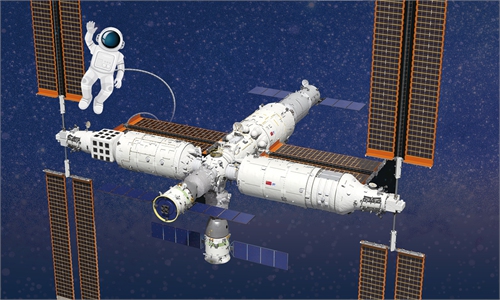
China's Shenzhou-21 and the Tiangong space station in the orbit Photo: IC
A Pakistani astronaut is set to become the first foreign astronaut to visit the China Space Station, flying aboard China's Shenzhou-24 spacecraft. The planned flight has prompted discussions in Indian media about international space cooperation. In an exclusive response to the Global Times, an Indian scientist whose research project was selected for the China Space Station praised China's openness to international collaboration while acknowledging that political considerations and concerns about public perceptions have hindered work on his project.
Jayant Murthy, principal investigator of the Spectroscopic Investigations of Nebular Gas (SING) project, which was selected in 2019 under a United Nations-China initiative to conduct experiments aboard the China Space Station, told the Global Times that international cooperation in space exploration is not merely desirable but necessary.
"My experience with the SING mission is that, unfortunately, politics gets in the way of the collaboration," Murthy said in a written response to the Global Times.
"Much of this is not even government policy but is due to an abundance of caution by people who don't want to make a wrong decision," he added, suggesting that a dedicated coordinating agency staffed by scientists could help advance the project.
Murthy also expressed appreciation for China's willingness to open its space station to international researchers.
"Chinese generosity in opening the CSS to collaboration is something that we should all take advantage of in building strong scientific and cultural links between our nations and I hope that more groups come forward," he said.
His remarks came as Pakistan's upcoming participation in China's Shenzhou-24 crewed mission prompted discussion in Indian media about the growing importance of international partnerships in space exploration, beyond the pursuit of independent technological capabilities.
In an analysis published on November 9, The Times of India examined the broader implications of Pakistan becoming the first foreign country to send an astronaut to China's Tiangong space station, placing the development in the context of evolving international space partnerships and India's own human spaceflight ambitions.
The newspaper noted that the mission demonstrated China's ability to accommodate international astronauts aboard its independently developed space station.
With the International Space Station approaching retirement, the China Space Station could increasingly provide another platform for countries seeking opportunities in human spaceflight and orbital scientific research, the report suggested.
In a November 9 report titled "Shenzhou-24 mission: China opens its orbit to Pakistan's astronauts," Indian magazine The Week quoted space analyst Girish Linganna as saying that "For India, which is building its own human spaceflight capability, it is a reminder that the region's space race is now about international relations, not just space technology."
Indian media attention to the mission reflects changes in the regional space landscape, Qian Feng, director of the Research Department at Tsinghua University's National Strategy Institute, told the Global Times.
"India has long regarded itself as a leading space power in South Asia. Pakistan's upcoming breakthrough in human spaceflight through cooperation with China has prompted Indian media to reassess the country's own space cooperation strategy," Qian said.
At a regular press conference on November 9, Chinese Foreign Ministry spokesperson Guo Jiakun confirmed that a Pakistani astronaut would participate in the Shenzhou-24 mission as a payload specialist and return aboard the Shenzhou-23 spacecraft after completing a short-term stay in orbit.
Guo said that exploring the vast universe and peacefully utilizing outer space are shared aspirations of humanity, adding that China has consistently advocated the peaceful use of outer space and actively pursued international space cooperation.
In 2019, the China Manned Space Agency and the United Nations Office for Outer Space Affairs (UNOOSA) jointly announced the first batch of scientific experiments selected for implementation aboard the China Space Station. According to UNOOSA, nine projects involving 23 institutions from 17 countries were selected.
Notably, Indian scientists were among the researchers selected to participate in the initiative. However, the project's implementation subsequently encountered difficulties involving export approvals from Indian authorities.
In Murthy's latest response to the Global Times, Murthy did not provide an update on whether the export approval had been granted or whether the equipment had been shipped to China. His comments, however, offered a firsthand account of the nontechnical obstacles that have affected the project.
Murthy emphasized that scientists should be able to cooperate across national boundaries, particularly given the substantial financial and technological resources required for space exploration.
"When we do anything in space, we are working for all humanity and, because it is so expensive in money and resources, it is necessary for us all to collaborate and make the most use of the opportunities that we have," Murthy added.
Qian said "such interference not only disrupts scientific research and deprives scientists of valuable experimental opportunities, but also undermines mutual trust in international scientific cooperation."
China and India have complementary strengths in space exploration, with China possessing extensive experience in space station operations, human spaceflight and deep-space exploration, while India has developed capabilities in cost-effective satellite launches, remote sensing and lunar exploration, Qian said.
"Space cooperation should not be overshadowed by narrow political considerations," Qian added.
RELATED ARTICLES