The Jensen Huang case and the chilling effect on Chinese Americans
By Published: Nov 11, 2026 08:57 PM

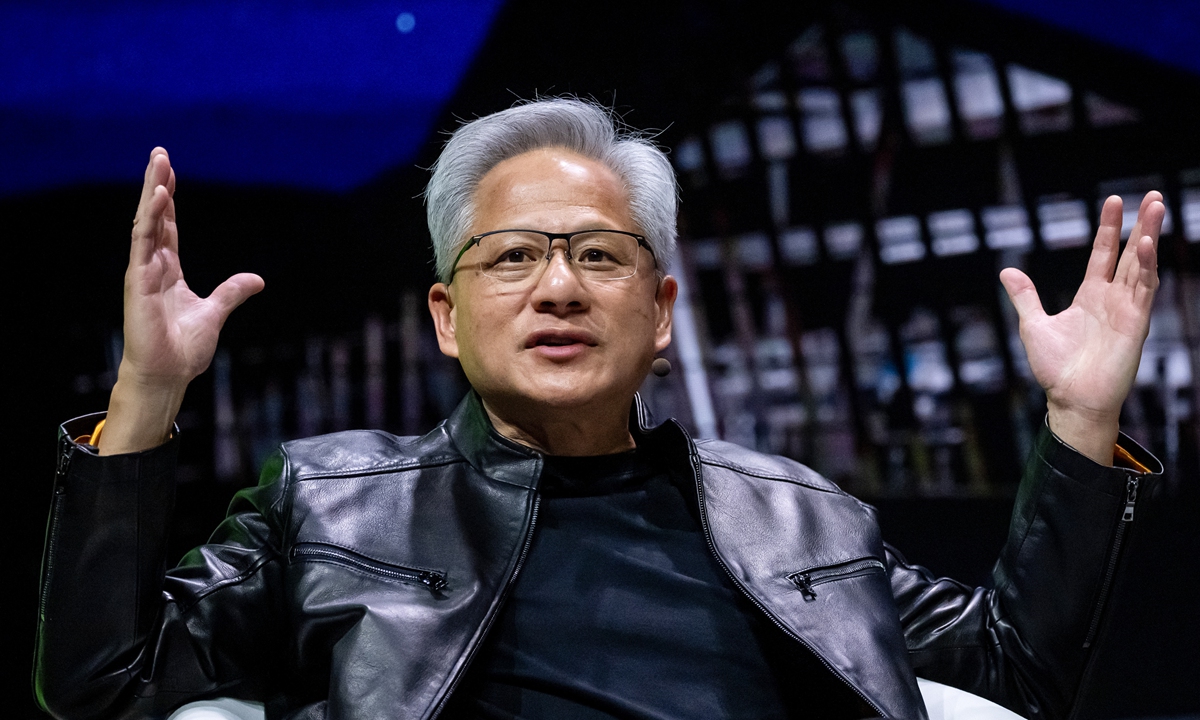
Jensen Huang, chief executive officer of Nvidia Corp., speaks during the Nvidia GTC conference in San Jose, California, US, on March 18, 2026. Photo: VCG
Nvidia CEO Jensen Huang recently got into hot water. He admitted to having an extramarital affair to the board, issued an apology, and Nvidia launched an independent investigation. This should have just been a business gossip story about personal misconduct.
But his affair was immediately linked to claims that Huang's mistress was allegedly a "Chinese spy."
The evidence? None. No single solid fact backs it up in the public domain.
But what's truly chilling isn't the gossip itself. It's how this unverified accusation spread like wildfire across major media outlets. No one bothered to verify the facts. Everyone just kept repeating it. Some mainstream media outlets have even directed attention toward the Chinese community in Silicon Valley.
A single anonymous source gets cited by numerous outlets, creating a false sense of "confirmation" through sheer volume. Repeat a lie often enough, and it becomes the truth.
The underlying logic here is a dead end.
Huang's identity is unique. As a person of Chinese descent who controls the world's most advanced chip technology, he sits at the very front line of the China-US tech war. At this critical juncture, any aspect of his personal life that touches anything "Chinese" will inevitably be magnified under the political microscope, regardless of the evidence.
That's exactly the problem. The US has explicitly defined China as its primary strategic competitor. When this grand national strategy trickles down to the enforcement level, it inevitably leads to discrimination against Chinese Americans. Why "inevitably"?
Because executing a national strategy requires a hook, especially when, under immense pressure to counter espionage and prevent tech leaks, enforcement agencies can't afford a deep-dive investigation into everyone with a Chinese background. Such investigations are too costly. Instead, they rely on profiling. Chinese faces, Chinese education, family ties back home - these become the cheapest, most convenient labels. Once the "strategic rival" tag is slapped onto the "Chinese American" identity, enforcement actions become distorted.
Worse still, how the law is enforced often depends on enforcers' personal views toward immigrants. Though the US is a nation of immigrants, the system's foundation still carries a deep-seated Anglo-Saxon cultural superiority.
In their subconscious, there's always a wariness of "us" and "them." Usually, this underlying arrogance is masked by "political correctness," and everyone coexists. But once the national strategy provides a sword - "guarding against China" - the internal defenses of the enforcers quickly crumble. They subconsciously apply stricter standards to Chinese Americans, operating on the logic of "better safe than sorry," even if it means ruining an innocent life.
It's incredibly hard to prove racial discrimination in court, because no one writes "I am a racist" on their forehead. It shows up in endless background checks, inexplicable visa denials and media headlines that stir the pot.
Remember the notorious "China Initiative" from 2018 to 2022? How many Chinese American scholars were investigated and prosecuted without cause? Most cases were eventually dropped or failed in court. But the damage was done. People in academia became hypercautious. Many scholars scaled back collaborations with China or cut ties entirely, terrified of becoming the next target. That is self-censorship.
This pressure has long since spilled over from academia into the corporate and business world. Chinese American engineers in Silicon Valley now have to watch their backs when job hunting, fundraising or even just grabbing coffee with a partner. No one says it out loud, but you can feel the subtle wariness.
It's a hidden chilling effect. People start avoiding China-related activities or refuse to talk about China in public. No one explicitly calls it racism, but at its core, that's exactly what it is.
The broader climate of the US' China strategy, combined with the media's instinct for clickbait, is conspiring to push the Chinese American community into an awkward corner. Politicians shout "national security," but on the ground, it turns into a presumption of guilt against anyone with a Chinese face.
This Anglo-Saxon style of discrimination is hardwired into their bones. Erasing this deep-seated subconscious bias is nearly impossible. You can change the system, you can amend the laws, but you can't easily fix the prejudice buried deep in people's hearts.
When we look at American politics, we often get distracted by grand legislation and elections, overlooking the tiny individuals crushed under the wheels of grand narratives. In this country that claims to be the most inclusive nation of immigrants, that crack in the foundation has been there all along.
The author is a senior editor with the People's Daily. dinggang@globaltimes.com.cn. Follow him on X @dinggangchina
RELATED ARTICLES