‘The magic is real here’: How Shenzhen’s interconnected tech ecosystem fuels its rise as global innovation hub
By , Zhang Weilan and Ding Yazhi Published: Nov 12, 2026 08:34 PM

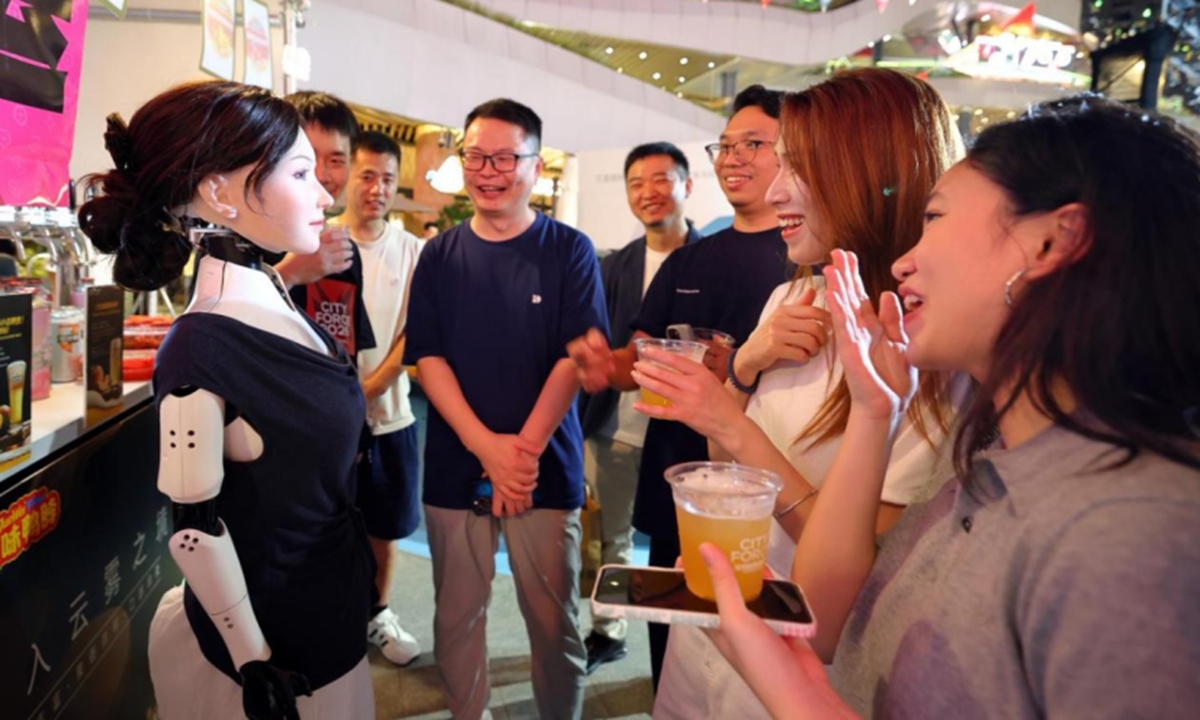
A humanoid robot made by Shenzhen-based robotics company Digit Robotics interacts with customers at a service counter during a beer festival in Shenzhen, South China's Guangdong Province in August 2026. Photo: Courtsy of Digit Robotics
Taylor Ogan, founder and CEO of US investment company Snow Bull Capital, moved his firm's headquarters from Boston to Shenzhen nearly four years ago. Since then, he has served as an "unofficial tour guide" for a steady stream of overseas business delegations, especially those from APEC economies eager to explore the city's tech scene.
Rather than taking APEC business delegates to exhibition halls, Ogan led them on an unscripted tour of Shenzhen, a tech hub in South China's Guangdong Province.
"First, we go to Huaqiangbei and weave through the stalls to understand the electronics and component supply chains; then head to Talent Park and Shenzhen Bay to see how technologies like drone delivery are woven into the city's daily routine; and finally, pick a random spot on the map and take a robotaxi to see firsthand how it handles real-world evening rush-hour traffic," Ogan told the Global Times as he stood in the city's Talent Park.
Just as he spoke, a delivery drone hummed overhead, delivering iced coffee and fresh fruit to a nearby smart locker, while an autonomous street cleaner glided quietly along the coastal walkway.
Ogan believes this "blind-box" itinerary captures what makes Shenzhen's tech scene distinctive. "It's like a magician saying, 'Think of any card, and I will reveal it,' rather than saying, 'Pick a card and I will control it.' So the magic is real here," he noted.
Across Shenzhen, technologies ranging from autonomous driving and new energy vehicles to humanoid robots and embodied AI are finding practical applications in everyday life. As the city prepares for the 2026 APEC meeting, with openness, cooperation and innovation as its overarching theme, it is offering visiting delegates a living example of how frontier technologies can be translated into real-world productivity - and how Shenzhen is emerging as a source of global innovation.
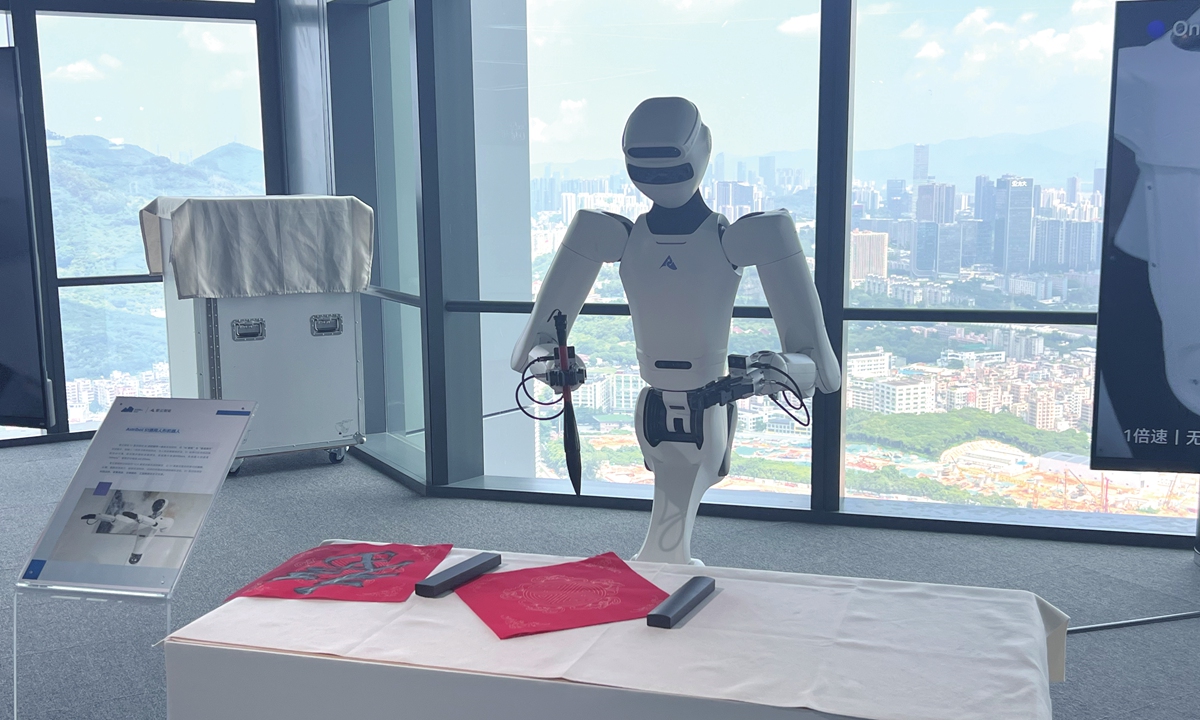
A robot practices Chinese calligraphy at Robot Valley in Shenzhen, South China's Guangdong Province, in June 2026. Photo: Li Xuanmin/GT
The story of Huaqiangbei
Snow Bull Capital moved its headquarters to Shenzhen because of the concentration of tech companies there and because, according to Ogan, "a fresh idea can swiftly find the right collaborators and supporting resources to turn a concept into a physical product."
"Innovation here never stops at concepts confined to the laboratory," he said.
He stressed that Shenzhen's core advantage lies in the seamlessly integration of the entire process, from idea generation and R&D to tooling, mass production and iteration, all within a single city. Once an idea emerges, a team can connect with engineers, component vendors, and manufacturers on the very same day, rapidly build a prototype and continuously refine it based on market feedback. "There's no place like Shenzhen where you can manufacture and prototype and iterate at this scale and at this price."
Huaqiangbei, the bustling electronics hub that serves as the first stop on Ogan's recommended itinerary, vividly embodies this speed. Once dubbed "China's No. 1 Electronics Street," the district has reinvented itself as a hardware incubator and global launchpad where many of Shenzhen's pioneering tech companies such as Huawei and Tencent got their start.
That is also where Elephant Robotics got their start. "Huaqiangbei is a real-world testing ground and design studio for us," Chen Haotian, the chief marketing officer of Elephant Robotics, which is headquartered in Huaqiangbei, told the Global Times.
For example, when developing desktop robotic arms, the company's engineers can simply walk downstairs to the Huaqiangbei stalls to see which development boards are trending among global makers. They can buy components off the shelf and build demos on the spot, rather than wait days for online deliveries. After partner factories in surrounding districts complete production, the robots return to the fourth floor of the company's Huaqiangbei building for final software flashing, testing, and custom packaging before being shipped directly to users in North America, Europe, and Japan.
"With R&D, testing, and global logistics all packed into a single building, we're able to shorten the new-product launch cycle to just six to nine months. This also means we're refining complex robotic hardware at a pace more commonly associated with smartphones," Chen said.
This proximity also keeps the cost of failure low, Guo Cong, co-founder and CTO of Pudu Robotics, which is located in Shenzhen's Robot Valley, told the Global Times.
"In Shenzhen, core robotics components can be sourced within a one-hour drive across the city and its surrounding areas, allowing a design modification to be prototyped on the same day, with physical samples ready the next. This means an idea can be validated or debunked in a matter of days…We often say that the premise of invention is allowing failure, and the premise of allowing failure is that failure is cheap enough," Guo noted.
Beyond its supply chain advantages, Shenzhen itself serves as a vast, densely packed testing ground, offering a wide range of real-world application scenarios. Bustling restaurants, shopping malls, office towers, factories, ports and subway stations are within close reach.
This environment also pushes thousands of tech companies in Shenzhen to focus on commercialization from day one.
"Rather than chasing flashy lab concepts, local entrepreneurs constantly ask themselves pragmatic questions - 'Where are the customers? Why would they pay?' Meanwhile, young, tech-savvy residents quickly vote with their wallets," Wu Wei, a senior executive from Shenzhen-based robotics company Digit Robotics, told the Global Times.
According to Wu, this pragmatic approach is particularly evident in the humanoid robotics sector, where startups like Digit Robotics, EngineAI, and X Square Robot are developing commercial applications across a range of fields, from public services and combat demonstrations to industrial manufacturing. Each is carving out a distinct path in a thriving and diversified ecosystem.
"If a technology can establish a viable business model in Shenzhen, it has what it takes to compete in global markets," Ogan said.
An interconnected innovation ecosystem
In the eyes of both local and foreign entrepreneurs, the city's real competitive advantage lies in an innovation ecosystem in which every link is indispensable.
"The rise of Shenzhen's tech ecosystem is more like a quintessential Chinese story of collective efforts directed toward a shared industrial goal. This system relies on a number of indispensable pillars working in tandem, and no single factor can be singled out: pragmatic industrial targets, a large pool of engineers with diverse disciplinary backgrounds, rapid supply chain response, fierce merit-based competition to improve performance and lower costs, global commercial networks that reward winners, and - crucially - a safety net that allows room for failure," Xie Tiandi, a tech professional with experience across Shenzhen's drone and robotics industries, told the Global Times.
"In Shenzhen, the value a venture creates can outlast the venture itself. The talent, technology and industrial capabilities it brings together remain part of the city's innovation ecosystem. Resourceful entrepreneurs quickly put these strengths to work in new ways, giving the next venture a stronger foundation to build on," Xie said, adding that "this self-sustaining capacity" is one of the factors behind Shenzhen's industrial transformation from "producing according to others' blueprints" to "designing and developing its own products."
Within this ecosystem, the local government plays a measured but constructive role.
"Staying out of the way when not needed, yet being there whenever called upon" is how Digit Robotics and many other homegrown tech firms describe their experience. According to Wu, local authorities maintain close communication with business in their day-to-day operations without overstepping or micromanaging, leaving companies ample room to grow.
The scale of this ecosystem is reflected in the numbers.
Shenzhen has more than 26,000 nationally recognized high-tech enterprises, the highest concentration of any Chinese city, according to local media reports. It also has over 1,000 designated "little giant" firms, again the most of any Chinese city. Shenzhen's growth also reflects China's broader rise in global innovation rankings: China entered the top 10 of the Global Innovation Index for the first time in 2025 and has emerged as an increasingly important global hub for frontier R&D, advanced manufacturing, and next-generation supply chains.
As the APEC Economic Leaders' Meeting draws near, this dynamic innovation hub is ready to welcome the world, showcasing the possibilities of Asia-Pacific cooperation and the latest advances in cutting-edge technology.
"This is China's embracing and showing the world: 'This is our diamond that we've been curating. Now we're ready to show everyone,'" Ogan said.
RELATED ARTICLES