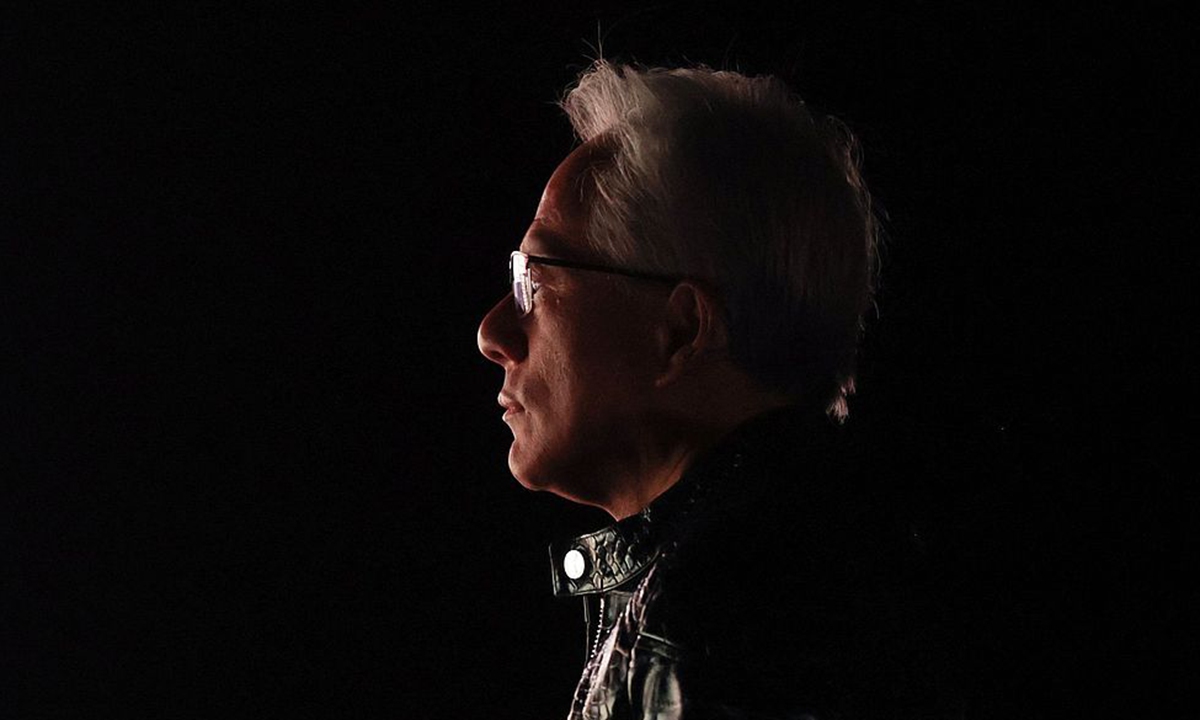
Nvidia's co-founder Jensen Huang Photo: VCG
Jensen Huang, one of the most prominent figures in the global AI boom, has resigned. The immediate trigger, as presented in public, was a series of reports about his private life. But from the initial reports in the New York Times to the intense coverage across US media, the controversy has become about far more than a personal matter.Huang's affair was framed from the outset as a matter of US national security. Senate Minority Leader Chuck Schumer wrote in an X post, "Despite Jensen Huang's resignation, Congress must demand answers from Mr. Huang and others at Nvidia about how they may have put U.S. national security at risk."
This is a pattern worth watching closely amid the current US climate of technological competition with China. First, an individual case is used to ignite public debate; then the framework of "national security" is invoked to elevate it into an issue of systemic risk. In today's Washington, "national security" can sometimes be invoked without reference to a concrete, verifiable threat, becoming a narrative tool that can be applied to prominent ethnic Chinese professionals operating at the intersection of US-China tech competition.
The Huang case illustrates this pattern starkly: he lobbied for chip exports to China - a move that could be portrayed as potentially endangering national security; he reportedly had a personal relationship with a woman suspected by US intelligence of having ties to Chinese intelligence - another "potential national security concern;" and he wielded influence in Washington while maintaining business ties with China - again, grounds for raising "national security concerns."
The word "may" is the key. It allows suspicion to be cast without establishing that wrongdoing has occurred or reaching a verdict. In this climate, a combination of Chinese identity and political circumstances can be enough to turn a celebrated business leader into a perceived security risk.
The more accomplished and influential a person is, and the more centrally positioned they are between China and the US, the more vulnerable they may become to being singled out in the name of "national security."
More alarming is the way this is reinforced by a broader narrative that demonizes China. China is cast as a strategic competitor of the US, while "national security precautions" imposed on the entire Chinese community are being heightened to an unprecedented degree. "The Jensen Huang affair exposes corporate America's China problem" - read a headline by The Hill. But this problem was not created by China; it reflects a contradiction within the US itself.
On one hand, the US relies on the creativity and expertise of top Chinese talent; on the other, it increasingly treats them as potential security threats. It needs Nvidia's technology and global competitiveness, yet it does not want the company to make its own commercial decisions about the Chinese market. That is the real contradiction.
This contradiction will not stop with Jensen Huang alone. The next target could well be other tech entrepreneurs unwilling to fully align with Washington's political agenda - including those who might argue that the US should win by running faster rather than by tripping up its opponents. In the current US political environment, ordinary business logic has come to be seen as "politically incorrect." Entrepreneurs are being forced to fight on two fronts at once: the technology race in the global market, and political scrutiny in Washington. Many in Silicon Valley will probably have to weigh every decision carefully: asking not whether they have done anything wrong, but whether their business decisions involving China and the US might one day be recast as "national security risks."
Today Jensen Huang, tomorrow who? Perhaps Washington is already looking for the answer.
