Xi to attend APEC Economic Leaders' Meeting, related events in Shenzhen
25-year relay from Shanghai and Beijing to Shenzhen highlights China’s shift toward providing solutions and anchoring Asia-Pacific integration: analysts
By Sun Langchen and Published: Nov 14, 2026 01:00 AM

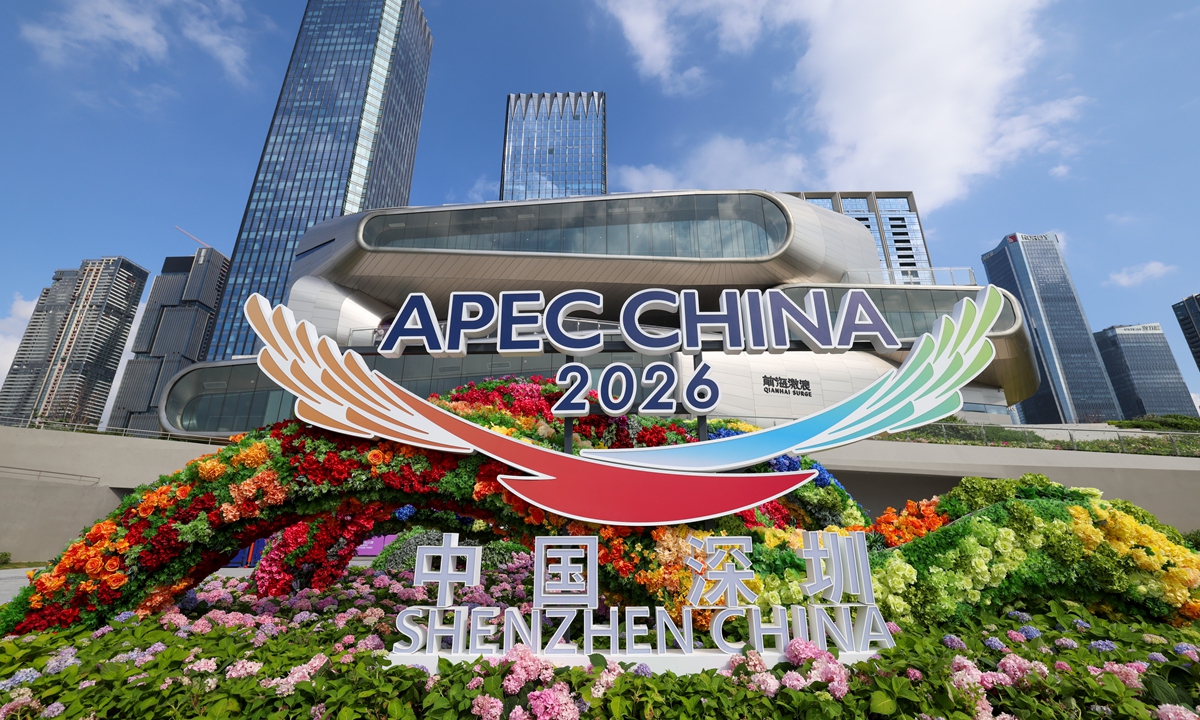
The APEC "China Year" logo decoration is seen at Qianhai Stone Park in Shenzhen. China will hold the 33rd APEC Economic Leaders' Meeting in Shenzhen from November 18 to 19, 2026. Photo: Xinhua
The 33rd APEC Economic Leaders' Meeting will be held in Shenzhen from November 18 to 19 under the theme "Building an Asia-Pacific Community to Prosper Together." President Xi Jinping will chair the meeting and deliver remarks.
The APEC CEO Summit will be held in Shenzhen from November 17 to 18 under the theme "To Prosper and Win the Future Together." President Xi will attend the opening ceremony and deliver a keynote speech. President Xi will hold a welcome banquet for participating leaders and representatives, and hold bilateral meetings with foreign leaders on the sidelines of the meeting.
From the banks of Shanghai's Huangpu River in 2001 to the shores of Beijing's Yanqi Lake in 2014, and now to the coast of the South China Sea in Shenzhen, the three host cities string together a 25-year journey of mutual achievement between China and the Asia-Pacific.
As China takes the baton as APEC host for the third time after a 12-year interval, the country is expected to play a more pivotal and constructive role in rallying regional centripetal force, bringing much-needed certainty, and turning the blueprint of building an Asia-Pacific community into concrete action amid an increasingly turbulent global environment, scholars and attendees said.
"We look forward to working with all parties to adopt the Shenzhen Declaration at next week's APEC Economic Leaders' Meeting, and achieve practical outcomes in areas that are vital for both regional and global economic growth, such as trade, connectivity, digital economy, and artificial intelligence," Chinese Foreign Ministry spokesperson Mao Ning said on Friday, when asked about China's expectations for the key outcomes of the APEC summit.
From learning the rules to shaping the agenda
Looking back at China's three APEC host years reveals a clear evolutionary trajectory in China's role in the multilateral cooperation mechanism, from an active participant and a key initiator to now a provider of solutions to the defining challenges of our times, Liu Chenyang, director of the APEC Study Center at Nankai University, told the Global Times.
This three-city relay also marks China's transition from "integrating into the Asia-Pacific" to "actively shaping globalization to shouldering the responsibility of leading it," underscoring the country's growing and uniquely constructive role in Asia-Pacific cooperation, analysts noted.
When China hosted the APEC Economic Leaders' Meeting in Shanghai in 2001, the country was preparing to join the World Trade Organization (WTO), and APEC provided a platform for China to familiarize itself with international economic and trade rules. By the time Beijing hosted the meeting in 2014, the meeting helped bring the proposed Free Trade Area of the Asia-Pacific (FTAAP) back to the center of discussions, Liu said.
Now, as China prepares to host APEC for a third time, the meeting is taking shape against a markedly different regional and global economic landscape - characterized by rising unilateralism, trade protectionism, "small yard, high fence" decoupling attempts, supply chain fragmentation, and geopolitical turbulence.
The more turbulent the global landscape becomes, the more indispensable China's role is in providing platforms for high-level dialogue through its diplomacy as host and injecting much-needed certainty into the Asia-Pacific, analysts said, while predicting that the meeting will put greater emphasis on advancing a shared vision for the Asia-Pacific's future.
As the highest-level, broadest, and most influential economic cooperation mechanism in the Asia-Pacific, APEC carries forward the momentum of regional integration. The mechanism itself has also arrived at a significant juncture for institutional development.
The 2020 Putrajaya Vision set out the goal of building an open, dynamic, resilient and peaceful Asia-Pacific community by 2040. The 2021 Aotearoa Plan of Action then established a framework for collective progress reviews at five-year intervals.
This makes 2026 an important moment to assess how far the 21 members - accounting for about 62 percent of global GDP and roughly half of global trade - have moved from broad commitments toward concrete action against protectionism and uncertainty over global supply chains, Yang Jiemian, chairman of the Academic Affairs Council of the Shanghai Institutes for International Studies, told the Global Times.
The Shenzhen meeting is not only a major institutional milestone for the mid-term review of the Putrajaya Vision, but also an opportunity to connect China's domestic reform and opening-up agenda with regional cooperation, Yang said.
Navigating headwinds with 'Chinese solutions'
The 33rd APEC Economic Leaders' Meeting has set three priorities, namely openness, innovation, and cooperation. This year's APEC CEO Summit will also feature discussions on a range of topics, including the development of the Free Trade Area of the Asia-Pacific, artificial intelligence, the digital economy, the development of the Guangdong-Hong Kong-Macao Greater Bay Area, and sustainable development.
Those settings directly address the pressing question of where Asia-Pacific development should be heading, and how to revitalize the region's economies and bridge development gaps.
Leaders across the 21 APEC economies are bringing pragmatic expectations to Shenzhen, with bilateral and multilateral interactions among major powers also being closely watched as an opportunity to foster a new model of major-country relations.
Canadian Prime Minister Mark Carney has said that the advantage of these meetings is that participants are free to raise issues "directly and frankly," according to a Reuters report. Australian Prime Minister Anthony Albanese called for stable regional trade and cooperation on emerging technologies, including AI.
Meanwhile, New Zealand Prime Minister Christopher Luxon underscored practical steps to make trade easier and less costly.
Analysts said that in a cautious global climate, a high-level, broadly representative dialogue hosted by China provides essential certainty—helping member economies calibrate their judgments, reduce miscalculations, and demonstrate a shared willingness to tackle challenges through cooperation rather than fragmentation.
Jayant Menon, visiting senior fellow at ISEAS under the Yusof Ishak Institute, said that preserving a rules-based multilateral trading system should be a central message of the meeting.
"The key message that should come out of the APEC meeting, from both ASEAN and China, is that a rules-based multilateral trading system must be preserved at all costs," Menon told the Global Times.
Despite the complexity of the regional landscape, practical interests continue to bring economies to the APEC table. Political and security differences have not disappeared, but trade, investment, technology and economic resilience remain areas where cooperation is widely sought, Lü Xiang, research fellow at the Chinese Academy of Social Sciences, told the Global Times.
He stressed that Shenzhen offers more than a venue for diplomatic discussions. Its development provides a concrete example of how openness, industrial upgrading and innovation can reinforce one another, as China seeks to turn its vision of an Asia-Pacific community into action, Lü said.
Enrique Dussel Peters, a professor at the National Autonomous University of Mexico, suggested that a global value chain perspective could offer a more practical way forward, allowing economies to deepen cooperation in areas such as auto parts, automobiles, electronics, telecommunications and agriculture through trade, foreign direct investment and research and development.
"China can and will play a critical role," Dussel Peters told the Global Times. He noted that China had become an increasingly significant partner for APEC economies across a wide range of fields, including culture, education, science and technology, trade and investment.
In the first three quarters of 2026, China's trade with other APEC economies reached 24.07 trillion yuan ($3.6 trillion), surging 23.9 percent year-on-year and accounting for 60.3 percent of China's total foreign trade.
RELATED ARTICLES