Ocean Field Notes: Jiaolong completes 17 Pacific dives as China’s DY100 ocean expedition prepares for Cook Islands survey
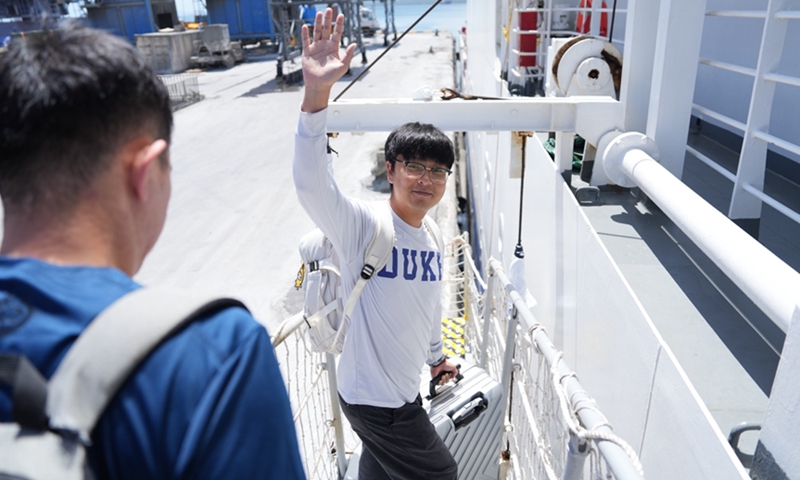
Tang Jingrong, a researcher who took part in the second leg of China’s DY100 scientific expedition, waves goodbye as he walks down the gangway of the Chinese research vessel Deep Sea No.1 in Suva, Fiji, on November 13, 2026. Photo: Feng Fan/Global Times
China's manned submersible Jiaolong completed 17 dives in the Pacific, including its first in the South Pacific, during Phase A of the second leg of China's DY100 scientific expedition. The phase ended on Friday, with 23 scientists beginning their journey home.
A new team of 22 researchers, including five scientists from the Cook Islands, will join the research vessel Deep Sea No.1 for Phase B. After taking on supplies in Fiji, the ship is expected to sail for the Cook Islands on Saturday for a joint survey to establish a baseline for the islands' seabed environment.
Jiaolong pilot Zhang Yi told the Global Times that the dives combined sea trials of the upgraded submersible at depths of around 7,000 meters with surveys of representative deep-sea habitats. Jiaolong logged more than 140 hours underwater, and the team carried out 34 tests across 11 categories on the vehicle and the equipment it carried.
Most of the dives took Jiaolong below 4,500 meters, giving it the greatest average dive depth of any expedition leg in recent years, Zhang said. It completed two dives deeper than 7,000 meters without any equipment failure.
"Jiaolong's performance showed what the submersible can do underwater after the upgrades with Chinese-made components, and how reliably the equipment runs," Zhang said. "Making one deep dive after another also gave our operations and maintenance team valuable experience."
While Jiaolong worked at depth, researchers aboard Deep Sea No.1 mapped the seabed with multibeam sonar, measured conductivity, temperature and depth, and collected samples using a box corer and trawl nets. Tang Jingrong, who led survey operations and took part in two manned dives, told the Global Times that the team worked through difficult sea conditions on a tight schedule to keep the instruments running and ensure the quality of the data and samples.
"It's a privilege to work at sea and gather firsthand data for China's deep-sea research," Tang said. "Once we're ashore, we'll get straight to organizing the data and analyzing the samples so we can make the most of what we've collected."
The full second leg is scheduled to last 91 days and involves 88 participants from 25 Chinese institutions and three overseas institutions. The China Deep Ocean Affairs Administration coordinates the expedition's second leg and the National Deep Sea Center organizes the work, with technical support from several institutions, including the First, Second and Third Institutes of Oceanography under China's Ministry of Natural Resources.
The surveys contribute to the Digital Deep-sea Typical Habitats (Digital DEPTH) program. By combining Jiaolong's seabed observations with water samples and plankton collected near the surface, researchers aim to fill gaps in ecological data for the high seas of the South Pacific. They will use the findings to map ecosystems in the water column and habitats on the seabed, and to assess their conservation value.
Before the ship reached port, Zhang said she was glad to be heading home after completing the team's assignment. Her thoughts were already with the incoming crew. "Jiaolong has a busy schedule ahead, and my colleagues are already on their way to take over," she said. "I hope every dive goes smoothly and safely."
