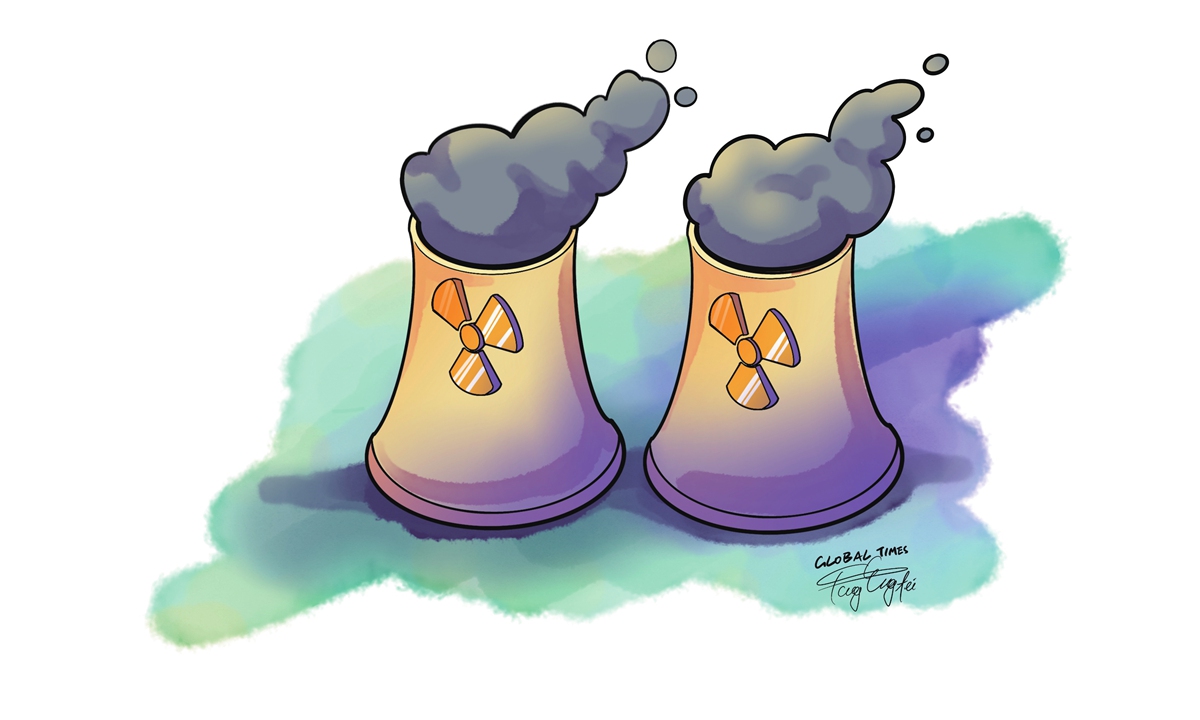
Illustration: Tang Tengfei/Global Times
Japan recently signed a memorandum of understanding (MOU) on nuclear energy cooperation with Vietnam, under which Tokyo plans to export small modular reactors (SMRs), along with Japanese technology, personnel training and financial support. The aim is to assist Vietnam to bring the nuclear project into operation after 2040.
If the plan goes ahead, Vietnam will become the first Southeast Asian country to adopt Japanese nuclear technology, marking a breakthrough in Tokyo's push into the region's nuclear power market.
This is not Japan's first attempt to secure a foothold in Vietnam's nuclear power market. In 2010, Japan was selected to build the Ninh Thuan-II nuclear power plant, with two reactors totaling about 2 million kilowatts in capacity. The project was not canceled after the 2011 Fukushima nuclear disaster, but made little progress beyond a feasibility study completed by the Japan Atomic Power Company in 2013.
In November 2016, Vietnam's National Assembly scrapped it, citing changing economic conditions and shifting investment priorities. When Vietnam revived nuclear power program in 2024, Japan was again among the potential partners. But Tokyo decided to withdraw in November 2025, citing a construction schedule that would see the work begin no earlier than 2036, potentially slipping to around 2040. That was incompatible with Vietnam's requirement to have the plant operational before 2035.
Having failed to secure the large-scale Ninh Thuan project, Japan is now turning to SMRs in a renewed bid to gain ground in Vietnam. But the current push is about more than nuclear power. Behind it lie Tokyo's long-term calculations over Southeast Asia's energy landscape and geopolitical balance. Japan has at least three calculations in mind.
The first is keeping its nuclear industry alive. Japan's nuclear power sector has struggled since Fukushima disaster. Of its 33 operable reactors, only 15 have resumed commercial operations, while the commissioning dates of three reactors under construction remain uncertain. The shrinking domestic market threatens the survival of its nuclear supply chain, its research team, and its skilled workforce.
In April, Japan's Ministry of Economy, Trade and Industry released a roadmap for developing next-generation reactors, identifying overseas market expansion as a key priority. The government has mobilized about 400 companies across the nuclear supply chain, backed by policy support and resources. After all, exporting nuclear technology is Tokyo's way of keeping its shrinking domestic industry afloat. Overseas orders could help it retain research team and keep its supply chain running.
The second is geopolitical consideration. In Japan's Indo-Pacific strategy, Vietnam has long been a key partner for deepening its presence in Southeast Asia and counterbalancing the influence of other major powers. During talks with visiting Vietnamese leader in Tokyo on November 9, Japanese Prime Minister Sanae Takaichi repeatedly promoted her "Free and Open Indo-Pacific" vision, calling for joint efforts to address "regional challenges." And, she proposed providing Vietnam with equipment under Japan's Official Security Assistance framework.
Nuclear cooperation fits clearly into Japan's geopolitical agenda. Tokyo's calculation is clear: By embedding itself throughout Vietnam's nuclear power development, Japan could gain greater bargaining leverage to pressure Hanoi into aligning with its security priorities and leaning toward Tokyo in the wider competition in the region.
The third is access to critical minerals. Vietnam ranks among the world's leading countries in rare-earth reserves, while securing critical mineral supply has become a pressing priority for Japan. At the same summit in Tokyo, Japan sought to capitalize on Vietnam's energy concerns by pushing for deeper cooperation on rare earths and other critical minerals.
Put simply, Japan is dangling a nuclear power promise that may not materialize until after 2040, while seeking an immediate foothold in Vietnam's rare-earths market.
But turning the Japan-Vietnam nuclear MOU into reality will require answers to two hard questions.
The first is the reliability of Japanese nuclear power technology and who would bear responsibility in the event of an accident. Fukushima was one of the worst nuclear disasters in modern history, dealing a severe blow to Japan's nuclear safety reputation.
Yet in handling the nuclear-contaminated water from Fukushima, Tokyo brushed aside concerns from the international community and neighboring countries, choosing the cheapest of all disposal options: releasing the water into the sea. Since the discharge began in August 2023, more than 180,000 tons of nuclear-contaminated water has been released. Yet the volume remaining in its storage tanks has fallen by only about 8 percent, while new contaminated water continues to accumulate.
Japan has yet to fully resolve the risks created by its nuclear disaster, and its approach to contaminated water appears to put cost ahead of ecological safety. People, especially the Vietnamese public, have every reason to ask: If a Japanese-supplied reactor were to suffer an accident in Vietnam, how would Japan take the responsibility and cope with the risks? A bow and an apology would hardly be enough.
The second concerns the credibility of Japan's nuclear commitments and the risks of nuclear proliferation.
Japan has long presented the peaceful use of nuclear energy as the basis for its international nuclear cooperation. Yet it is the only non-nuclear-weapon state under the Treaty on the Non-Proliferation of Nuclear Weapons (NPT) with commercial nuclear fuel reprocessing capabilities, the ability to extract weapons-grade plutonium, and an operable reprocessing facility. Its stockpile of nuclear materials far exceeds civilian needs.
Former Japanese Prime Minister Yukio Hatoyama wrote in a book that one of Japan's aims in building nuclear power plants was to retain tech capability to manufacture nuclear weapons. Meanwhile, the Takaichi administration is pushing to use the planned revision of Japan's National Security Strategy by the end of the year as an opportunity to discuss easing the country's Three Non-Nuclear Principles. The issue of nuclear-powered submarines has also been brought into the discussion.
If the very political foundation of Japan's commitment to the "peaceful use of nuclear energy" is to suit its changing strategic priorities, how much weight can the promises in a nuclear cooperation memorandum carry? This is a question that warrants serious vigilance.
The author is an associate professor in the Department of International Politics at the University of International Relations in Beijing. bizopinion@
globaltimes.com.cn