ARTS / CULTURE & LEISURE
Young entrepreneurs revive traditional crafts, from village looms to modern life
A living thread
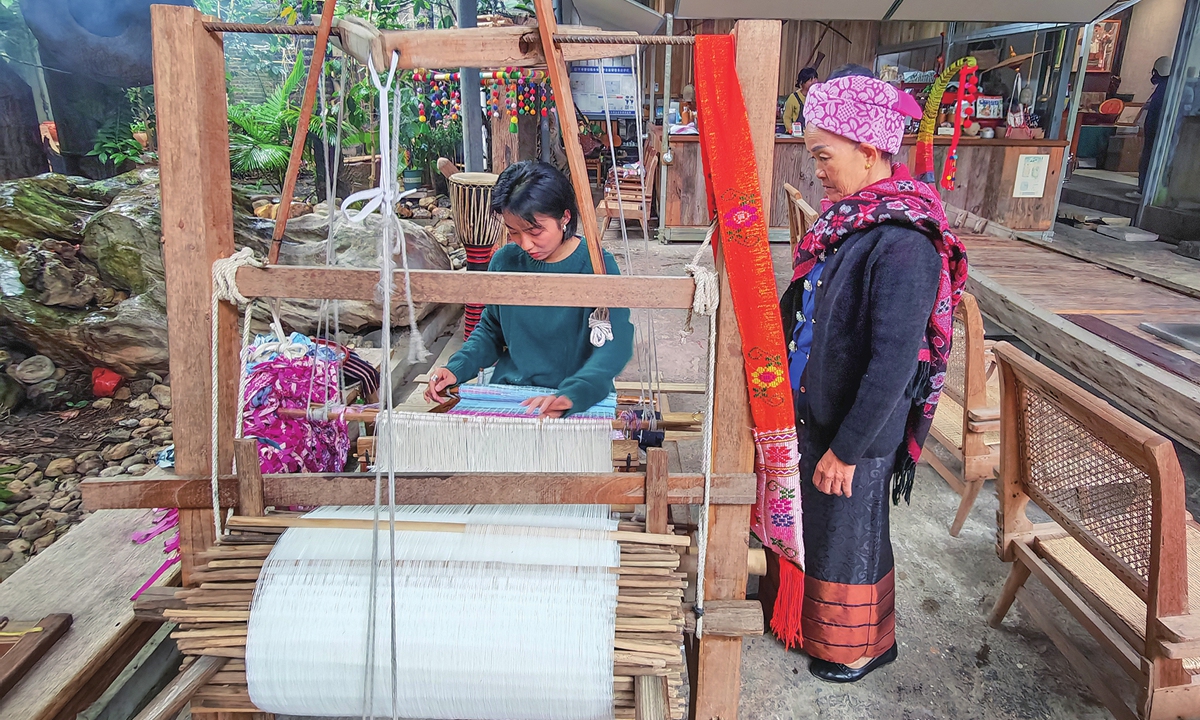
Young designer Yang Yue (left) works with a local artisan in Mangshi, Southwest China's Yunnan Province, to make handicrafts using traditional Dai weaving techniques. Photo: Courtesy of Wubenliving
Whenever Yang Yue, a young designer from Mangshi in Southwest China's Yunnan Province, is given a traditional Dai woven belt, the maker often recalls a time when everyone in the community wore them. Some women wove their own belts; others received them as part of their wedding dowries.
For Yang, these stories also reflect the gradual disappearance of traditional Dai textiles from everyday life. Once used by local families for clothes, bedding and wedding items, the homespun fabrics have become increasingly rare as machine-made textiles and changing clothing habits have displaced them.After studying architectural design in the UK, the then 26-year-old Yang returned to her hometown and began visiting villages in the province's Dehong Dai and Jingpo autonomous prefecture. She collected old textiles, learned traditional weaving techniques and explored ways to turn them into everyday products such as handbags, laptop bags and sachets, hoping to bring these fabrics back into the lives of younger generations.
"We don't want the crafts in local villages to be confined to display cases, where people can only admire them from a distance. We want them to become part of everyday life, appearing on dining tables, at tea gatherings and in people's travel bags," Yang told the Global Times.
Preserving heritage
Yang recalled often seeing traditional ethnic buildings in her hometown demolished amid urban development when she was a child, sparking her interest in protecting local cultural heritage. As an adult, she studied architectural design and later went to the UK to explore new ways of preserving traditional culture.
Through exhibitions, academic forums and visits to heritage projects in the UK, Yang learned about different approaches to protecting traditional architecture and handicrafts.
"During that time, I gradually realized that heritage protection is not just about preserving historic sites. It is also about allowing traditional culture to remain part of modern life," she said. The experience gave her ideas for developing new designs based on traditional textiles.
Back in Yunnan, Yang began to learn to weave from a local inheritor of Dai brocade. She studied the process step by step, from spinning and sizing yarn with rice water to arranging warp threads. She also asked her teacher about the meanings of different patterns and how they were traditionally used.
"I may never become a professional weaver, but I need to learn the craft myself and understand how each step is done and what different patterns mean. Only then can I retain the characteristics of traditional craftsmanship when designing products," Yang told the Global Times.
After gaining a better understanding of the weaving techniques and patterns, Yang founded her own cultural and creative brand, Wubenliving, and began exploring ways to turn liezhibu, a traditional Dai woven textile, into everyday products such as handbags, laptop bags and sachets.
"The core idea is to make craftsmanship serve people's lives, rather than making people adapt their lives to the craft. That is a good way for a tradition to survive," she said. "The essential techniques of traditional crafts should not be changed arbitrarily, but product designs and uses can evolve with the times."
Orders for the new products also encouraged some local women to take up their looms again. In the past, they mainly wove cloth for household use or as gifts for relatives and friends. Now, they are producing textiles in response to product orders. Some weavers have also begun taking part in the design process, discussing colors, patterns and combinations with the team.
"Now they know that the cloth they make can be turned into products and sold, which gives them greater confidence," Yang said. "I hope that traditional weavers will become more than just people who carry out the weaving, and take a more active role in product design."
Entering everyday life
Similar efforts are under way in Kaili, Southwest China's Guizhou Province, where traditional crafts such as ethnic Miao embroidery and batik are reaching more consumers through product design, tourism experiences and online sales.
The Xiuli Tao intangible cultural heritage market in Guizhou has brought together more than 700 businesses, offering over 6,000 types of intangible cultural heritage products. The market has received more than 2 million visitors, generated 430 million yuan ($60 million) in comprehensive tourism revenue and created more than 4,300 jobs, according to the Guizhou Agricultural Economics Network.
Young entrepreneurs are also finding new ways to market traditional handicrafts. Pan Xiaohui, 26, returned to Kaili in 2022 and took over her mother's Miao embroidery company. Using digital design, online orders and livestream sales, she helped the company produce 28,000 embroidered items in 2025, generating 36 million yuan in output value and involving more than 6,000 embroiderers who took orders, according to the Guizhou Agricultural Economics Network. The company's products are also being exported to Russia, Canada and France.
Ye Xiaopeng, a Chinese master of arts and crafts, told the Global Times that preserving traditional handicrafts requires more than protecting existing techniques and finished works. It also means finding ways to bring traditional crafts into contemporary life and meet changing consumer needs.
"Design innovation should respect the techniques and cultural meanings behind traditional crafts, rather than treating traditional patterns as mere decorations," Ye said. He stressed that artisans should have a say in how their skills are used in new products and receive a fair share of the income. This, he said, would ensure that those who make the crafts also benefit from their renewed popularity.
"Ultimately, a traditional craft's future depends on the people who practice it. Only when artisans can earn a living from their skills and younger generations see a future in learning them, can the craft continue to develop and be passed on," he said.
RELATED ARTICLES