IN-DEPTH / IN-DEPTH
Five years after relocation, former villagers thrive in the smart communities of China’s ‘future city’ Xiong’an
People-centered urban devt in Xiong’an
By in Xiong’an Published: Nov 15, 2026 10:49 PM


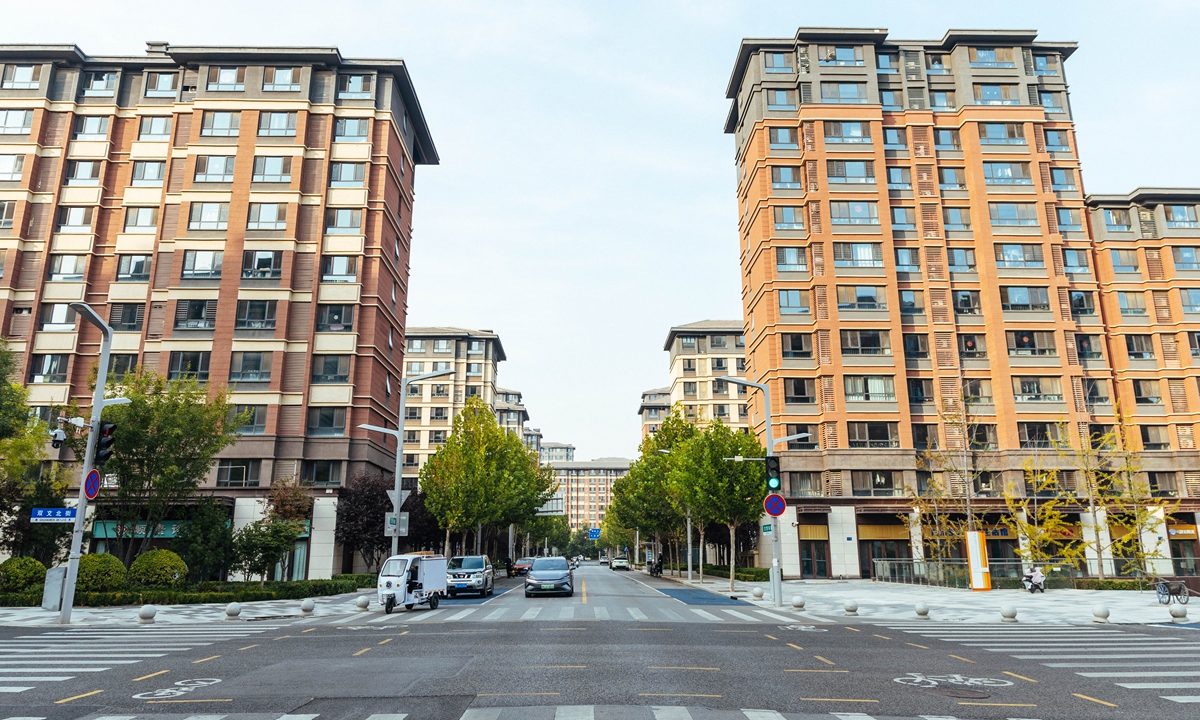
Street view of resettlement housing in Rongdong community, Xiong'an New Area Photo: Li Hao/Global Times
A high-speed rail journey from Beijing West Station takes barely an hour, carrying travelers roughly 100 kilometers southwest of the capital to Xiong'an New Area in North China's Hebei Province. Here lies Rongdong community, where the landscape is defined by rows of neat mid-rise residential buildings. There are no towering skyscrapers and no traffic jams. Instead, orderly buildings stand spaced generously apart amid patches of green and winding waterways. This is the first large-scale resettlement zone built for residents displaced by the city's construction.
Xiong'an New Area was officially established in April 2017, about 100 kilometers southwest of Beijing, designed to uphold primary functional positioning as the major recipient of functions relieved from Beijing that are non-essential to its role as China's capital. It is built into an innovation hub in the new era and a model of promoting high-quality development. In November 2021, the first batch of relocated residents moved in.
More than five years on, how are the local people who gave up their ancestral homes and farmland for Xiong'an's construction faring? How wide is the gulf between the narrative of "forced sacrifice" and "damaged interests" peddled by certain overseas rumors, and the lived reality unfolding on this land? The Global Times reporter walked into Nanwenying community, one of the first resettlement neighborhoods in Rongdong area of the city, to find out.
Street view of resettlement housing in Rongdong community, Xiong'an New Area Photo: Li Hao/Global Times
From 'villagers' to 'new residents'
When the Global Times reporter met Liu Binghui at the Nanwenying community, he had just returned from a volunteer patrol, still wearing his red vest. In his early 60s, Liu was an ordinary villager in Anxin county (Xiong'an encompasses Xiongxian, Rongcheng and Anxin counties) before relocation. He used to farm and take on odd jobs. Now he joins community volunteer activities every week or every 10 days - picking up cigarette butts, clearing rubbish and conducting night patrols. He spends three hours each time, without pay.
"People often ask me what I get out of it," he told the Global Times with a smile. "For me, it's about the companionship - a sense of participation and belonging."
Liu remembers the old days of the past community clearly: narrow roads, few buildings, a far trip to the town clinic for medical care, a long walk to buy groceries. Now, after resettlement, the community health station is downstairs. The community canteen is a few steps away. Bus rides are free for those over 60. What satisfies him most is the "15-minute living circle": his granddaughter's school, his wife's medical appointments, and his own walks in the park - all just a 15-minute walk away.
He lives in a six-member household; his children living far away were initially worried about their parents adjusting to new apartment life. After a few visits, they were confident that their parents had settled into the new environment. "They see it's convenient here, easy to see a doctor, even better than the village," Liu said.
Liu has heard accusations from some who smear the establishment of Xiong'an, claiming it has shortchanged relocated residents. "I've lived here for over four years. Do I not know whether my life has gotten better or worse?" he asked.
This plain and straightforward rebuttal carries more weight than any statistic. By the end of 2025, 169,000 relocated residents had moved into new homes in Xiong'an. Most of them, like Liu, have gone from clustered villages to orderly low-rise apartment communities.
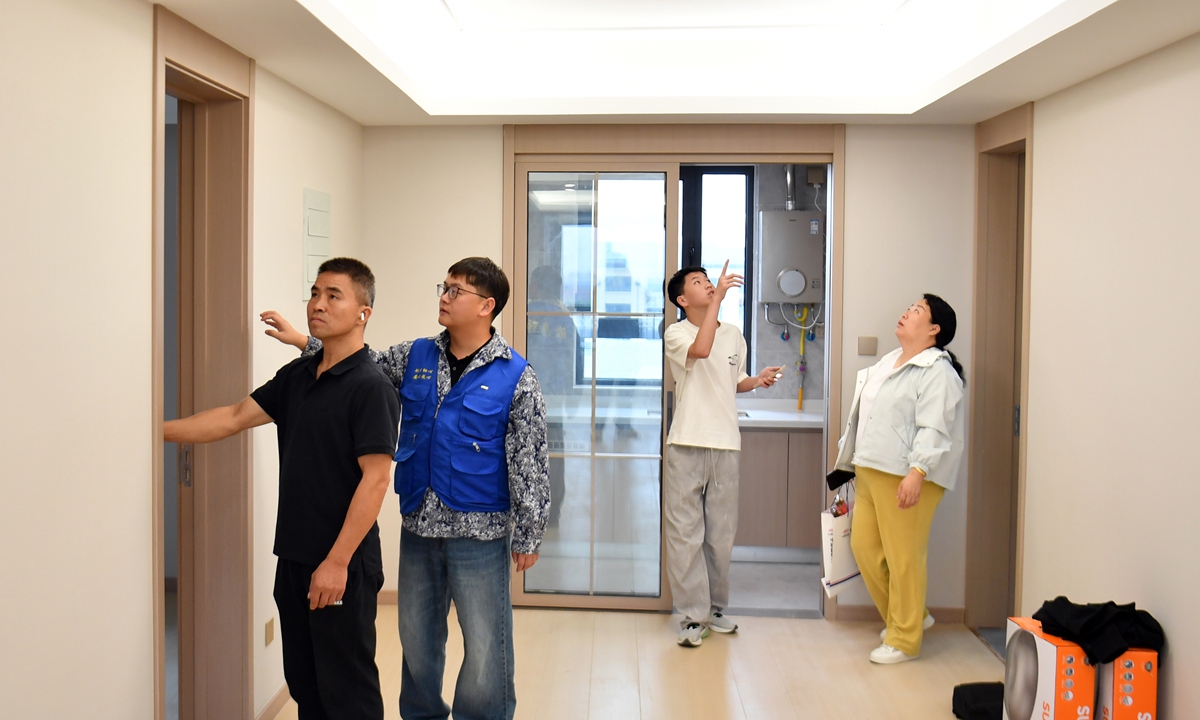
Returning residents inspect their new fully furnished apartments in Dahe, Xiong'an New Area, Hebei Province, on October 9, 2026. Photo: VCG
Small gestures foster familiarity and trustAt first, the resettlement process in Nanwenying was not smooth. Chen Churong, Party secretary of the Party committee of Nanwenying community, remembers the early days of 2021: each household typically received two or three apartments, which were allocated by lottery and scattered across different compounds. The community had no way of knowing who actually lived where. The buildings looked nearly identical, and even residents often got lost. Social workers knocking on doors during the day frequently found no one home.
"So, we counted lights at night," Chen said. "Whichever unit had its lights on meant someone was living there. The next day we'd go back and knock on that same door, to talk with them and introduce our services."
The bigger task, Chen told the Global Times, was helping residents get familiar with their new surroundings and the way a community office works. Many residents were new to this kind of community and were not yet in the habit of turning to it for help. The community began with small, practical matters: helping elderly residents adjust their televisions, booking hospital appointments online, coordinating apartment repairs and mediating noise disputes between neighbors. These were small gestures that gradually built familiarity and trust.
Social worker Tian Jia told the Global Times that cigarette butts were once scattered somewhere in the community, so staff began picking them up. Eventually, residents started putting on red vests and joining in. That was the beginning of Nanwenying's "cigarette butt revolution." The volunteer corps later expanded to night patrols, pairing volunteers with elderly residents living alone and clearing neglected corners. No pay, all voluntary.
During the interview, an elderly woman walked up and patted Tian on the arm warmly: "Haven't seen you in a while - what have you been up to?" That kind of familiarity cannot be faked.
Chen showed the system dashboard. Water and gas usage data scrolls in real time. When a meter in a unit suddenly starts running, it means someone has newly moved in - the community can then visit and register them, rather than waiting for residents to come forward.
For elderly residents living alone, water and gas data is analyzed every four hours. Prolonged inactivity triggers an automatic text alert to the assigned social worker. One resident in her 90s, with no children, only opens her door to the social worker who visits every day after work.
The system also tags 10 categories of residents, including veterans, elderly people living alone, vulnerable children, and people with disabilities. After each home visit, information is entered, enabling targeted assistance. Each social worker is responsible for 200 to 300 households, conducting regular visits, with all resident matters recorded in ledgers. Nanwenying's 73 ledgers correspond to its 73 buildings - one page per household, updated dynamically. Community workers call it their "living map."
The service station handles 48 high-frequency items - including medical insurance, social security, and business licenses - all in one place. On employment, the local community integrates policy briefings, regular job postings, job referrals and skills training to help residents improve their job prospects.
Chen told the Global Times that when the community was first established, residents would cross the street to avoid staff. Now, some invite social workers to their homes for a meal. Discipline prevents staff from accepting, but the invitation itself is the answer.
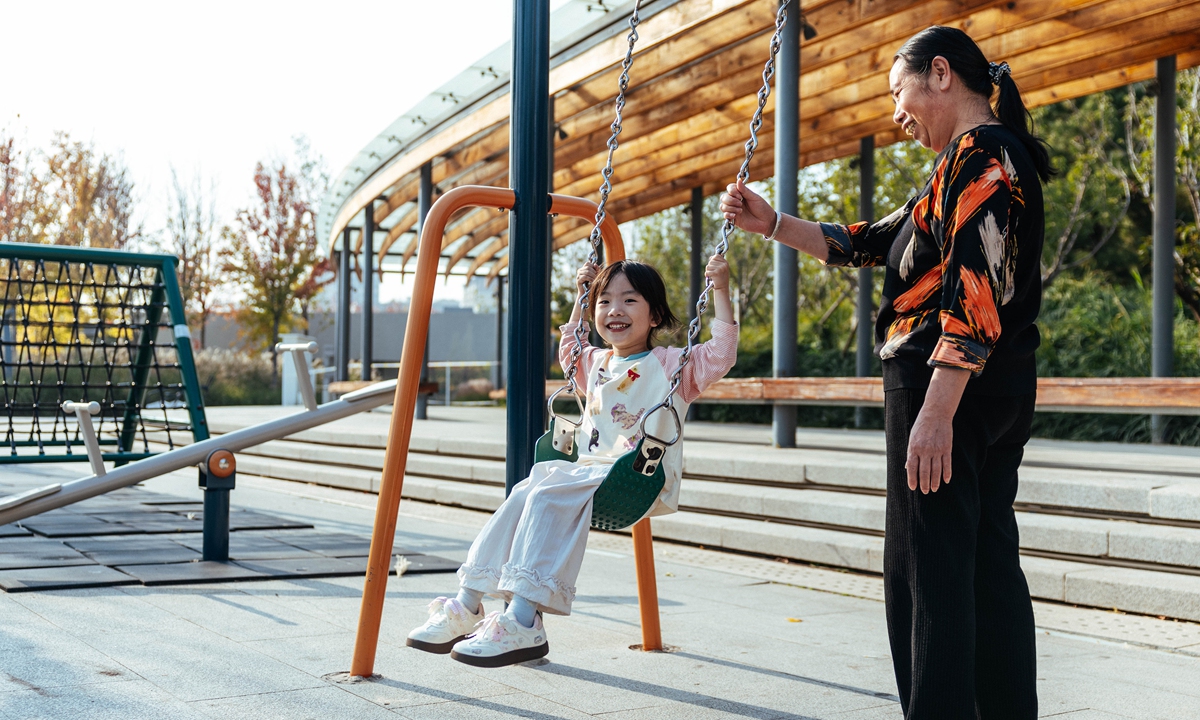
Residents relax in the park of Rongdong resettlement community on October 9, 2026. Photo: Li Hao/Global Times
Down-to-earth methods to collect concerns
A short walk from Nanwenying, in the Boyating compound of the Hexi community, the square was already bustling by late afternoon. A screen was set up, with tea dispensers steaming. Elderly residents sat together while children ran about. A popular film played on the screen, and nearby, community staff conducted blood pressure checks while skilled volunteers sharpened knives and repaired bicycles. This is Hexi's "big bowl tea cinema."
When the film ends, the tea bowls stay out. The "public sentiment tea gathering" begins. Residents speak up one by one: dim street lights, loose handrails, and a request for more chairs under the trees. Community staff note each item in a ledger.
According to the People's Daily, since 2025 the Rongdong area has promoted mechanisms such as "big bowl tea cinemas" and "heart-to-heart talks," using the most down-to-earth methods to gather the most genuine concerns.
Walking through Rongdong's streets, one finds no downtown bustle. If what you crave is the crowded, hectic energy of a mega-city, you will be disappointed.
But that is precisely how it was designed. Xiong'an's goal was never to build another congested super-city, but a place with generous living space, a good environment and no traffic jams. Rongdong's nearly 100 red-brick buildings are arranged in orderly rows, and building heights are strictly controlled at three tiers - 24, 36 and 45 meters - with no adjacent buildings allowed to cross tiers, giving the skyline an expansive, rhythmic quality.
Transport is more convenient than many expect. With the Beijing-Xiong'an intercity railway, Xiong'an has joined the capital's one-hour commuting circle. A direct high-speed rail service from Beijing to Baiyangdian station, launched earlier this year, puts the journey at just about an hour. A state-owned enterprise employee who has worked in Xiong'an for eight or nine years said he has watched the transport links mature step by step: "Beijing-Xiong'an integration is really taking shape."
Xiong'an's planning brought together more than 60 academicians and over 3,500 experts and technical personnel. That figure is often cited to demonstrate the city's "high starting point," according to the local government.
But what truly makes a city stand out is never the lines on a blueprint. It is the resident Liu Binghui's smile as he puts on his red vest, the familiarity of an elderly woman patting Tian Jia on the arm, and the tea gathering where someone writes down what you said.
What Xiong'an is doing, at its core, is answering a simple question: who is a city actually for? The answer lies not in the skyline but in the details - resident ledgers, tea-table talks, and water-meter checks on elderly residents living alone. What matters is that the small things people care about get written down and fixed. This is exactly the spirit behind the principle that cities are built by the people and for the people.
For other developing countries building new cities and resettling rural communities, Xiong'an's most useful lesson may not be its buildings, but this habit of taking ordinary people's concerns seriously.
RELATED ARTICLES