Global Governance Forum concludes in Xiong'an New Area; delegates explore how China's tech advances can contribute to global governance
By and Hu Jinyang in Xiong'an Published: Oct 25, 2026 09:12 PM

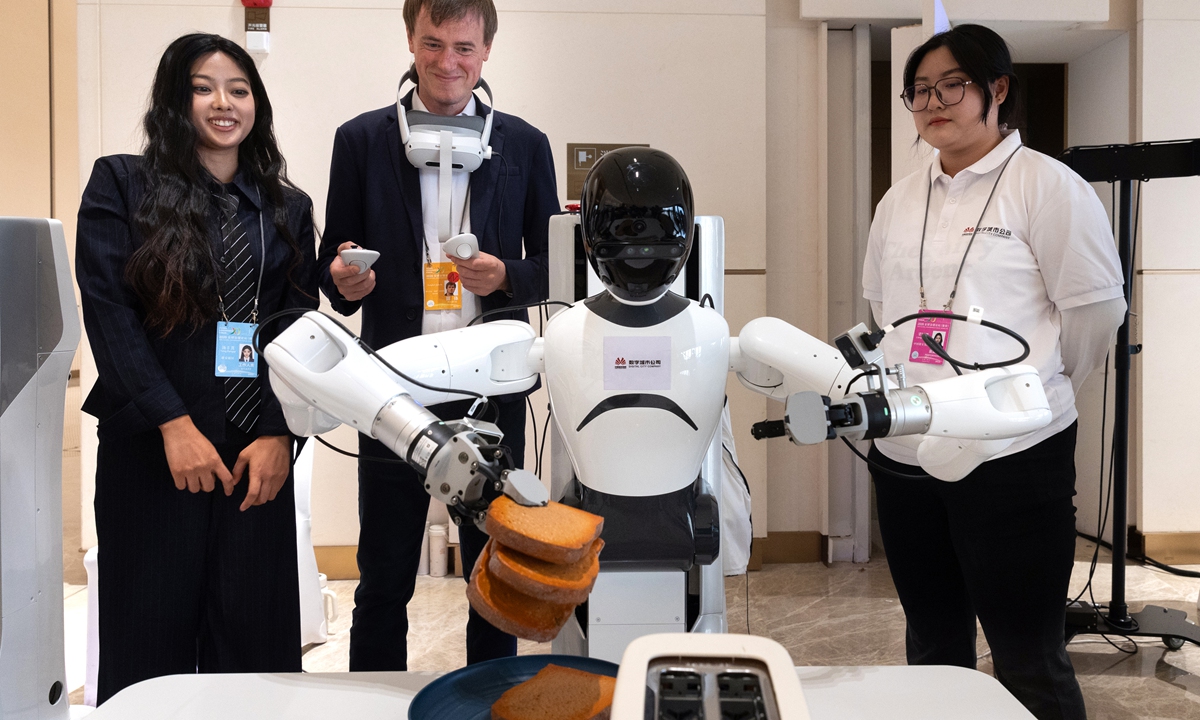
An attendee tests a robot during the 2026 Global Governance Forum (Xiong'an) in Xiong'an New Area, North China's Hebei Province, on October 23, 2026. Photo: VCG
The 2026 Global Governance Forum (Xiong'an), held from October 23 to 25, concluded on Sunday in Xiong'an New Area, North China's Hebei Province, with artificial intelligence (AI) emerging as a major topic of discussion among international participants, who explored how China's approach to AI development and governance could offer lessons for the wider world.
Under the theme "Rebuilding Confidence and Cooperation: Reforming and Improving Global Governance in a Transforming World," the forum brought together nearly 400 representatives from political, academic, strategic, business and youth sectors from more than 90 countries and international and regional organizations.
Wang Yi, a member of the Political Bureau of the Communist Party of China Central Committee and Chinese Foreign Minister, attended the opening ceremony and delivered a keynote speech.
Hosted by the Chinese People's Institute of Foreign Affairs (CPIFA), the forum provided a platform for participants to exchange ideas on reforming and improving global governance, with AI governance attracting particular attention.
Among the recurring keywords in the discussions were practical applications, safety, risks and equitable access. The Global Times observed particularly strong attendance and lively exchanges at AI-themed sessions, where participants raised questions ranging from how AI could be applied to public services and traditional industries to how countries could manage emerging security threats and prevent a widening digital divide.
Pan Jingyu, director of the China-SCO Countries AI Application Cooperation Center, told the Global Times that global AI governance is entering a critical period for jointly shaping rules, developing standards and building technological capacity.
China has reached a leading position in AI development, Pan said, noting that the emergence of highly competitive Chinese AI models has attracted widespread international attention. Their affordability, innovative open-source ecosystems and technological capabilities have challenged the dominance of a handful of global technology giants, offering Global South countries new possibilities for leapfrogging in digital development, Pan said.
Andrea Renda, director of research at the Centre for European Policy Studies (CEPS), believes China's approach to AI development could also offer useful lessons for Europe.
"China is a pioneer in artificial intelligence," Renda said, pointing to its focus on applying AI in specific industrial settings and public services, with an emphasis on people-centered applications that improve everyday life. He noted that this approach could be particularly relevant to the EU, where high energy costs and established industrial structures make it important to use AI to strengthen existing industries rather than simply replace them.
Speaking to the Global Times about his first visit to Xiong'an, Renda said he had studied the city's development model since the project was launched. He suggested that Xiong'an's experience could offer a blueprint for more sustainable global AI governance, with AI treated as a means to improve people's lives rather than an end in itself. However, he stressed that such a model should ensure local control over data and allow communities to benefit from the value created through technological development.
Describing Europe as the "old continent," Renda noted that European cities cannot simply be rebuilt from scratch as Xiong'an has been. Nevertheless, he said the new area offers valuable lessons in energy management, AI, data governance, urban green spaces and the government's role in fostering innovation, which could help European cities find new ways to develop.
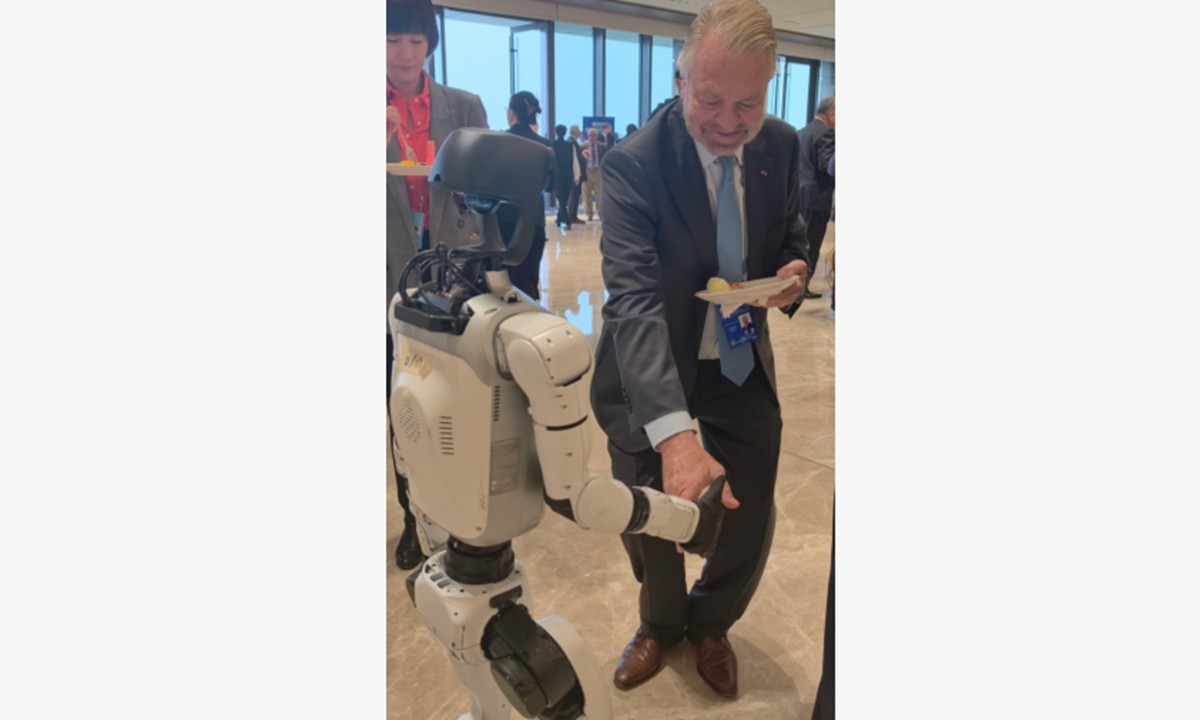
A foreign guest shakes hands with a robot at the Global Governance Forum in Xiong'an New Area, North China's Hebei Province, on October 24, 2026. Photo: Hu Yuwei/Global Times
While many participants saw opportunities in AI-driven development, others at the forum warned that unequal access to technology and growing security risks could undermine its benefits.
Lyu Deqiang, president of the Singapore chapter of the Global Responsible AI Council, said the widening AI divide between countries makes fairness in global governance an increasingly urgent issue.
He told the media that global AI governance is currently shaped largely by major powers and economies, including China, the US and the EU. Dialogues such as the forum were particularly meaningful because they gave smaller and medium-sized countries, along with other stakeholders, opportunities to voice their concerns and share perspectives.
Pan also warned that AI security threats are evolving in two directions as the technology advances rapidly. On one hand, the weaponization of large language models and the use of AI in cyberattacks and defense are lowering the barriers to launching attacks. On the other, AI-specific threats, including prompt injection, model poisoning and unauthorized actions by AI agents, are becoming increasingly prominent.
These challenges, he said, highlight the need for stronger international coordination on AI governance.
Beyond discussions at the forum, Xiong'an itself offered international participants a firsthand look at how digital technologies can be integrated into urban governance.
Some foreign guests visited Xiong'an's digital infrastructure facilities, learning about the city's cloud computing infrastructure and its concept of "three cities in one" — above ground, underground and in the cloud.
The city's use of cloud-based data systems in public services also drew interest. During the forum, participants discussed how community-level data could help improve neighborhood management and provide more targeted services for elderly residents and people with disabilities.
Some foreign visitors told the Global Times that it was their first time encountering the concept of three interconnected cities, describing it as a striking example of how innovative urban planning and digital infrastructure could be integrated into a city established only nine years ago.
Jorge Agudero, a writer and scholar from Spain, told the Global Times that China's achievement in building Xiong'an into a technologically advanced, green and innovative "city of the future" in just over nine years was difficult for many foreigners to imagine.
RELATED ARTICLES