'We'll see more DeepSeek moments,' foreign industry representative touts China's AI push
Annual CDF forum sheds light on technological development and innovation pathways
By and Tao Mingyang Published: Mar 23, 2026 09:02 PM

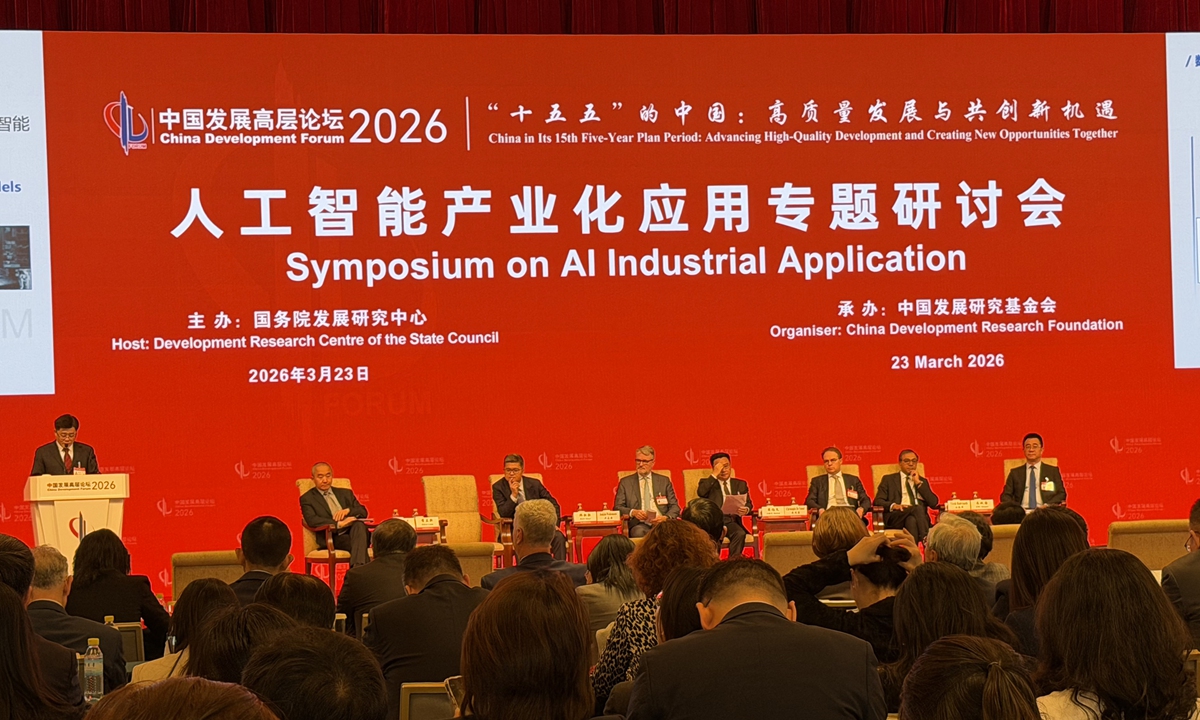
Representatives from home and abroad attend the Symposium on AI Industrial Application at the China Development Forum (CDF) 2026 in Beijing on March 23, 2026. Photo: Chen Qingqing/GT
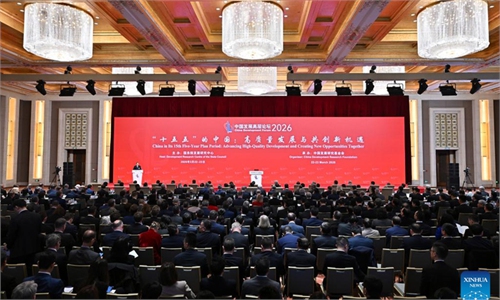
From DeepSeek to Seedance 2.0 to OpenClaw, China's intensified push in artificial intelligence (AI) not only gained global attention, but also has become a major focus of heated discussions at the ongoing China Development Forum (CDF) 2026 that run from Sunday to Monday in Beijing.
"I would assume that we will see more DeepSeek moments," Denis Depoux, global managing director at Germany's strategy consulting firm Roland Berger, told the Global Times on the sidelines of the forum.
The AI development in China is very vibrant, and there are many models competing with each other and "pretty much every month of something new," Depoux said. He also believed that the AI development is about applications and it's expected to see more use cases across various industries.
The Global Times found that China's innovation and AI development took center stage at this year's forum, with two panels dedicated to application and governance.
Apple CEO Tim Cook who had presented at the forum praised the innovations of Chinese developers and the automation at the country's manufacturing facilities, US media outlet Fortune reported on Sunday.
Alibaba chairman Joe Tsai also said during the CDF that China's recent AI progress has been supported by heavy investment in the power grid, a commitment to open-source models, and the country's manufacturing supply chain, Singapore- and Jakarta-based technology news website Tech in Asia reported.
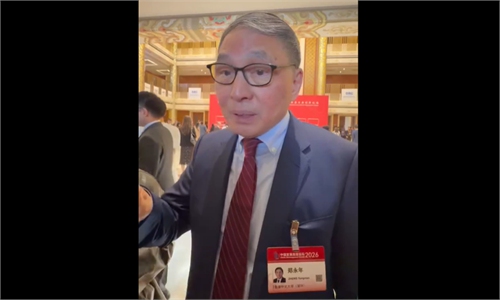
In an interview with the Global Times on the sidelines of the forum, Zheng Yongnian, dean of the School of Public Policy at the Chinese University of Hong Kong, noted that, from a global perspective, AI is currently highly concentrated in China and the US in terms of technology, scale, and output.
Economies such as Europe and Japan may see development in certain niche areas in the future, but when it comes to systemic integration capabilities, the truly competitive players are likely to remain China and the US, he said.
As for what exactly China and the US are competing over, Zheng suggested it is more useful to understand it from the perspective of the "division of labor," since AI cannot exist without application scenarios. The US' strength lies in original, "0 to 1" fundamental research, such as breakthroughs in core AI technologies, while China's advantage, by contrast, lies in its rich and extensive application scenarios which are significantly stronger than those in the US, he noted.
Some US attendees to the forum said they are amazed by the rapid development of China's AI technology.
There has been huge enthusiasm for AI in China across generations, from the young to the elderly, Adam Tooze, a professor at Columbia University, told the Global Times.
"It's clearly a driver of productivity," Depoux told the Global Times. "I think what the world needs is growth and growth comes out of productivity or out of being able to produce whatever you produce more with fewer resources. And that's where AI is a key driver."
Driven by technological innovation and commercial applications, the scale of AI industry continues to expand in China. It is estimated that by the end of the 15th Five-Year Plan (2026-30) period, the size of China's AI-related industries will exceed 10 trillion yuan (about $1.45 trillion), opening up even broader growth prospects, Liu Liehong, a member of the Communist Party of China Leadership Group of the National Development and Reform Commission and head of the National Data Administration (NDA) told at a panel discussion of the forum on Monday.
As AI evolves from general-purpose foundation models to more specialized industry-specific models, its integration with the real economy is becoming increasingly deep, Liu said.
"High-quality, domain-specific datasets are gradually replacing general corpora as the key factor determining how effectively models can be deployed in practice. Only by promoting the deep integration of AI across all sectors can technological potential be transformed into real drivers of development," he added.
RELATED ARTICLES