Global CEOs gather in Beijing for China Development Forum, eyeing China for opportunity and certainty in time of turbulence
By and Tao Mingyang Published: Mar 22, 2026 11:20 PM

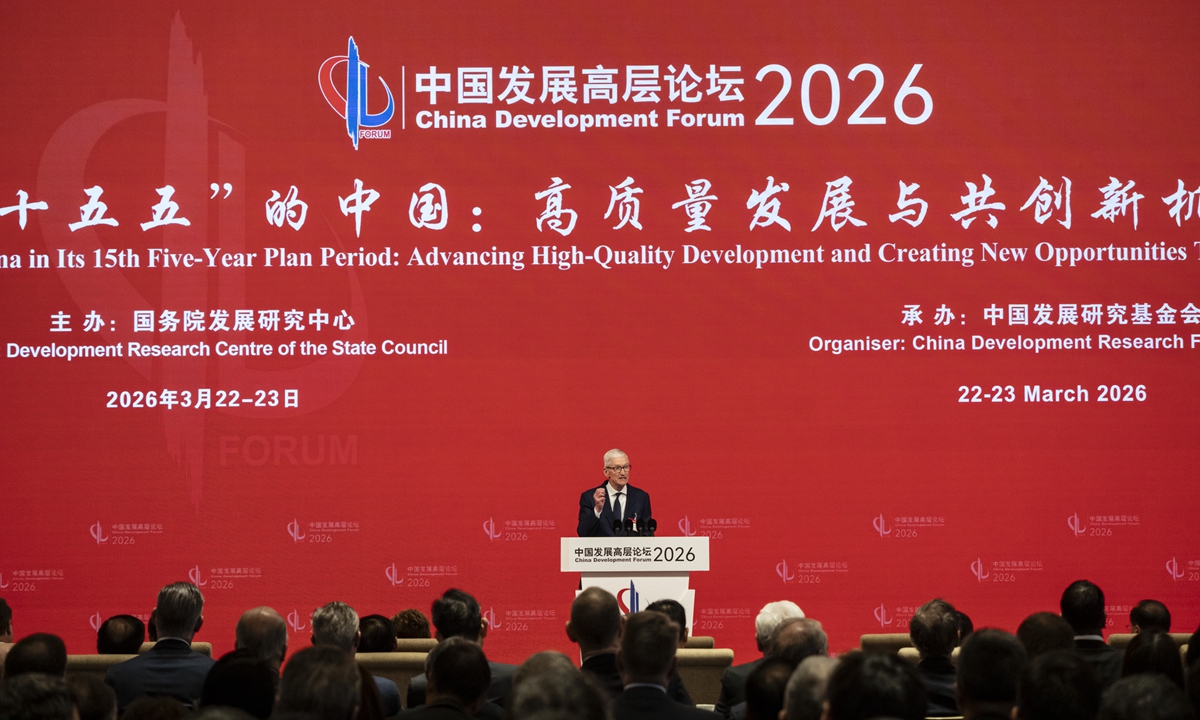
Apple CEO Tim Cook speaks at the China Development Forum 2026 in Beijing on March 22, 2026. Photo: VCG
As US and Israeli strikes against Iran rattle financial markets and send oil prices surging, over 80 leaders of the world's largest multinational corporations, including Apple CEO Tim Cook, Volkswagen Group CEO Oliver Blume, Mercedes-Benz CEO Ola Källenius and Samsung Electronics chairman Lee Jae-yong, convened in Beijing on Sunday for the China Development Forum.
The sheer density of corporate heavyweights in one room sends a clear message - as global economy feels on edge, the world's executives are increasingly looking to China to serve as a crucial anchor of predictability and certainty, analysts said.
Chinese Premier Li Qiang attended the opening ceremony of the CDF 2026 in Beijing on Sunday and delivered a keynote speech, the Xinhua News Agency reported.
Chinese Premier stressed creating new market opportunities through openness and technological progress, and upholding global market order through healthy and fair competition.
He also said high-quality development and stable economic growth of China will continue to provide development opportunities for the world.
Unilateralism and protectionism are running rampant, while forces advocating cooperation and promoting development continue to grow stronger; economic growth in traditional sectors faces difficulties, while development in emerging fields is gaining momentum; the international rules-based order suffers severe damage and disruption, while many countries actively advance reforms and improvements to global governance; power politics prevails with arbitrary and reckless conduct, while calls for upholding fairness and justice grow ever louder, Li said.
China will continue to safeguard a fair and orderly market environment, strengthen communication and collaboration with all parties, and jointly promote the stability and security of global industrial and supply chains, he added.
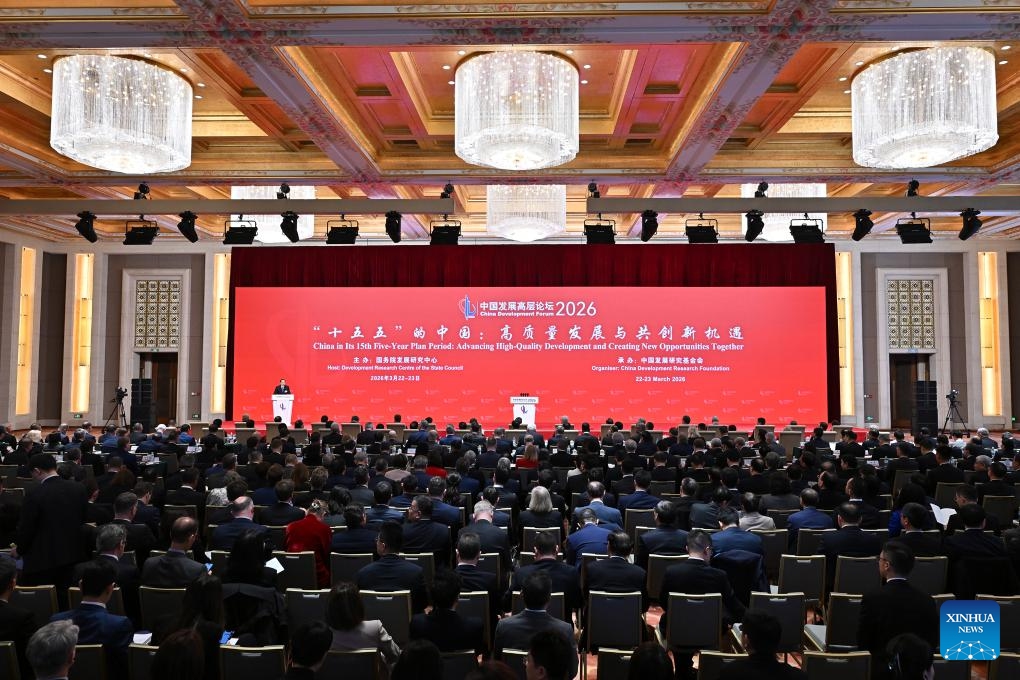
Participants attend the China Development Forum 2026 in Beijing, capital of China, March 22, 2026. The China Development Forum 2026 kicked off in Beijing on Sunday. The theme of this year's forum is "China in Its 15th Five-Year Plan Period: Advancing High-Quality Development and Creating New Opportunities Together." (Photo: Xinhua)
Key platform
A number of representatives from multinational companies and scholars said they were impressed by the stability that China represents, and some also highlighted China's appeal as the dynamic innovation landscape that continues to contribute to global economic growth.
"China is one of the few countries with a clear plan, and as one of the largest economies in the world, it is important for the world to know China's growth rate for the next five years, the objectives, and how the domestic economy will transition, for example, from real estate to innovation and technology," Michele Geraci, former undersecretary of state at the Italian Ministry of Economic Development, told the Global Times on Sunday on the sidelines of the forum.
Asked what key message the forum sends to the world, Zheng Yongnian, dean of the School of Public Policy at the Chinese University of Hong Kong, offered a succinct assessment: while the world is marked by uncertainty, China is becoming increasingly certain.
"We use China's certainty to cope with global uncertainty. That is why people—not only entrepreneurs - are coming to China," Zheng told the Global Times. He noted that recent visits to China by leaders from Europe and Canada reflect the same logic, as development requires a stable and predictable environment.
Held annually since 2000, the CDF is a key dialogue platform involving Chinese officials, global business elites and domestic and foreign scholars. The theme of this year's forum is "China in Its 15th Five-Year Plan Period: Advancing High-Quality Development and Creating New Opportunities Together," with 13 themed symposiums and multiple close-door discussions, according to the organizer Development Research Center of China's State Council.
From follower to powerhouse
Multiple news outlets including Bloomberg and Times of India noticed Apple CEO Tim Cook's remarks in Beijing. Cook praised the innovations of Chinese developers and the automation at the country's manufacturing facilities. He said Apple and China share common goals, including in green development and carbon neutrality, Bloomberg reported.
Before attending the forum, Volkswagen CEO Oliver Blume said in an interview that Germany's car industry could learn from China's disciplined industrial planning, according to Reuters on Sunday.
"What we experience very positively in China is a high level of discipline and willingness to execute," he said, per Reuters. "It is worth looking beyond our own backyard... we can learn a great deal from how the country has developed."
The current geopolitical environment and the US policies are prompting all nations, particularly European countries, to reconsider their alliances and economic partnerships, Denis Depoux, global managing director at Germany's strategy consulting firm Roland Berger, told the Global Times.
"Today, with the US no longer a stable ally or partner for Europe, European countries like France and Germany are revisiting their alliances. It's not only Europe, Canada and the UK are also seeking strong economic partnerships with China," Depoux said.
"Twenty years ago, when Apollo started operations in Asia, only one country in Asia was among the world's top five economies. Today, three countries - China, India, and Japan - are in the top five, with China leading. Currently, about 40 percent of global GDP comes from Asia. This makes Asia one of the most important markets for planning future business," Eiji Ueda, partner and head of Asia Pacific for Tokyo-based Apollo Management, told the Global Times.
Speaking about learning from China, some foreign scholars said they have been impressed by China's high-tech development and new energy push.
China has moved in a remarkably short period of time from being a follower that was catching up with the global technological horizon to being perhaps the powerhouse of research in so many areas, Adam Tooze, a professor at Columbia University, told the Global Times on the sidelines of the forum.
China's development will remain very positive because China has taken the innovation route, prominent American scholar Jeffrey Sachs told the Global Times on Sunday.
Sachs spoke highly of China's innovation clusters. "The No.1 cluster is Shenzhen, Hong Kong, Guangzhou. Three of the top six innovation clusters of the world are in China, also Beijing and Shanghai," he said. This gives China a tremendous impulse and a tremendous contribution to the world economy. And it's all the more reason to be optimistic about the coming years, Sachs said.
That sentiment was echoed by corporate leaders. Delivering the forum's opening address, Tim Cook, Apple's CEO, focused heavily on China's capacity for modern innovation.
Invoking a Chinese proverb to make a pointed case for continued global economic integration, he urged the room toward cooperation rather than division. "A single tree does not make a forest; a single string cannot make music," Cook said. "Together, I believe we can plant that forest. We will not only write a new chapter, but an entirely new book."
RELATED ARTICLES