China-Russia-US leaders set to meet, sending a strong political signal: Global Times editorial
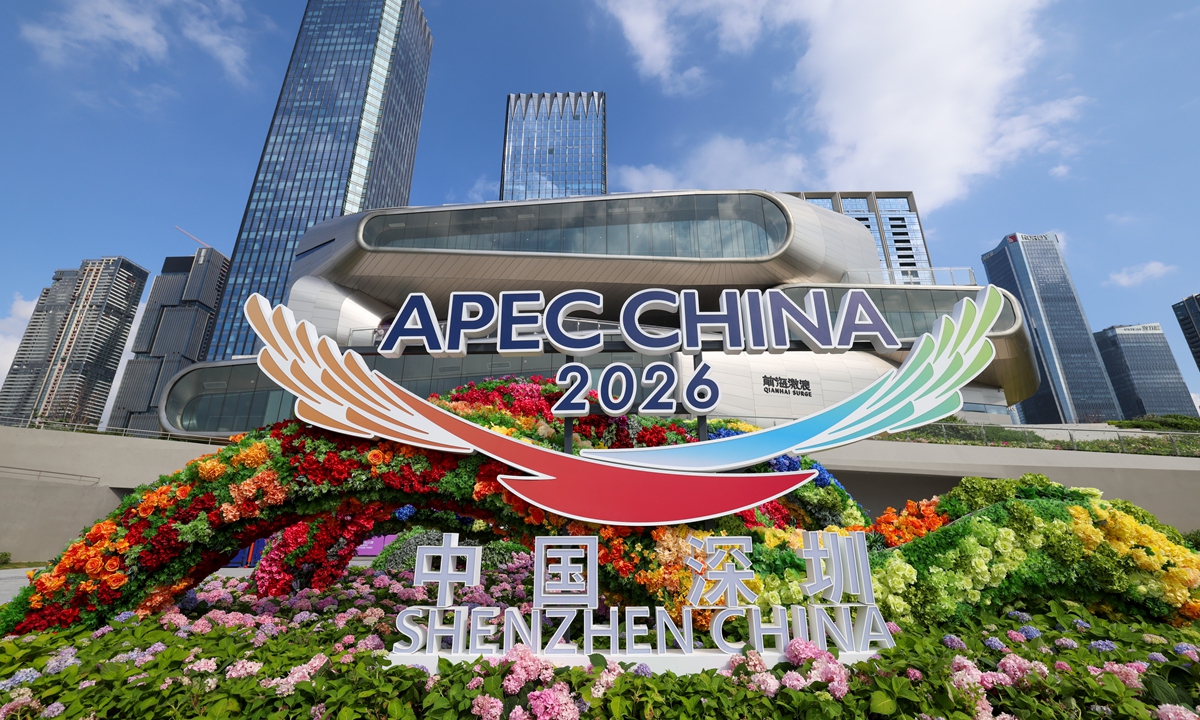
The APEC "China Year" logo decoration is seen at Qianhai Stone Park in Shenzhen. China will hold the 33rd APEC Economic Leaders' Meeting in Shenzhen from November 18 to 19, 2026. Photo: Xinhua
The efforts to foster a new type of major-country relationship mark a new phase in China's major-country diplomacy with Chinese characteristics, featured by proactive leadership and systematic construction. The meeting to be held in Shenzhen is a manifestation of the international community's high recognition of China's image as a stable and responsible major country.Chinese President Xi Jinping will hold a China-Russia-US summit with Russian President Vladimir Putin and US President Donald Trump in China's Shenzhen on November 19. This marks the first-ever face-to-face meeting between the leaders of China, Russia, and the US in history. They will engage in an in-depth exchange of views on maintaining world peace and promoting strategic stability in relations among major countries, making this a landmark event. The three countries' efforts to stabilize relations among major countries through mutual coordination not only serve as a powerful rebuttal to the outdated narrative that "great powers are inevitably destined for confrontation," but also send a clear message to a turbulent world: International society can certainly, through dialogue and communication, forge a new path for the peaceful coexistence of great powers in this new era of multipolarity.
In today's world, no global challenge can be resolved without the participation of major powers. The stability of global industrial and supply chains depends on policy coordination among core economies; the de-escalation of regional conflicts ultimately relies on influential major countries jointly promoting reconciliation and dialogue; and transnational issues such as global development, food security and energy security can easily fall into a deadlock of endless discussion without basic tacit understanding among major countries.
Similarly, emerging issues such as climate governance, public health cooperation and global governance on artificial intelligence will struggle to establish universally binding rules of global governance without the coordinated leadership of major countries.
China, Russia and the US are all founding members of the UN and permanent members of the Security Council. Historically, these three countries stood shoulder to shoulder to secure victory in the World Anti-Fascist War. In the current situation, they bear the important responsibility of cooperating to address global challenges and promote world peace and stability.
The fact that China, Russia and the US will sit down for face-to-face talks once again demonstrates that the head-of-state diplomacy plays an irreplaceable role in providing strategic guidance. The effort to foster a new type of major-country relationship marks a new phase in China's major-country diplomacy with Chinese characteristics, featured by proactive leadership and systematic construction. The meeting to be held in Shenzhen is a manifestation of the international community's high recognition of China's image as a stable and responsible major country.
Under the strategic guidance of head-of-state diplomacy, China-Russia relations have developed in a long-term, healthy, stable and high-quality manner, while China-US and US-Russia relations have also embarked on a path of positive interaction. The growing consensus among all parties to foster mutual trust and manage competition has become a crucial prerequisite for the trilateral meeting to take place.
The three heads of state are about to exchange views face-to-face on core issues. This will not only further enhance mutual strategic trust among major powers but also send a strong political signal to the international community regarding the stability of relations among major countries, thereby helping to boost global confidence in world development. On Chinese soil - the most stable and responsible venue - stability, consensus and confidence converge simultaneously. The right timing, favorable conditions, and sound relations have naturally come together.
From a longer-term perspective, if China, Russia and the US succeed in charting a new path of peaceful co-development, the impact will be far-reaching. There are nearly 200 sovereign states in the world; the vast majority hope to enjoy a stable external environment for development and benefit from the dividends of peace brought about by coordination among major countries, rather than taking sides among them.
When China, Russia and the US demonstrate through concrete actions that a new type of major-country relations is a viable model for coexistence, more countries will be willing to join the ranks of multilateral cooperation. The old mind-set of dividing the world along the lines of bloc confrontation will naturally and gradually lose its appeal.
Over 80 years have passed since the end of World War II and the founding of the UN, and human society is still struggling to find solutions to major issues such as war and peace, regression and progress, and development and security. Whatever answers may emerge, it must be acknowledged that promoting constructive interaction and overall coordination among major countries on the basis of stable relations will help alleviate disputes, curb turmoil and advance cooperation.
Based on historical experience and current realities, China opposes "great-power co-governance" but advocates for strengthening coordination and cooperation among major countries. Guided by the goals of reforming and improving global governance and building a community with a shared future for humanity, China advocates for an equal and orderly multipolar world. The underlying principle it upholds is the democratization of international relations.
Those who view the trilateral meeting between China, Russia and the US as major countries "carving out new spheres of influence" or establishing a "new Yalta system" clearly hold only a one-sided view of history, ignoring historical patterns. They focus solely on the needs of individual parties while disregarding the overall and comprehensive interests, emphasize only the power aspect of major countries while neglecting their responsibilities, and are so preoccupied with the reality of polarization in the international landscape that they lose sight of the ideal of democratizing international relations.
Strengthening communication, managing differences, and stabilizing relations among China, Russia, and the US is in the interests of all three countries, meets the expectations of the international community, and contributes to stabilizing the global situation while promoting dialogue and cooperation.
The trilateral meeting between China, Russia and the US cannot resolve all the challenges facing the international community overnight, but it is undoubtedly opening a path toward more positive, rational and sustainable development. At the same time, it offers a promising direction for addressing the fundamental question of "how major countries should coexist."
RELATED ARTICLES