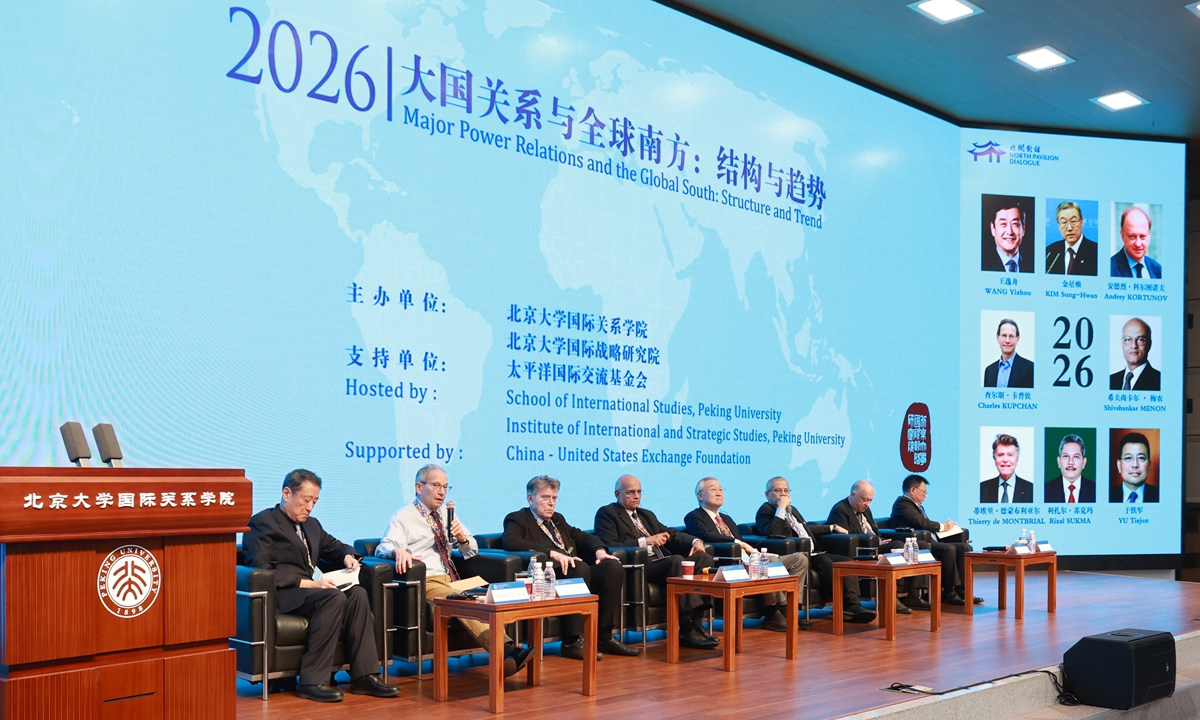
PKU's School of International Studies and the Institute of International and Strategic Studies co-host the public forum titled "Major Power Relations and the Global South: Structure and Trend" in Beijing on October 16, 2026. Photo: Courtesy of PKU's Institute of International and Strategic Studies
Editor's Note:As global power disperses, what does this mean for the international order? Amid intensifying competition, how can major powers find common ground? And what role can countries beyond China and the US play in shaping global affairs? These questions were among those discussed at the recent 12th North Pavilion Dialogue, organized by the Institute of International and Strategic Studies (IISS), Peking University (PKU), under the theme "Major Power Relations and the Global South: Structure and Trend." The Global Times has selected excerpts from remarks delivered by four speakers at a public forum on October 16, offering readers their perspectives on the shifting global landscape, the choices facing middle powers and the Global South and the future of China-US relations.
Shivshankar Menon, former Indian national security adviser and former foreign secretary
For me, we are actually going back to what is known in history. There is no world order today because the distribution of power is much flatter than it has been for centuries.
During the Cold War, the US and the Soviet Union combined accounted for about the same proportion of world military power. Today, there is no such concentration of power. This is why today there is so much talk about middle powers, the Global South and other categories.
Today, so many countries want to join BRICS because it represents hope for an alternative to what they see around them: a lack of order. For me, this is not something that we should be too frightened of, as this "lack of order" is a transition from the previous order.
Where is the hope? First, [there is] the Global South, middle powers, or whatever you want to call them. None of these are very precise categories, but they have a role to play in today's world because power is much more widely distributed.
Then, if you look at the proportion of global trade to global GDP, it has been roughly the same since 2011. We're still all part of one global capitalist economy. This is not a multipolar world with two separate systems, two separate ideologies and two completely separate ways of living. Not at all.
The biggest hope for me is what I see happening in Asia, where we pragmatically deal with the issues we face. Look at India and China. Even when we get into trouble, we try to deal with it. For me, that is the example we see most clearly in Asia. We might have differences and difficulties, but we can still manage them.
Yu Tiejun, a professor at PKU's School of International Studies and president of the IISS
We are moving toward a more multipolar international order, as the US' intention and capability to play the central role in the international system established in the post-World War II era decline. Because of its domestic problems, the US' intentions and capabilities are changing, although it remains the most powerful country in the world. If we are moving toward a more multipolar international order, then we need to discuss the role of middle powers such as India and other countries, the increasing strategic autonomy of American allies, and the role of Global South countries. Many people ask the question: What does China really want? In brief, we want to see a stable, secure and more prosperous world. I think the keywords in China's foreign policy today include stability. China wants to maintain stability in the international environment.
How can that be achieved? China has put forward four global initiatives. I think that is a positive step. The next step is how to implement them fully and translate them into concrete measures.
China and the US want to establish a constructive relationship of strategic stability based on respect, fairness and reciprocity. They can work together to do something meaningful and beneficial, and other major powers can also contribute to maintaining global stability and development.
Rizal Sukma, a senior fellow at the Centre for Strategic and International Studies, Jakarta
The discussion of the Global South fits into the two topics of the structure of power and relations among major powers. For me, the concept of the Global South is a very elusive concept. In fact, it means different things to different people. It also depends on how you use it and for what purpose. I think the concept of the Global South should be used to promote cooperation rather than competition. If the term is used in a way that creates space for competition among countries in the South themselves, that would be counterproductive.
On the question of what other countries can do in terms of US-China competition, I don't think the "middle powers" can do very much, except perhaps provide a platform, as ASEAN does, where leaders can meet and talk if they want to.
As for not taking sides, this is not just about countries declaring themselves non-aligned. It is also in the interests of China and the US that other countries do not take sides, as this helps maintain stability.
Charles A. Kupchan, a senior fellow at the Council on Foreign Relations and professor of international affairs at Georgetown University
One [of the two major tectonic changes approaching] is a redistribution of global power on a scale that really hasn't been seen in a very long time. Power shifted from the South and the East to the North and the West several hundred years ago. In many respects, Europeans and North Americans became the anchor of the international system for several centuries. We now have a moment in history in which the pendulum is swinging back. Power is shifting from the West to the East, from the North to the South.
I worry about multipolarity because of the distribution of power. I think the distribution of power will be more viable around the US and China. But I do think that, when it comes to the practice of politics, it will be more multipolar. This is where the Global South comes in. All the countries out there are not choosing sides because they don't need to. They have options.
That says to me that there will be much more fluidity and much more unpredictability about which country aligns with which country. That tells me that, in practice, the world will be much more multipolar than bipolar.
It's important that we begin to think about how to work across geopolitical and ideological divides. We now live in a deeply integrated, globalized world where, if we do not grow together, we will sink together. As a consequence, we need to figure out how the US and China can get along, live comfortably alongside each other and work together to meet the challenges of a globalized world. The US and China need to figure out how to de-escalate the tensions that have been building for over a decade and begin to find ways to trust each other and work together. That would create common ground for countries to work together on issues such as Iran, Palestine-Israel relations, global warming and development. Instead of competing over influence in these regions, the US and China should really be working together. It's a tall order, but you have to get that bilateral relationship right.
RELATED ARTICLES