Demanding China apologize for ‘overcapacity’? The Economist has fallen into hysteria
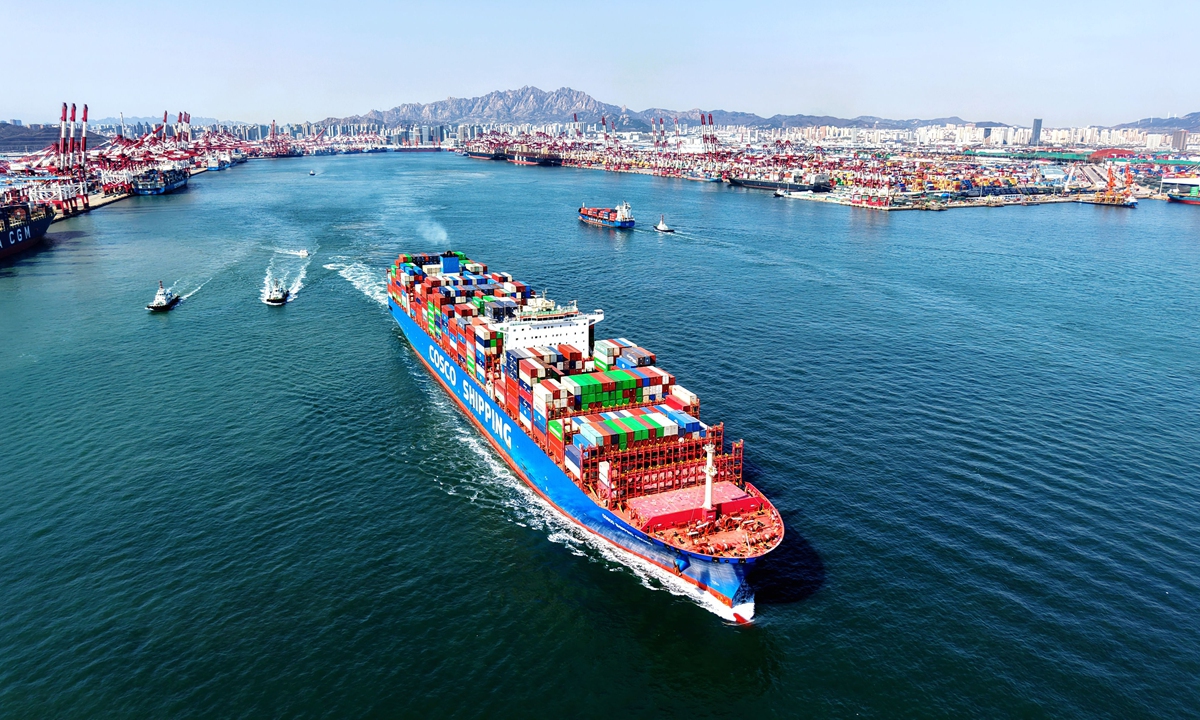
View of a container vessel near Qingdao port in East China's Shandong Province on April 7, 2026 Photo: VCG
The Economist recently published an article titled "China won't apologise for overcapacity." It first slapped China with the unfounded accusation of "overcapacity," then imagined a scenario in which China supposedly "won't apologise," before arriving at an absurd conclusion that China's industrial policy is based on the belief that "might makes right." This outrageous article has sparked widespread mockery online, with some netizens sarcastically saying that if "overcapacity" is a problem, then the US should apologize to the world for its excess dollars, excessive US Treasury debt and oversized military power.
The editors of The Economist do not necessarily lack common sense. Yet they chose to write such an article because they know that this kind of narrative can still earn scattered applause in some Western public opinion circles. "Overcapacity" is a label manufactured by some in the West and deliberately pinned on China. The purpose of hyping up this concept is to undermine China's competitive advantages in global industrial chains. They believe this will help preserve their own declining sunset industries. The Economist's demand for an "apology" is rooted in an imperialist mind-set of hegemony: Good things are only allowed to belong to me; if you have them, that itself becomes a sin, and you must apologize to me for it.
China's large-scale production capacity and strong export performance have been built on comparative advantages, driven by Chinese companies' determination, hard work and innovation. This is particularly true in fields such as new energy. Global renewable energy development is still in its early stages, and enormous demand exists not only in developing countries but also in developed economies such as Europe and the US, where supply remains far from meeting actual needs. The chaos Europe experienced during this summer's heatwaves and warnings of power shortages from the US' largest power grid both highlight the urgent need for continued development of new energy. China does not have "overcapacity;" rather, it has consistently provided high-quality capacity to the international community, a fact recognized by the world.
The so-called "overcapacity" is merely a political tool dressed up in academic language. The only thing The Economist's article has achieved is proving this point once again. Some in the West have lingered too long in the fading glory of their former dominance and remain trapped in the outdated mind-set that "might makes right." They cannot even answer the simplest question: If China's production capacity is truly "excessive" and "harmful," then what kind of extraordinary power does China possess that allows it to win the favor of global consumers and attract cooperation from businesses around the world?
The fantasy of forcing China to apologize for a non-existent "overcapacity" is nothing more than a fit of hysteria - and it is time to seek treatment.
RELATED ARTICLES