ARTS / CULTURE & LEISURE
Shenzhen makes room for migratory birds with new rules
City of wings
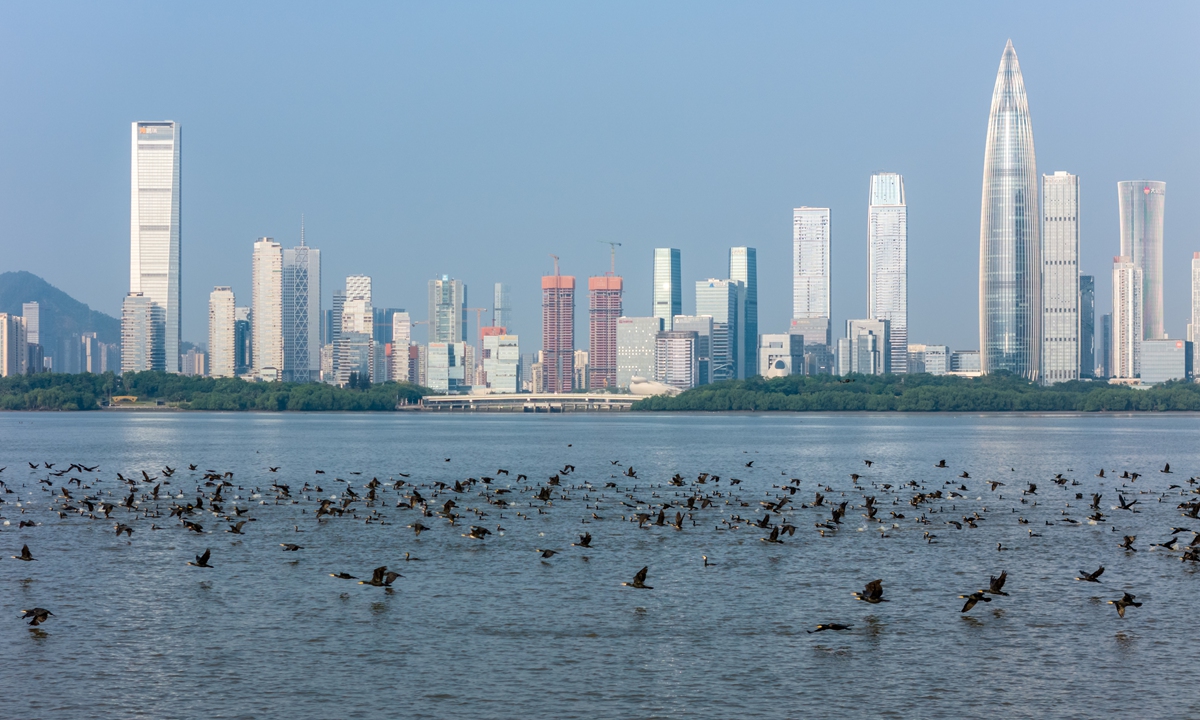
A flock of migratory cormorants fishes in Shenzhen Bay on October 30, 2026, in Shenzhen, South China's Guangdong Province. Photos: VCG
As the annual migration season arrives, Shenzhen Bay in South China's Guangdong Province is once again coming alive with the flutter of wings. Flocks of migratory birds are returning to the wetlands to feed, rest and spend the colder months. This year, the wild birds have something more to welcome them: new legal protections and a city making greater efforts to ensure their safe passage.
Newly implemented regulations on mangrove wetland protection in the Shenzhen Special Economic Zone calls for better management of nighttime lighting in and around migratory bird habitats, giving legal backing to the city's well-known "Lights Out For Birds" initiative.
The move marks a new step in Shenzhen's efforts to build an eco-friendly city.
Sun Lili, a member of the Shenzhen Municipal Committee of the Chinese People's Political Consultative Conference (CPPCC) and co-founder and executive chairperson of the Mangrove Conservation Foundation, told the Global Times that urban development must never come at the expense of wildlife habitats.
Building roads and installing streetlights are essential to ensuring safe travel and making a city more convenient for its residents. A streetlight may seem like a small piece of municipal infrastructure, but when placed along a migratory bird route, it can have far-reaching implications for wildlife survival and the ecological character of the city, noted Sun, who has advocated for bird-friendly lighting controls near the reserve.
As Shenzhen hosts the 33rd APEC Economic Leaders' Meeting, the city's efforts to protect migratory birds offer the world a glimpse of a different dimension of Chinese modernization: a megacity where urban dynamism and the quiet habitat of wildlife can coexist.
During the 2026 APEC Ministerial Meeting on Forestry held in Shenzhen in July, representatives from 21 economies discussed sustainable forest management, mangrove and blue carbon conservation, urban biodiversity, smart ecological governance and legal forest-products trade. Shenzhen's ecological practices were also shared and discussed among Asia-Pacific economies.

A black-faced spoonbill and two great egrets are seen on the mudflat at Shenzhen Bay Park in Shenzhen on November 9, 2026.
Space for nature
The Guangdong Neilingding Futian National Nature Reserve near Shenzhen Bay is China's only national nature reserve located in the heart of a city. Its mangroves and tidal flats provide an important wintering and stopover site for migratory birds traveling along the East Asian-Australasian Flyway (EAAF).
Nearly 100,000 migratory birds stop over at Shenzhen Bay each year to rest and spend the winter, with more than 270 bird species recorded in the Futian reserve to date.
During the 2025-2026 migratory season, the total number of waterbirds recorded in Shenzhen Bay reached 47,474, the highest in five years and an increase of about 24 percent from 2021.
During the 2026 International Black-faced Spoonbill Census, 341 of the birds were recorded in Shenzhen Bay, accounting for 4.4 percent of the global population and underscoring the area's importance as a key wintering ground for the species.
In February, when a netizen proposed installing additional streetlights in Shenzhen Bay Park to brighten its walking paths, the park administration declined the suggestion citing the need to avoid disturbing migratory birds in their habitats. The response sparked widespread discussion on social media, with the topic "Lights Out For Birds" earning unanimous praise.
Sun recalled that she was moved by the public recognition of the idea that a great city should be willing to make room for birds and leave space for nature.
Birds are extremely sensitive to light, and artificial light pollution can severely disrupt their biological rhythms. At night, they may struggle to roost safely, become disoriented and fly off course, avoid landing on mudflats, or even be forced to abandon their wintering grounds altogether, said Sun.
The regulations' significance lies in filling a legislative gap by establishing clear ecological standards and responsibilities for urban lighting, while incorporating bird protection into municipal infrastructure planning. It has also helped build consensus among government departments that public facilities should serve people while respecting nature and safeguarding wildlife, she said.
Regional effort reaches far
Zhou Jiang, vice president of the Regional Science Association of China, told the Global Times that Shenzhen's approach resonates with the APEC's pursuit of openness, cooperation and common development.
Shenzhen is located at a key point along the EAAF. From a regional perspective, ecosystem integrity depends on connections between different areas. Protecting a wetland provides migratory birds with a reliable stopover, while restoring ecological corridors helps wildlife feed, migrate and reproduce. By safeguarding its local ecosystems, Shenzhen is therefore also helping maintain a life-support network shared by many regions, Zhou noted.
Just as economies across the region are interconnected, ecological security also requires collective efforts and mutual support, he said.
In February, Foreign Ministry spokesperson Lin Jian praised an open wildlife overpass in Shenzhen, saying it was a striking example of harmonious coexistence between humans and nature.
Opened in 2024, the Kunpeng Trail No. 1 Bridge is China's first elevated ecological corridor bridge designed to accommodate both pedestrian walkways and a dedicated 50-meter-wide wildlife passage. Less than one-tenth of its deck is reserved for pedestrians. Its surface mimics the natural contours of a mountain, using native soil and indigenous plants to provide natural food sources for birds and insects.
Zhou noted that these initiatives reflect Shenzhen's deeper thinking about the meaning and scale of modern urban development.
Zhou said that Shenzhen's practices show that a dynamic, fast-growing city can make room for other forms of life and take responsibility for a shared future through proactive restraint, scientific planning and institutional innovation.
RELATED ARTICLES