ARTS / CULTURE & LEISURE
AI film&TV alliance launched in China as India also eyes short-drama market
By Published: Nov 16, 2026 09:52 PM

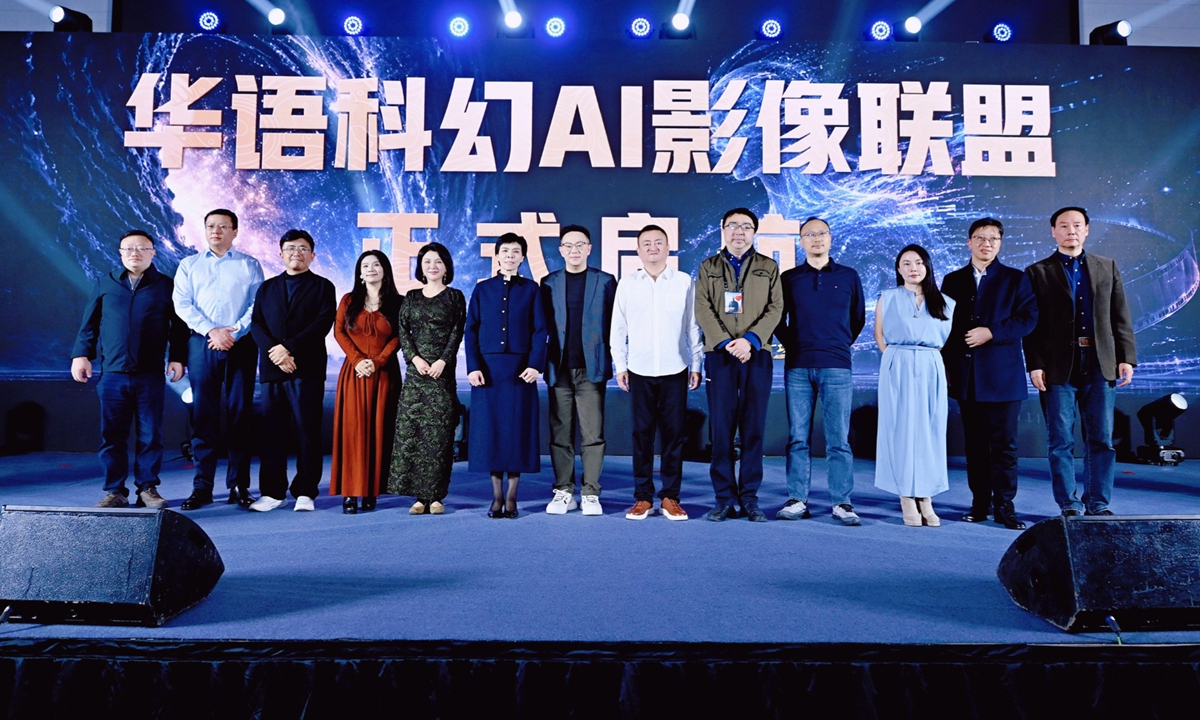
Photo: Courtesy of the Chinese Science Fiction AI Visual Alliance
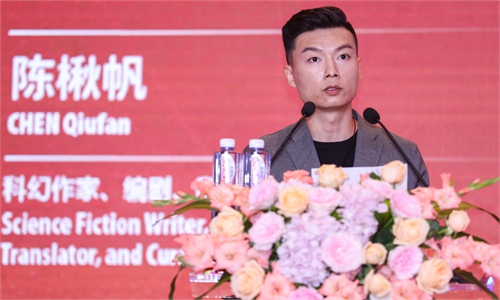
A new alliance aimed at turning Chinese science fiction literature into films, TV series and other screen projects with the help of artificial intelligence (AI) has been launched in Chengdu, Southwest China's Sichuan Province.The Chinese Science Fiction AI Visual Alliance was formally established during the 2026 Science Fiction Nebula Carnival on Saturday. Organizers announced that four literary works, including He Xi's novel Tiannian (Heavenly Years), will be the first projects to enter development.The alliance has been launched by Perfect World Pictures together with Hainan Yitian Vision, and Qingchun Nihao Media. According to the partners, each will take on a distinct role. Hainan Yitian Vision will supply intellectual property and original content. The company says it currently holds or represents the rights to 81 science fiction works. Qingchun Nihao Media will contribute screenwriting, directing and producing expertise. Meanwhile, Perfect World Pictures, a major Chinese film and television company, will draw on frontier AI technology and industrial capital to fuel innovation in sci-fi filmmaking and accelerate breakthrough in the genre
The initiative reflects growing ambition in China's entertainment industry to build on the international breakthrough achieved by Liu Cixin's The Three-Body Problem. The novel became the first Asian work to win the Hugo Award in 2015 and has since been translated into dozens of languages. Its success, along with a high-profile Netflix adaptation, significantly raised the global profile of Chinese science fiction and has encouraged both creators and investors to pursue more ambitious screen projects.
Gan Weikang, chairman of Hainan Yitian Vision and a vice-chair of the Chinese Science Fiction Nebula Awards organizing committee, said the collaboration is intended to create a complete chain from original writing through to finished productions. He said that the alliance would pursue not only AI-generated content but also live-action series, games and animation.
Zeng Yingxue, senior vice president of Perfect World Co. Ltd and head of Perfect World Pictures, told the Global Times that the company had initiated the alliance. "We hope, from an industry ecosystem perspective, to open up IP resources through equal access and open bidding, empower young creators, and build a collaborative human-AI creative environment," she said. "We aim to create a complete pathway from intellectual property to talent, and from creative ideas to finished films."
She also cautioned that technology should not come at the expense of storytelling. "The more rapidly technology advances, the more important it is to preserve the depth of stories and the warmth of emotion," Zeng added. Chinese sci-fi had long been constrained by technical limitations and high costs, she said, but now has a viable path to the screen. The launch comes as AI-assisted short-form drama grows rapidly in China, with productions moving beyond familiar romance and revenge tropes into historical, military and sci-fi settings. One recent AI short drama, Holding Arms into the Song Dynasty, about a modern military unit transported to the late Northern Song Dynasty (960-1127), has drawn a large audience. Figures released by platforms claim more than 10 million follows on one service and cumulative views exceeding 12 billion across the internet.
The short-drama trend is also attracting interest overseas. According to trade publications, Aamir Khan Productions, the company of the Indian star known in China for 3 Idiots and Dangal, plans to enter the short-form market in partnership with Excel Entertainment. Zhang Peng, a cultural researcher and associate professor at Nanjing Normal University, told the Global Times that AI could help Chinese science fiction reach more international audiences by improving translation, localization and early visualization of scenes. However, he noted that technology remains a tool rather than a replacement for storytelling. "What ultimately moves audiences is distinctive imagination, solid narrative and shared human emotion," he said.
The new alliance reflects a broader effort within China's entertainment industry to convert a growing body of science fiction writing into commercially viable screen content, at a moment when AI tools are lowering some of the traditional barriers of cost and technical complexity.
RELATED ARTICLES