Shenzhen's Qianhai showcases China's institutional reform
Landmark stone a defining symbol of China's high-standard opening-up
By in Shenzhen Published: Nov 16, 2026 11:01 PM

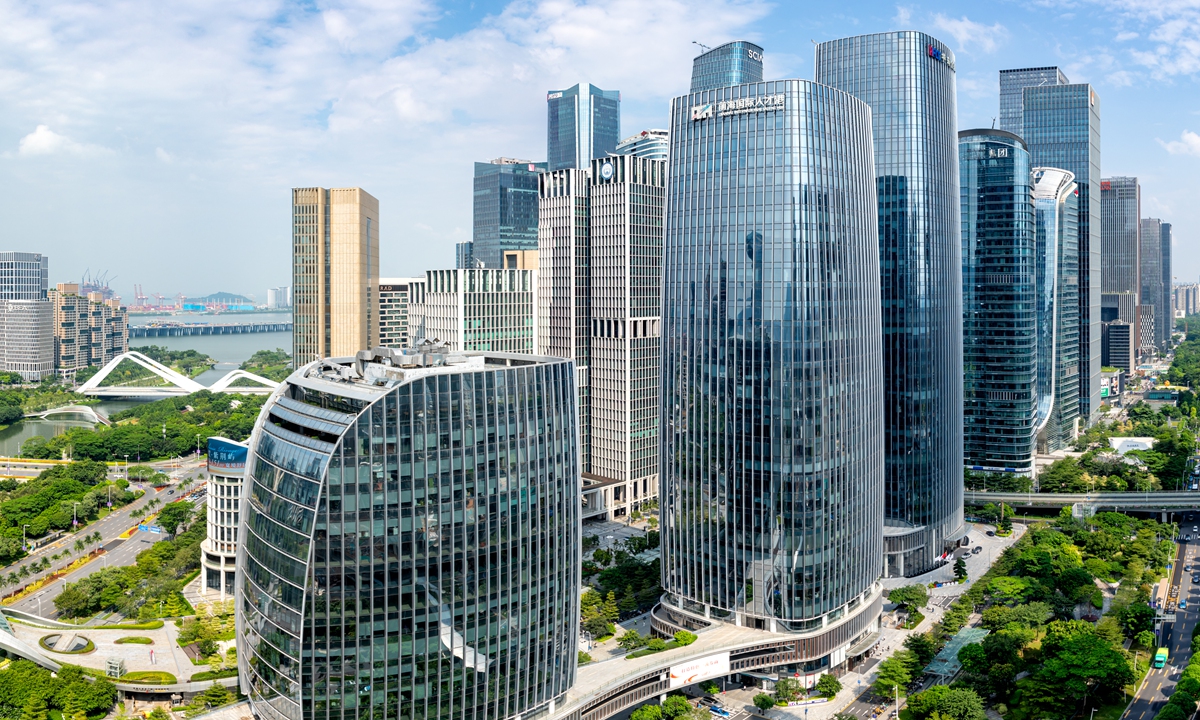
Skyline of Qianhai Financial Center (QFC) Photo: Courtesy of Qianhai's management committee
In Shenzhen, South China's Guangdong Province - the host city of the upcoming 2026 Asia-Pacific Economic Cooperation (APEC) Economic Leaders' Meeting - one of the most consequential urban landmarks is not a glass-curtained skyscraper, but a weather-beaten yellow wax stone.
Standing on a coastal viewing platform in Qianhai Stone Park, where brisk sea breezes sweep off the bay across lush green lawns and tree-lined promenades, the rock measures about 2.8 meters high, 2.1 meters wide, and 0.65 meters thick. Boldly engraved with the two Chinese characters for "Qian Hai," its natural silhouette resembles a ship setting full sail, framed against the sparkling waves of the Qianhai Bay on one side and a rising skyline of modern financial towers on the other.
Just blocks away from this stone, the Qianhai International Conference Center will serve as the venue for the 2026 APEC CEO Summit, which is scheduled to be held from Tuesday to Wednesday.
Chinese President Xi Jinping, along with leaders from APEC economies Australia, Canada, Chile, China's Hong Kong, Indonesia, the Republic of Korea, Malaysia, Mexico, Russia, Thailand and Vietnam, will attend the summit and deliver speeches or remarks, or participate in panel discussions, the Xinhua News Agency reported on Sunday.
The 33rd APEC Economic Leaders' Meeting will be held in Shenzhen from Wednesday to Thursday under the theme "Building an Asia-Pacific Community to Prosper Together."
More than just a scenic marker, the Qianhai Stone stands as a defining symbol and witness of China's high-standard opening-up.
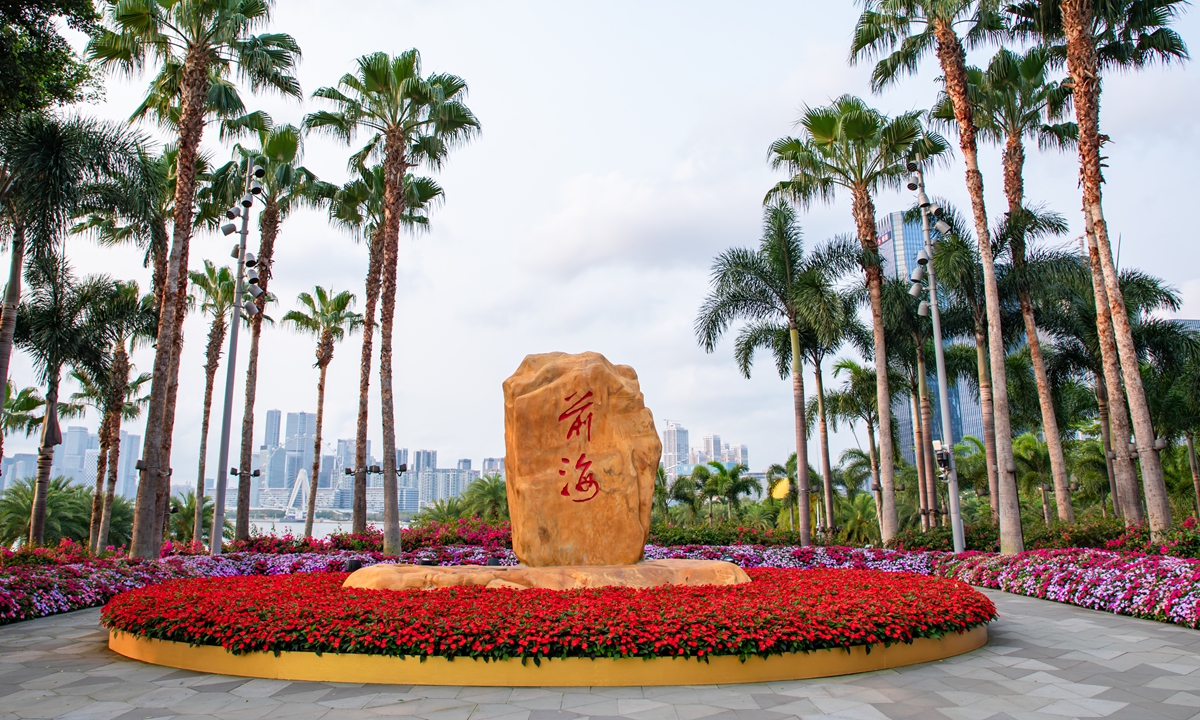
Qianhai Stone Park Photo: Courtesy of Qianhai's management committee
Where barren coastal mudflats once lay just over a decade ago, a bustling metropolis teeming with global innovators and financial institutions now thrives. However, the most profound transformation this stone has witnessed is not the physical leap of Shenzhen from mudflats to a modern city, but Qianhai's evolution into a premier strategic platform for China to pioneer institutional opening-up, deepen comprehensive reform, and engage deeply in international economic cooperation across the Asia-Pacific and beyond.
The stone's iconic status is deeply rooted in key historical moments of China's opening-up journey.
In December 2012, standing beside the Qianhai Stone, President Xi issued a call to embark on a new journey of reform and opening-up. "No stop in reform, and no stop in opening up," Xi said during his trip to Guangdong Province at that time, according to the Xinhua News Agency.
Xi also visited Qianhai in October 2018 and October 2020, on the occasion of the 40th anniversary of China's reform and opening-up, and the 40th anniversary of the establishment of the Shenzhen Special Economic Zone, respectively.
As the 33rd APEC Economic Leaders' Meeting prepares to kick off, the iconic Qianhai Stone on the shores of the South China Sea stands as a testament to how China's unwavering commitment to high-standard reform and opening-up continuously injects certainty and fresh momentum into the development of the Asia-Pacific, and how the development dividends generated are actively shared with regional partners to anchor long-term prosperity and win-win cooperation.
Since the beginning of the year, China has worked with APEC economies to deliver nearly 50 practical outcomes, advancing cooperation in areas such as promoting regional economic integration, supporting the work of the World Trade Organization, deepening digital and intelligent cooperation, and developing the green economy, according to a press conference held by China's Ministry of Commerce on Monday.
A magnet for multinationals
For Hong Kong entrepreneur Forrest Lee, lunchtime follows a familiar daily routine. Stepping out of his office in the North Zone of the Qianhai Shenzhen-Hong Kong Youth Innovation and Entrepreneur Hub, he walks past streets lined with Hong Kong-style tea restaurants that fill the air with familiar food aromas, and along a tree-lined coastal promenade that leads to the Qianhai Stone. This is a walk that brings together his six-year entrepreneurial journey across the Shenzhen River.
"I've visited the stone multiple times, and every time I walk past the gigantic seaside boulder shaped like a ship setting sail, I can feel the velocity of development across this dynamic land," Lee told the Global Times.
Lee is the founder of Synovate Technologies, a Hong Kong-invested industrial AI company specializing in cognitive sensing solutions powered by machine hearing technology. He opened a small office in Qianhai in 2020, a time when the area surrounding the Qianhai Stone was still relatively open and barren, with limited supporting facilities, he recalled.
His goal at that time was also very straightforward: to tap into the Guangdong-Hong Kong-Macao Greater Bay Area's robust industrial supply chain and the hub's strategic location for both Chinese mainland and Hong Kong clients.
Six years on, propelled by burgeoning R&D and market opportunities, the company's team has grown nearly tenfold, with business footprints - using Qianhai as a springboard - expanding from the Chinese mainland to Asia-Pacific markets like Singapore.
"In Qianhai, the essence [of opening-up] lies not merely in policy incentives, but is increasingly driven by institutional innovation and industrial ecosystems - what we call an upgrade in 'soft connectivity' between the Chinese mainland and Hong Kong, encompassing recognition of professional qualifications, smoother cross-border capital flows, aligned commercial rules and deeper industry collaboration. This deeper integration of resources, talent and markets represents a high caliber of opening-up, both in depth and scope," Lee noted.
In addition to start-ups, multinational heavyweights also pioneer innovative operations and unlock new business opportunities in Qianhai, including those previously beyond their reach.
In July 2025, Cathay Pacific opened its Shenzhen Digital and IT office in Qianhai, a vivid example of how Qianhai's opening-up and innovation ecosystem is helping businesses harness the Chinese mainland's technological strengths to sharpen their global competitiveness.
"Working closely with Cathay's Hong Kong headquarters and Guangzhou IT office, the Shenzhen office leverages Qianhai's position as a regional innovation hub to accelerate the Group's digital development and strengthen its technological capabilities," a company spokesperson told the Global Times.
Global financial giant HSBC has also deepened its roots in the zone. In January 2025, the group unveiled "HyQ," a new office complex in Qianhai backed by an investment exceeding 4 billion yuan ($556 million). In 2017, HSBC Qianhai Securities was established as the Chinese mainland's first foreign-controlled (Hong Kong-funded) securities joint venture — a landmark project in Qianhai's pioneering financial opening-up.
"As a strategic platform for Shenzhen's institutional innovation, Qianhai can play a greater role in rule alignment and industrial synergy, amplifying the advantages of Shenzhen-Hong Kong integration to build a high-level opening-up gateway facing the Asia-Pacific," Li Qile, general manager of the Guangdong-Hong Kong-Macao Greater Bay Area at HSBC China, told the Global Times.
To date, 183 Fortune Global 500 companies have established a presence in Qianhai. In the first half of this year, actual foreign investment in the Qianhai Cooperation Zone reached 25.01 billion yuan, up 102.9 percent year on year, the Global Times learned from the area's management committee.
"What is unique about Qianhai is its ability to translate institutional opening-up into tangible dividends for all participants — seamlessly connecting the Chinese mainland's complete manufacturing and R&D supply chains with international financial, legal, and professional services through rule alignment," Liang Haiming, president of the Silk Road iValley Research Institute, told the Global Times.
'A special zone within a special zone'
If the Shenzhen Special Economic Zone in its early days answered the question of how China could open its doors to integrate into global manufacturing chains, Qianhai — often dubbed a "special zone within a special zone" — is now tasked with another mission: offering China's solution to global headwinds such as supply chain disruptions, rising trade protectionism, and geopolitical uncertainties through deeper institutional opening-up.
As these very challenges sit atop the agenda of the upcoming APEC meeting in Shenzhen, the "Qianhai model" provides a compelling reference for how regional economies can navigate fragmentation and chart new pathways toward open cooperation.
"China's opening-up has evolved far beyond simply lowering tariffs or offering land subsidies and entered a new stage characterized by institutional innovation. The establishment of Qianhai as a pioneering reform zone came at a pivotal moment, providing a testing ground for such efforts," Qi Mingyang, who founded Shenzhen Qianhai Fuyonggu Capital Management Co in the zone in 2015, told the Global Times.
"I think the analogy of an 'institutional power adapter' is particularly apt. What we are exploring in Qianhai is precisely how to bring our rules, regulatory practices and standards into closer alignment with international ones, and once mature, such experience could potentially be promoted to other areas," Qi noted. Having mastered international rules onshore before sailing offshore, his firm has also grown from a local asset manager 10 years ago into a leading Hong Kong-based financial institution.
Qianhai has also been a pioneer in Asia-Pacific cooperation. In July, the China Center for Promoting APEC Cross-Border Data Flow Cooperation settled in Qianhai, extending rule-alignment networks directly across the region.
Flowing from Qianhai to the rest of the country, these institutional innovations send a clear and resolute message: China remains firmly committed to advancing high-standard opening-up. This commitment also closely echoes the priorities of the upcoming APEC meeting in Shenzhen — openness, innovation, and cooperation — with China's policy consistency and institutional predictability widely hailed by attendees for injecting vital confidence and certainty into global businesses and regional partners alike.
For developing APEC members still on the path of industrialization and urbanization, the "Qianhai model" offers a pragmatic roadmap: rather than blindly replicating skyscrapers, economies can pair modern services - customs, payments, legal and financial frameworks - with manufacturing upgrades by piloting institutional innovations on a limited, risk-controlled scale before expanding them nationwide, Chinese observers said.
RELATED ARTICLES