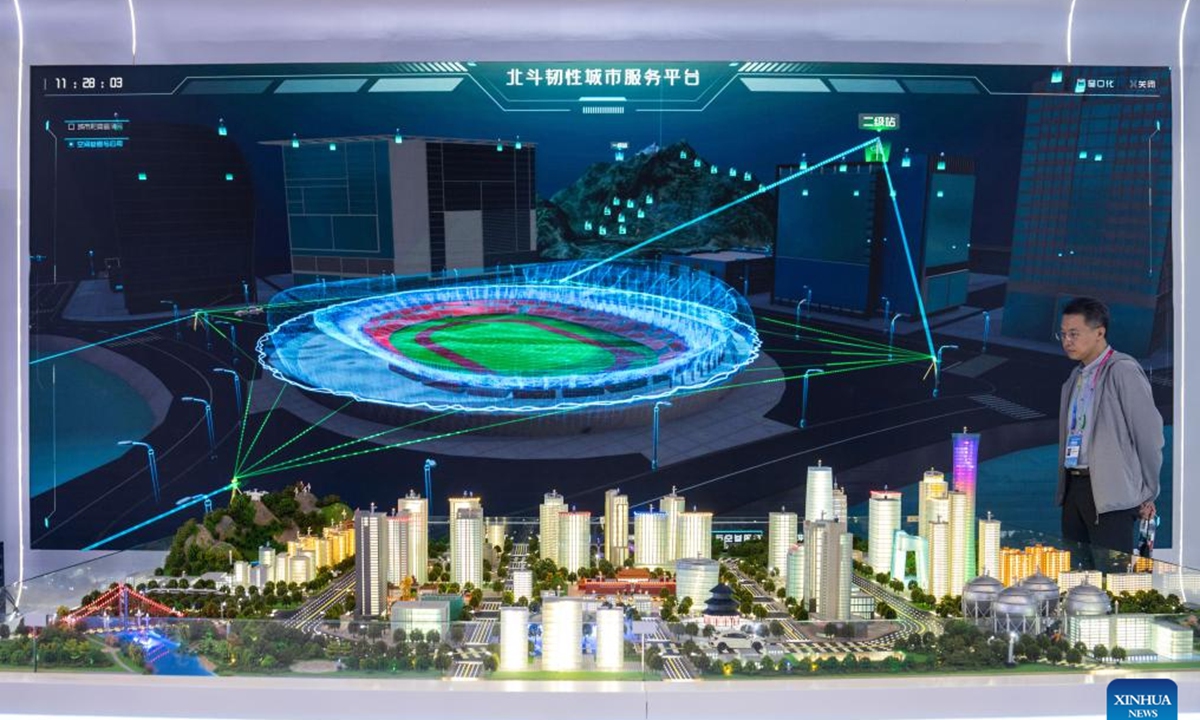
A visitor learns about a platform that uses the BeiDou Navigation Satellite System (BDS) to monitor urban safety risks and issue early warnings during the 4th International Summit on BDS Applications in Zhuzhou, central China's Hunan Province, September 24, 2025. Photo: Xinhua
The number of BeiDou terminal devices in use across China, excluding consumer electronics, approached 42 million units by the first half of 2026, up nearly 9 million from the same period last year, representing year-on-year growth of about 27 percent, according to a report released on Tuesday.
The 2026 China BeiDou industry development index report, released by the GNSS & LBS Association of China at a forum in Beijing on Tuesday, also showed that the penetration rate of BeiDou in integrated applications exceeded 90 percent, the Global Times learned from the association.
In the consumer market, more than 98 percent of the 124 million smartphones shipped in China in the first half of 2026 supported BeiDou positioning. Shipment of passenger vehicles equipped with BeiDou terminals totaled about 10 million units, while sales of electric bicycles featuring BeiDou positioning reached 26 million units, the report showed.
As the only annual index research report in China focusing on the comprehensive development of the BeiDou industry, the report provides a comprehensive assessment of the industry's development in terms of marketization, industrialization, internationalization, mass-market applications, and development across regions and industries. It also serves as an important reference for industry analysis and policymaking.
Association President Zhang Huifeng said the BeiDou industry would be characterized by four major trends: becoming foundational infrastructure development, deeper integration, broader application scenarios and globalization.
BeiDou will evolve from a navigation system into a unified spatiotemporal foundation serving both the digital and real economies. As BeiDou becomes more deeply integrated with 5G/6G, AI, the Internet of Things, and low-Earth-orbit satellites, an integrated space-air-ground spatiotemporal service system is rapidly taking shape, Zhang said.
Demand will also continue to grow across applications such as the low-altitude economy, Level 3 and above autonomous driving, smart agriculture, digital twins and embodied intelligence, the president added.
BeiDou is reshaping traditional industries, according to the Xinhua News Agency. For example, in Shanghai's suburban farmlands, more than 10,000 mu (about 667 hectares) of high-standard farmland have become a showcase for smart agriculture, with BeiDou-enabled machinery handling every step of rice cultivation - from plowing to harvesting.
According to data from the Ministry of Industry and Information Technology, by the end of 2025, cumulative shipments of domestically produced BeiDou-compatible chips and modules had neared 2.6 billion units, while the total installed base of BeiDou-enabled terminals had exceeded 2.2 billion, Xinhua reported.
Buoyed by its domestic reach, BeiDou is accelerating its global footprint. As one of four global navigation satellite systems recognized by the United Nations, BeiDou-related products have been exported to more than 140 countries and regions.
RELATED ARTICLES