China's LineShine retains top supercomputer ranking in the world, leads two global benchmarks
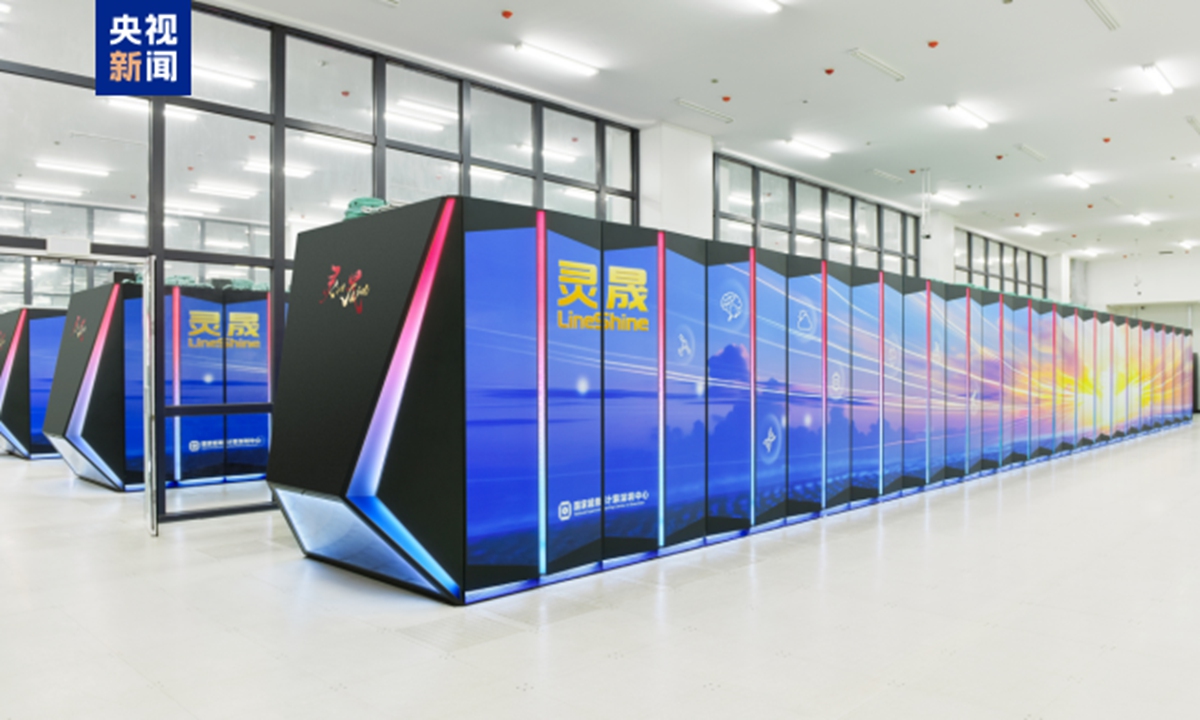
China’s fully domestically developed “LineShine” supercomputer file photo: China Media Group
China's homegrown LineShine has retained its position as the world's fastest supercomputer, topping both the TOP500 and HPCG rankings released on Monday in Chicago. The results mark its second consecutive first-place finish after China reclaimed the crown in June.
Installed at the National Supercomputing Centre in Shenzhen, Guangdong Province, LineShine achieved 2.198 exaflops, or 2.198 quintillion floating-point operations per second, on the High Performance Linpack (HPL) benchmark, according to the TOP500 organization. That put it about 21 percent ahead of the US-based El Capitan supercomputer, which ranked second at 1.809 exaflops.
LineShine also retained the first place in the High-Performance Conjugate Gradient (HPCG) ranking with 22 petaflops, ahead of El Capitan's 17.41 petaflops. While HPL measures performance in solving dense systems of linear equations, HPCG tests computing patterns more closely resembling those used in scientific applications.
The latest rankings were announced on Monday at SC26, the International Conference for High Performance Computing, Networking, Storage and Analysis, in Chicago.
LineShine first claimed the TOP500 title in June, displacing El Capitan and becoming the first Chinese supercomputer to lead the list since Sunway TaihuLight in 2017. It also became the first system in TOP500 history to exceed two exaflops of sustained double-precision performance using only central processing units (CPUs), according to the ranking organization.
Behind the achievement is a home-developed computing architecture. LineShine features an innovative all-CPU design incorporating Online Acceleration technology, combining high-performance scientific computing with intelligent computing capabilities. The system uses homegrown technologies across processors, networking, storage and system software, according to the National Supercomputing Centre in Shenzhen.
LineShine's computing power is being put to work in scientific research. Using the system, researchers have carried out first-principles calculations involving 200 million silicon atoms and electronic-structure simulations of solid-state battery interfaces involving more than 10 million atoms. The work, conducted using the domestically developed XLSDFT software, has been named a finalist for the 2026 ACM Gordon Bell Prize, one of the most prestigious awards in high-performance computing.
The latest global rankings came after LineShine topped China's 2026 High-Performance Computer TOP100 list, released on Sunday at the eighth China Supercomputing Power Conference in Beijing. Its performance was 4.5 times that of the top-ranked system in 2025, according to the National Supercomputing Centre in Shenzhen.
"The top ranking is not the end, but a new starting point. The value of supercomputing would ultimately be measured by its applications," said Lu Yutong, director of the Shenzhen center and chief designer of LineShine, on Sunday. Lu said the center would strengthen the domestic software ecosystem and work to translate computing power into scientific discoveries, engineering breakthroughs and industrial innovation.
China has prioritized computing infrastructure development under its 15th Five-Year Plan (2026-30), which calls for expanding the supply of high-performance intelligent computing resources, improving nationwide computing resource coordination and developing an integrated national computing network.
China's intelligent computing capacity reached 2,592 exaflops by the end of September, up 146 percent year-on-year, said Xie Cun, an official with the Ministry of Industry and Information Technology. The figure, measured differently from the double-precision performance used in TOP500 rankings, reflects the broader expansion of China's intelligent computing infrastructure.
The country's intelligent computing capacity reached 2,592 exaflops by the end of September, up 146 percent year-on-year, providing strong support for the rapid growth of the country's artificial intelligence innovation, said Xie.
Xie said that China would capitalize on opportunities presented by the development of next-generation communication network, pursue major strategic projects and accelerate the expansion and upgrading of computing infrastructure.
Global Times
RELATED ARTICLES