Chinese supercomputer returns to the world’s top spot, sending multiple signals: Global Times editorial
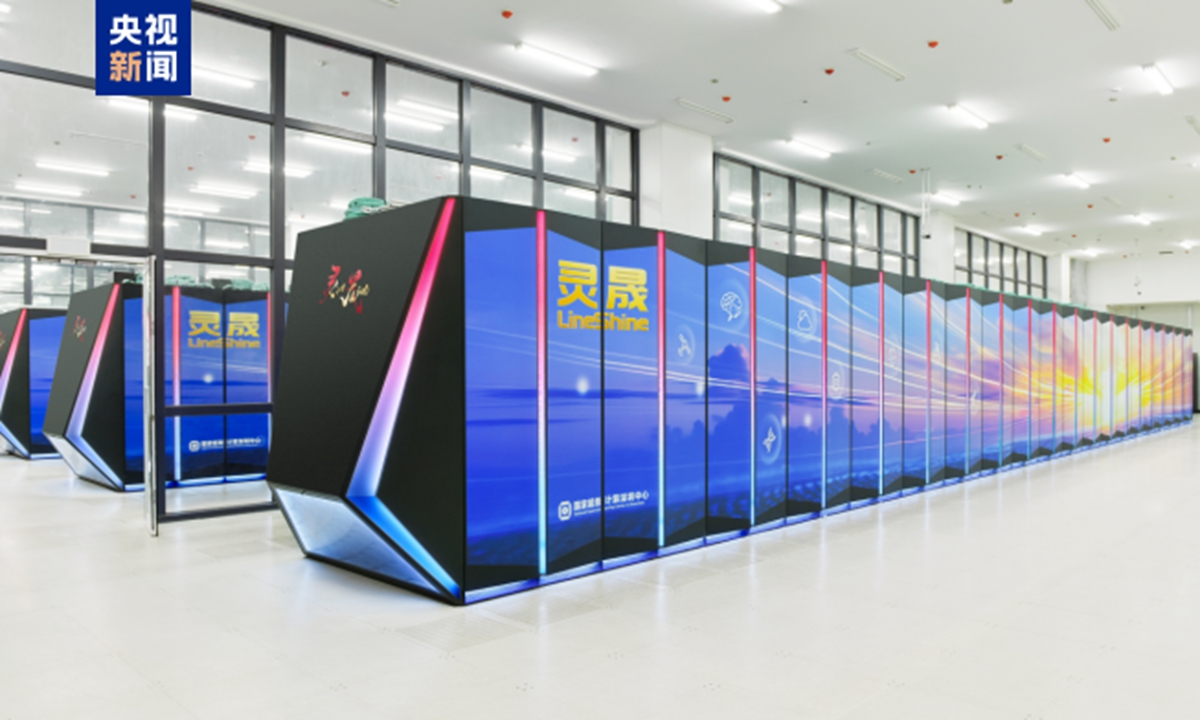
China's fully domestically developed "LineShine" supercomputer file photo: China Media Group
On Tuesday, at the International Supercomputing Conference in Hamburg, Germany, the World's TOP500 supercomputers list was released, with China's entirely domestically developed and independently controlled LineShine supercomputer claiming the top spot. This marks the second time a Chinese supercomputer has topped the list since the Sunway TaihuLight in 2017. Turing Award winner and TOP500 co-founder Jack Dongarra commented that China's LineShine offers the world a glimmer of hope for the transition of supercomputing toward the new system architecture of AI4Science, according to the National Supercomputing Center in Shenzhen.The LineShine supercomputer has two technical features. First, LineShine was researched and developed entirely domestically and independently. Faced with years of export controls on high-end GPUs and advanced chip equipment targeting China, Chinese research teams have established a complete closed-loop process - from chip design to system integration - truly achieving self-reliance and control. That means LineShine took first place despite facing layer upon layer of restrictions.
Second, while most of today's leading supercomputers rely heavily on GPUs, LineShine is the first supercomputer to achieve exascale performance using only CPUs, and it is approximately 20 percent faster than El Capitan, the US supercomputer that previously held the top spot. The even greater significance of LineShine reaching the top lies in the fact that it has validated the feasibility of a complete domestic technology stack, including domestically made chips, storage, interconnects, and cooling systems. Prior to this, no country had ever built the world's top supercomputer without relying entirely on products from AMD, Intel, or NVIDIA.
Many people may ask: it took nine years for China to reclaim the top spot; what happened in the meantime? As early as early 2015, the US Department of Commerce placed China's four major supercomputing centers associated with the Tianhe-2 on its so-called export control list. Since then, the US has been frequently overstretching the concept of national security: in 2019, it targeted two of China's "three supercomputing giants" - Sugon and Sunway TaihuLight; in 2021, it added seven Chinese supercomputing entities to the blacklist. Yet these layers of restrictions did not stifle China's scientific research; instead, they compelled the industry to shed its external dependencies and focus intently on honing its independent R&D capabilities.
Now that LineShine has reclaimed the top spot, it has provided a concrete answer through tangible achievements: whether it be "small yard, high fences" or "decoupling and severing supply chains," all cannot halt China's progress.
Chinese supercomputer's return to the global top not only demonstrates the country's increasingly robust self-reliance and control in the high-tech sector, but also offers new options and greater opportunities for global industrial development. Today, fields such as atmospheric and oceanic sciences, engineering simulation, materials science, drug discovery, brain science, scientific AI, and large language model inference all rely on powerful supercomputing support.
For a long time, high-end computing resources have been highly concentrated in a few Western countries. Many developing nations lack the capacity to build their own supercomputing systems and can only passively accept a single source of technology and stringent access restrictions. The path China has taken in computing power provides a model for countries in the Global South - one that is free from external control and allows for autonomous innovation.
Countries should work together, learn from one another's strengths, support each other, and pursue healthy development. Using national security as an excuse to impose sanctions on other countries undermines global cooperation and ultimately harms one's own opportunities for development.
Faced with China's technological advances, some voices in the West have fallen into a contradictory mindset: they want access to the world's most advanced technologies and products, yet worry that "overreliance" could bring "national security risks." They want to use them but hesitate to do so; they talk about "decoupling" but are reluctant to bear the costs. This dilemma is itself one of the bitter consequences of the "small yard, high fences" approach.
Facts have repeatedly proven that unilateral restrictions and technological decoupling benefit no one. Only by pursuing cooperation and win-win outcome can we expand the global supply chain market and achieve shared technological progress. Global science and technology are a community where everyone prospers or suffers together. Artificially creating technological barriers will only delay humanity's pace in addressing global challenges.
China's pursuit of technological development has never been about engaging in geopolitical competition with any country. The aspirations of more than 1.4 billion people for a better life require technological support, while common global challenges, such as climate change and public health, demand technological solutions. These are the true driving forces behind China's sci-tech innovation.
This is true of supercomputing, as it is of 5G, artificial intelligence, space exploration, and new-energy technologies. If the US could set aside its fixation on "technological hegemony" and view China's progress with greater objectivity, the potential for China-US cooperation in areas, such as AI governance, climate change, and global health, would be enormous.
In recent years, China's technological innovation has advanced rapidly, with many sectors accelerating the transition from quantitative growth to qualitative breakthroughs, from the low and mid-range to the mid- and high-end, and from being followers to leaders. China's ranking in the Global Innovation Index rose from 34th place in 2012 to 10th in 2025. China will not close the door to international cooperation because it has achieved technological leadership, nor will it abandon its commitment to independent innovation because of external restrictions.
The West should recognize the broader trend with clarity and realism: technological competition cannot be won through containment and suppression, and global scientific and technological progress cannot be achieved without the collaboration of multiple stakeholders. Setting aside narrow-minded geopolitical suspicions and engaging in dialogue and cooperation with an attitude of equality and openness is the right choice that aligns with the common interests of all humankind.
RELATED ARTICLES