Understanding the world's choice of China through the Summer Davos: Global Times editorial
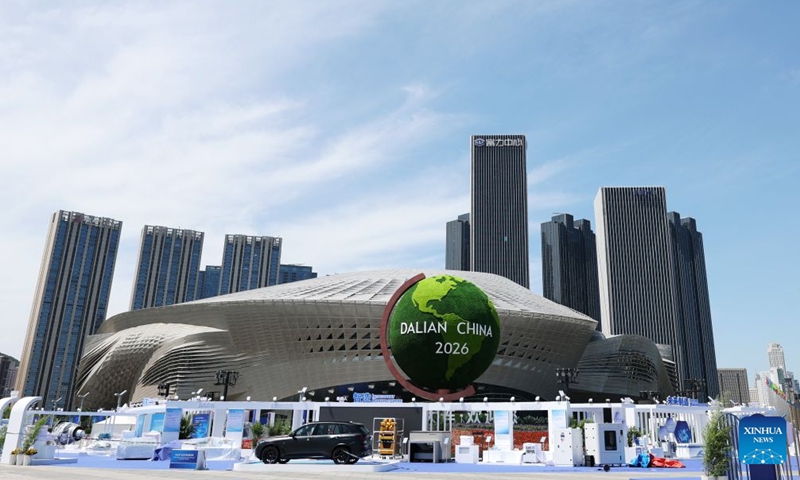
This photo taken on June 22, 2026 shows an exterior view of the Dalian International Conference Center, venue of the 2026 Summer Davos, in Dalian, northeast China's Liaoning Province. The World Economic Forum's Annual Meeting of the New Champions, also known as the Summer Davos forum, will be held in the port city of Dalian from June 23 to 25. (Photo: Xinhua)
From Tuesday to Thursday, the World Economic Forum's Annual Meeting of the New Champions, also known as the Summer Davos, is being held in Dalian. Amid geopolitical tensions, economic uncertainty, and rapid technological change, more than 1,700 representatives from the political, business, academic, and media sectors across over 90 countries and regions have gathered in Dalian, located on the shores of the Yellow and Bohai Seas - a gathering that in itself represents a statement of stance and a vote of confidence. This global gathering, themed "Innovating at Scale," invited guests from around the world to explore how innovation can bridge technological divides, break through trade barriers, and translate into real productive capacity - marking yet another instance of "Innovative China" sharing its achievements with the world.Across the globe, "innovation" has become a new calling card for China. The country's breakthroughs in artificial intelligence (AI), new energy, and advanced manufacturing have provided valuable insights to the world. The practical applications of China's innovations - such as new-energy vehicles (NEVs), 5G/6G networks, and industrial robots - are continuously making their way into the global market.
China's comprehensive industrial system, massive market, high-quality engineers, and high-density application scenarios attract an increasing number of multinational corporations to not only set up production lines in China but also establish laboratories, jointly building a platform for innovation with Chinese partners. All of this adds footnotes to "Innovating at Scale."
The Summer Davos highlights China's influence on the global innovation landscape. As a bridge connecting China's development with that of the world, the Summer Davos has, over the nearly 20 years since its inception, borne witness to the infectious power of "Innovative China." This year, outside the main venue of the annual meeting, NEVs, hydrogen-powered buses, and autonomous smart buses are lined up and ready for service; the venue's air conditioning is powered entirely by green electricity, expected to reduce carbon dioxide emissions by approximately 800 metric tons. The in-depth exchanges during the annual meeting will help enterprises from various countries seize opportunities in the Chinese market and promote the global dissemination of China's achievements.
Innovation is not a new term at Davos, but the phrase "at scale" has imbued innovation with a brand-new, contemporary significance. Several foreign media outlets highlighted the report "Top 10 Emerging Technologies of 2026," released on the opening day of the forum. The report identifies key technologies most likely to shape industries, policies, and society over the next five years, including everything-to-grid energy, direct lithium extraction, and personalized mRNA cancer vaccines, among others. China has accumulated a wealth of experience - both instructive and replicable - in transforming innovation from a "bonsai" into an industrial "landscape." As World Economic Forum (WEF) Managing Director Mirek Dusek noted, the world is eager to learn from China's experience.
2026 Summer Davos' agenda is both practical and forward-looking, revolving around five key themes: shifting trade, China's next chapter, technology in the real economy, jobs for the next generation, and the energy transition as a source of competitiveness. These topics directly address the most pressing challenges and priorities in today's global economic development, combining a clear sense of purpose with a global perspective. They respond to the challenges posed by unilateralism and protectionism, capture the new drivers of China's high-quality economic development, focus on how innovation can empower manufacturing upgrades, examine the profound impact of technological change on labor markets, and confront the global consensus on climate change and green, low-carbon development. Together, they fully reflect how "Innovative China" serves the broader vision of building a community with a shared future for humanity.
The world is optimistic about China not only because of its innovative capabilities, but also because of its unwavering commitment to openness. Just one day before the opening of the Summer Davos, the fourth China International Supply Chain Expo (CISCE) kicked off in Beijing, attracting more than 1,200 exhibitors from 85 countries, regions, and international organizations, with foreign-invested exhibitors accounting for over 36 percent of the total. This year's CISCE was almost a stage for robotic performances, with intelligent robots serving as volunteers, guides, and hosts. An AI exhibition zone was also established for the first time, showcasing a vibrant landscape of innovation. These figures and scenes demonstrate that global businesses have not been swayed by the political noise surrounding "decoupling" and supply chain disruptions. What attracts them are reliable supply chains, long-term cooperation, and shared innovation.
At a time when some countries are erecting trade barriers, politicizing, weaponizing, and overstretching the concept of national security on economic and trade issues, thereby increasing the risk of fragmentation in global industrial and supply chains, China continues to expand both institutional and market opening through platforms such as the China International Import Expo, the Canton Fair, and the CISCE. On the opening day of the CISCE, China announced 15 practical measures to further ease foreign investment access and improve the business environment. China's opening-up is not an abstract gesture, but a tangible environment where businesses can see opportunities, enter the market, stay, and thrive.
"The evolution of China's innovation model will influence growth across Asia and beyond," the WEF noted on its official website in introducing this year's Summer Davos.
According to the WEF, China's pursuit of stability and new quality productive forces is reshaping its industrial base and, by extension, international value chains. Looking ahead, the message emerging from Summer Davos is clear: "Innovative China" is not a closed technological island, but a platform for global cooperation; Chinese modernization is not an opportunity reserved for China alone, but a development process whose benefits can be shared with countries around the world.
RELATED ARTICLES