It’s time for G7 to wake up from its ‘leader’s illusion’: Global Times editorial
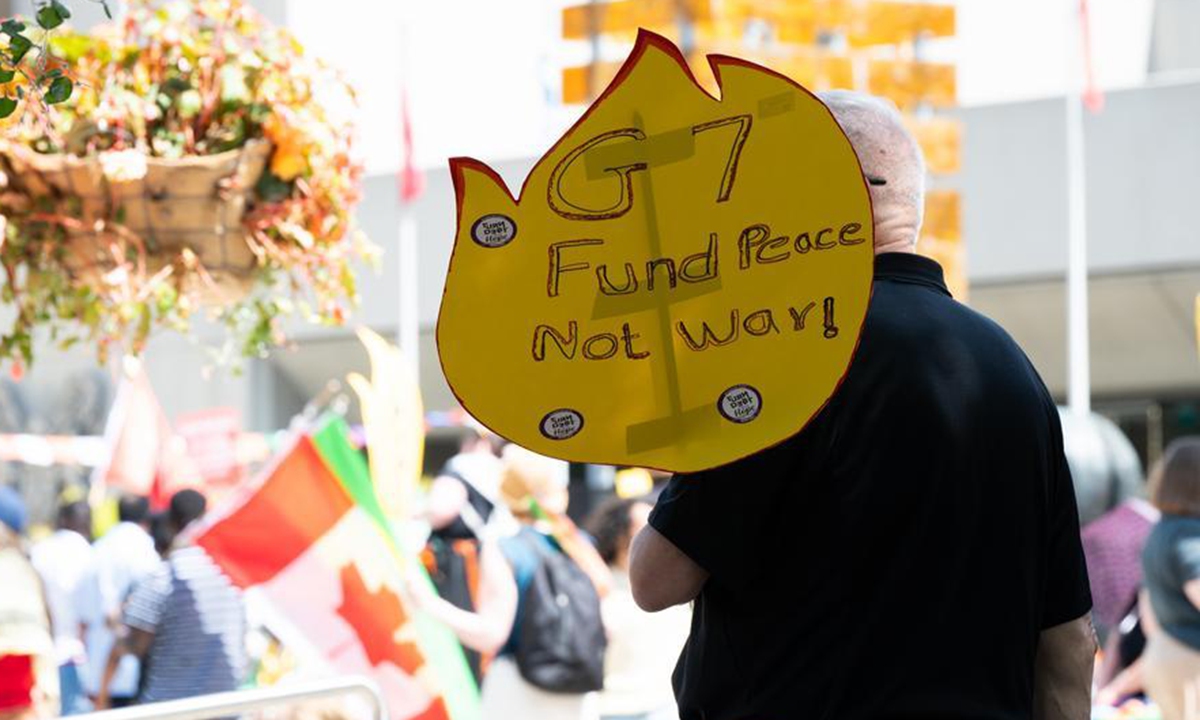
A protester holds a sign during a rally in Calgary, Canada, June 15, 2025. Photo: Xinhua
The Group of Seven (G7) summit will take place from June 15 to 17 in Evian-les-Bains at the foothills of the French Alps, also known as the town of Evian. Even before its opening, the summit has already drawn a flood of controversies and criticism, revealing deep divisions and unmistakable decline within the Western bloc. Even among citizens of G7 countries, the G7 is often described as a "hypocritical," "selfish," and "detached-from-the-world" club of wealthy nations. Against the backdrop of profound shifts in the global landscape and the accelerating trend toward multipolarity, the G7 has increasingly exposed its chronic problems of mispositioning, cognitive distortion, and functional erosion.
G7 countries are widely facing sluggish economic growth, rising debt levels, declining industrial competitiveness, deepening social fragmentation, and increasing pressures from population aging. Treating the "G7 disease" would require potent remedy. However, frictions among its member states persist, with trust in the US among European countries falling to a historic low. As a result, the G7 members themselves struggle to form a shared consensus, let alone prescribe appropriate remedies.
This year's summit is expected not only to fail, for a second consecutive year, to issue a joint communique, but also to become one of the summits with the "smallest common denominator" in its history.
At a time when both their strength and cohesion are in decline, the G7 not only fails to reflect on its own shortcomings, but instead attempts to prescribe remedies for others. According to European media reports, the summit has already informally settled on "blaming China" as its lowest common denominator, while also placing issues such as so-called trade imbalances, "overcapacity," critical minerals alliances, and "de-risking" on its agenda.
Without doubt, addressing the challenges facing the world today - whether it be industrial chain restructuring, energy security, or global financial stability and climate governance - cannot be achieved without the participation of China and other Global South countries. Therefore, the platform for discussion should not be a small clique dominated by a handful of developed countries, but rather a more equitable and representative multilateral cooperation mechanism.
Since the beginning of this century, the global landscape has undergone irreversible historical changes. China has remained the world's second-largest economy and has long been an engine for global economic growth. Emerging powers such as India, Brazil, and Indonesia have risen rapidly, and the collective ascent of emerging economies represented by the BRICS countries has fundamentally broken the old order of Western dominance over the world.
Today, countries of the Global South, with their vast populations, expansive markets, and strong development potential, have become a backbone force of promoting global growth. Against this backdrop, a group accounting for less than 10 percent of the world's population and whose share of the global GDP continues to decline still seeks to position itself as the "world's leader," even attempting to package its own interests as "international rules." This is obviously difficult to adapt to the current needs.
On one hand, the G7 has a "leader's illusion"; on the other, the group is facing a deepening sense of anxiety and helplessness. Under the combined pull of both, the G7 has chosen to shift the blame onto China to deflect domestic tensions, shirk its own responsibilities, and rally allies into exclusive cliques. Each member harbors its own agenda - some seek to monopolize the discourse of international affairs, while others aim to fish for geopolitical gains in troubled waters.
In fact, many of the G7's problems stem from its flawed perception of and policies toward China. It is like being ill oneself while prescribing medicine for others - the outcome is predictable. The global challenges facing the world today have long exceeded the capacity of any single bloc or "small-circle mechanism." China has already offered its prescription for addressing the deficits in peace, development, security, and governance: advancing an equal and orderly multipolar world and promoting universally beneficial and inclusive economic globalization.
Hopefully the G7 can wake up from its "leader's illusion" - embracing more openness and inclusiveness instead of self-imposed isolation; pursuing more win-win cooperation rather than zero-sum rivalry; and strengthening multilateral collaboration instead of resorting to unilateral dominance - so as to play a constructive role in safeguarding peace and promoting development. That said, we are also aware that waking someone who is pretending to be asleep is no easy task.
RELATED ARTICLES