What another wave of tightly packed ‘Beijing meetings’ demonstrates: Global Times editorial
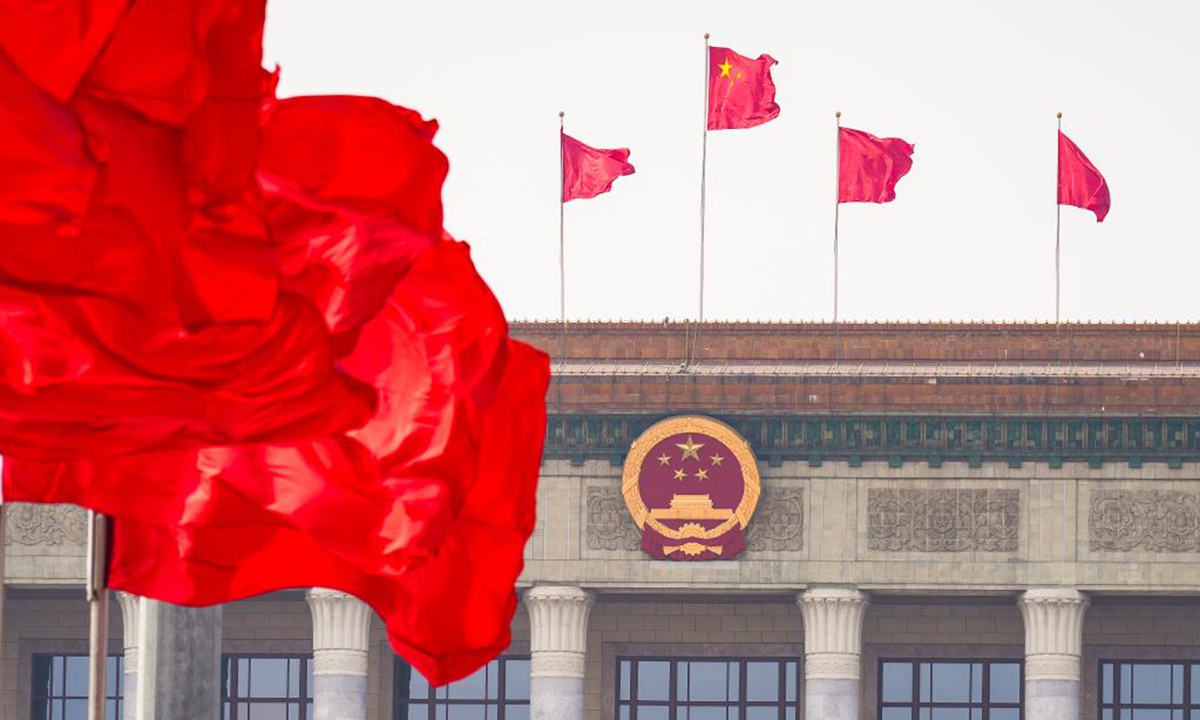
This photo taken on March 12, 2026 shows the Great Hall of the People ahead of the closing meeting of the fourth session of the 14th National People's Congress (NPC) in Beijing, capital of China. (Xinhua)
Beijing has once again witnessed another wave of "visits to China" in May, when there have been at least a dozen high-level bilateral exchanges and multilateral events hosted in China. The reason it is described as "another wave" is that from late last year to early this year, multiple European heads of state visited China in succession, while leaders from neighboring countries also made frequent trips - already drawing significant attention. Early this year, US media outlet Forbes remarked on its website that China was laying out the red carpet on a near-daily basis to welcome foreign leaders seeking a more stable development environment. Several months on, that red carpet has only grown longer and broader, vividly reflecting the appeal and centripetal force of China's major-country diplomacy.
China's diplomatic engagements have become so frequent that "tracking China's diplomatic schedule" has itself become a popular topic in public discourse. According to media statistics, all other four of the five permanent members of the United Nations Security Council have visited China; among G7 countries, all except Japan have done so. The list of visiting leaders from developing countries is even longer, including General Secretary of the Communist Party of Vietnam Central Committee, Vietnamese President To Lam, Sheikh Khaled bin Mohamed bin Zayed Al Nahyan, Crown Prince of Abu Dhabi, United Arab Emirates, Mozambican President Daniel Chapo, and Tajik President Emomali Rahmon, among others.
What may appear as a coincidental alignment of schedules is in fact no accident. In the face of the profound changes of our time and global turbulence, the world naturally turns its attention to where development prospects are clearer, direction more defined, governance solutions more effective, and stability more enduring. The logic behind this is not difficult to understand.
"Meet in Beijing" also reflects a sense of responsibility. The stability of the global landscape fundamentally depends on the trajectory of relations among major powers. Under the strategic guidance of head-of-state diplomacy, China has consistently taken it upon itself to uphold world peace and has worked in practice to advance a new model of major-country relations. During the China-US leaders' meeting, the two sides agreed to define their relationship as "a constructive China-US relationship of strategic stability", a new positioning for bilateral ties. The China-Russia leaders' meeting, meanwhile, marked a new stage of more dynamic and faster development in bilateral relations. One "new positioning" and one "new stage" have abandoned with outdated Cold War thinking of zero-sum games and bloc confrontation, injecting valuable certainty into global strategic stability, while also allowing the world to clearly see the confidence and composure of China diplomacy in the new era.
"Meet in Beijing" also reflects trust. Last month, President Xi Jinping met with Sheikh Khaled bin Mohamed bin Zayed Al Nahyan, Crown Prince of Abu Dhabi, United Arab Emirates, putting forward a four-point proposal on promoting Middle East peace and stability, offering a Chinese approach to resolving conflicts and achieving peace in the Middle East. At the same time, for many developing countries affected by disruptions in the Strait of Hormuz shipping routes, China has actively extended assistance, conveying its firm commitment to promoting peace and development. China has consistently translated its principles - encouraging dialogue, promoting political resolution of disputes, and opposing the use of force and bloc confrontation - into concrete actions, demonstrating a spirit of global responsibility and commitment to the common good.
"Meet in Beijing" bears witness to cooperation. As more countries "look East", they are proactively turning to China to learn from its experience and seek development opportunities. Whether it is German Chancellor Friedrich Merz making a special trip to study China's intelligent manufacturing and industrial robotics industries, Mozambican President Daniel Chapo visiting places such as Hunan and Qinghai to witness China's experience in balancing ecological protection and poverty alleviation, or General Secretary of the Communist Party of Vietnam Central Committee, Vietnamese President To Lam touring Xiong'an New Area and riding the Fuxing high-speed train and gaining an impressive experience of the many facets of Chinese modernization, they all reflect a high level of recognition of China's development and governance achievements, as well as a deep appreciation of its development model. The world sees that China's accomplishments are tangible and visible, that its governance philosophy works and offers valuable lessons, and that the opportunities created by China's development are highly inclusive and rich in potential.
"Meet in Beijing" also bears witness to resonance. At a time when unilateralism and protectionism are on the rise and the international order is under strain, the world urgently needs a new vision of global governance capable of bridging differences and building consensus. From the fruitful outcomes of high-quality Belt and Road cooperation to the proposal and implementation of the four major global initiatives, China's proposals have consistently focused on the defining themes of peace and development. China does not interfere in other countries' internal affairs, nor does it impose its will on others. It upholds equality among all nations, regardless of size, strength, or wealth. This Eastern wisdom - pursuing one's own development while helping others succeed and working for the common good - breaks the stereotype that "a strong nation must seek hegemony" and offers a new path for improving the global governance system. The steady stream of visits by political leaders from various countries is, in effect, a vote of confidence cast through concrete actions, reflecting the global resonance and shared response to China's proposals and vision.
"On May 1, 2026, China began implementing an expanded zero-tariff treatment on imports from all 53 African countries with which it has diplomatic relations"; "strengthen cooperation in fields including trade, new energy and intelligent economy, to encourage exchanges in culture, education, scientific research and sports"; "explore cooperation pathways that lead to win-win results, and jointly keep industrial and supply chains stable and unimpeded" - the broad recognition and trust China has earned from the international community ultimately stem from its consistent commitment to acting responsibly as a major country. China has never exported turmoil or confrontation to the world. Instead, it continues to provide stability, opportunity, and hope.
Through the wave of diplomatic activity seen this May, the world has witnessed a vibrant, open and inclusive China, as well as a China that upholds fundamental principles while pursuing innovation and shouldering major responsibilities. No matter how the international landscape may change, China remains a reliable partner that the world can trust.
RELATED ARTICLES