Seeing China’s stability against the backdrop of global turmoil: Global Times editorial
Listen
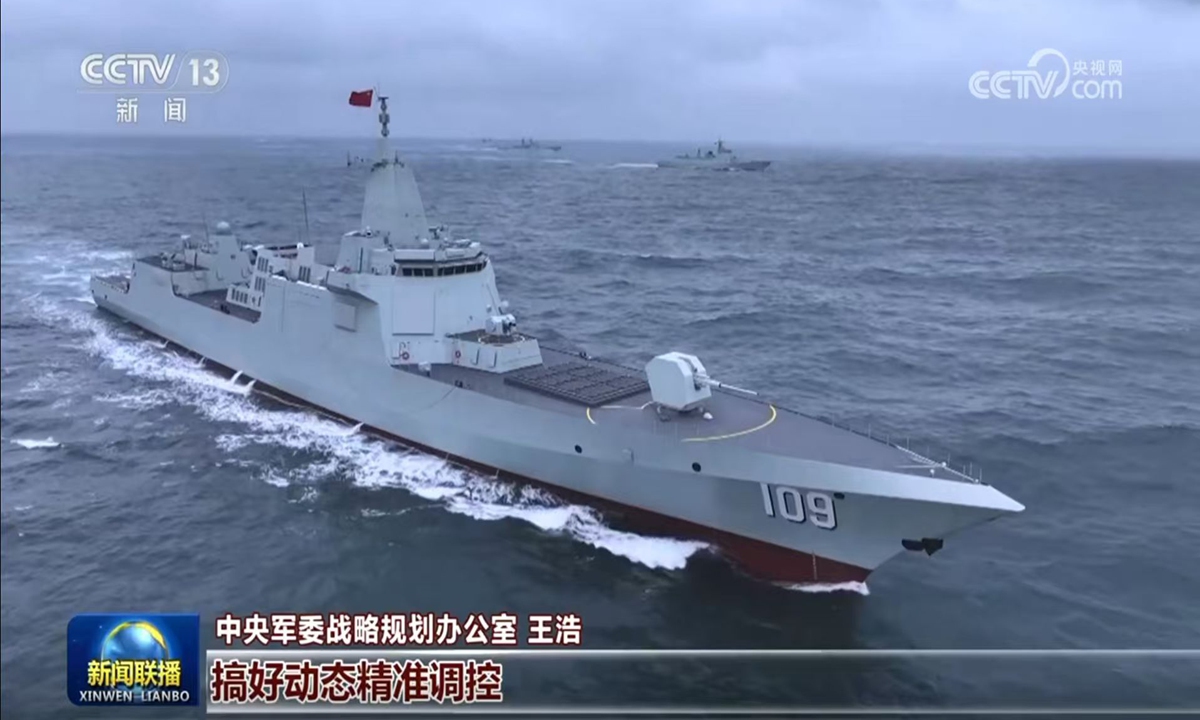
Two new Type 055 large destroyers of the Chinese People's Liberation Army Navy, the Hull 109 Dongguan and the Hull 110 Anqing, conducting joint training at sea with other vessels, are featured in a report aired by Xinwen Lianbo, a news program produced by China Central Television, on March 8, 2026. Photo: Screenshot of the Xinwen Lianbo
On Sunday, two new Type 055 guided-missile destroyers of the Chinese People's Liberation Army Navy, Dongguan and Anqing, made their official debut. The number of China's publicly known 10,000-ton-class destroyers has increased to 10, achieving balanced deployment across the three major theater commands. This development has inspired countless Chinese citizens. In the current complex and challenging international environment, this piece of news provides a tangible sense of reassurance. Attention to military development reflects an expectation for a strong defense safeguarding national progress, while behind the 10,000-ton-class destroyers lies China's steadfast pursuit of national stability and the well-being of its people.
From the industrial system to technological innovation, and from infrastructure to national defense and military modernization, China's rising comprehensive national strength has enhanced its strategic resilience in a complicated international landscape. During the just-concluded 14th Five-Year Plan (2021-25) period, China achieved one innovation milestone after another with its "pillars of a great power" - whether it is the ultra-large domestic market, the expansion of free trade agreements, or the high level of opening-up brought about by the broadening of visa-free access. Whether it is the innovation momentum driving emerging and future industries or the green dividends released as the world's largest investor in renewable energy, China has safeguarded the fundamentals of the global economy through its own stable development. It has injected valuable stability and development momentum into a turbulent world with tangible growth and pragmatic platforms for cooperation. The world sees that China not only has the will for peaceful development but also possesses the capability to achieve it.
As a major country with a population of over 1.4 billion and contributing around 30 percent to global economic growth, how China defines "peace" and how it pursues "development" are crucial. Will it seek peace through hegemonic means, engaging in beggar-thy-neighbor practices and bullying smaller states to secure exclusive development? Or will it follow a path of peaceful development based on mutual respect and win-win cooperation? For the world, these choices lead to vastly different outcomes. China's answer is evident in a series of concrete actions. From sharing the lunar soil samples that Chang'e-6 brought back with various countries to bringing new energy technologies into the homes of people across the Global South; from actively promoting political solutions to hotspot issues such as the Ukraine crisis and the Palestine-Israel conflict to working with like-minded countries to propose and initiate the establishment of the International Organization for Mediation - these facts show that every increase in China's strength adds another measure of hope for world peace.
Today's turbulent world urgently needs stability and cooperation. In this context, China's governance is steadily injecting much-needed stability into the world. Unlike certain major powers where decision-making is inefficient, internal divisions are severe, and foreign policies frequently swing back and forth, China is able to mobilize nationwide consensus and strength to advance shared goals in a coordinated way. Whether in major infrastructure projects, breakthroughs in key technologies, or efforts in social welfare and ecological protection, a powerful synergy can be formed through unity of purpose. As overseas observers have noted, China's most striking feature is not only the speed of its development, but also the stability of its progress and the clarity of its direction. The national governance system under the leadership of the Communist Party of China (CPC) can transcend political cycles, closely linking long-term vision with strong execution. China's ability to maintain strategic resolve amid a rapidly changing and complex environment, focus on managing its own affairs well, and remain firmly committed to the path of peaceful development also means that the world gains a valuable "long-term dividend" for peace and development.
"The chaos in the world" makes the "stability of China" more prominent. This stability stems from the deep commitment to the people and global responsibility found in the governance philosophy of the CPC. The CPC's understanding of governance performance is reflected in a broad vision of "committing to serving the public good, working for the people's well-being, ensuring sound decision-making, and taking solid steps to perform." As observed by foreign media, China's planning is "people-centered, rather than profit-oriented; focused on harmony, rather than hegemony." This understanding of governance performance, when projected onto the international stage, reflects a mindset of "benefiting the wider world." While certain major countries prioritize their own interests and build "high fences and small yards," China not only drives global development through its own progress but also actively shoulders great power responsibilities, contributing more Chinese solutions and wisdom to the world. The four global initiatives proposed by China inject strong momentum into the collaborative construction of a better world across the dimensions of development, security, civilization, and governance, and have received widespread acclaim internationally.
Amid changes unseen in a century, stability is a scarce commodity, and certainty is a source of cohesion. China's development is inseparable from a peaceful international environment, and the world's peace and development increasingly rely on China's stability. This strength is rooted in the profound heritage of Chinese civilization, derived from the unique resilience of the Chinese system, and stems from China's long-standing commitment to and practice of peaceful development. As the blueprint for the 15th Five-Year Plan gradually unfolds and the goals of high-quality development continue to be implemented, a stable and developing China, continuously advancing on the new journey of modernization, will undoubtedly contribute even more solid strength to promote the building of a community with a shared future for humanity and to write a new chapter in human peaceful development.
RELATED ARTICLES