China's supercomputer returns to top of global ranking
LineShine marks a major step forward for China’s supercomputing industry in overcoming foreign tech constraints: experts
By Zhang Yiyi, , Tao Mingyang and Published: Jun 24, 2026 01:05 AM


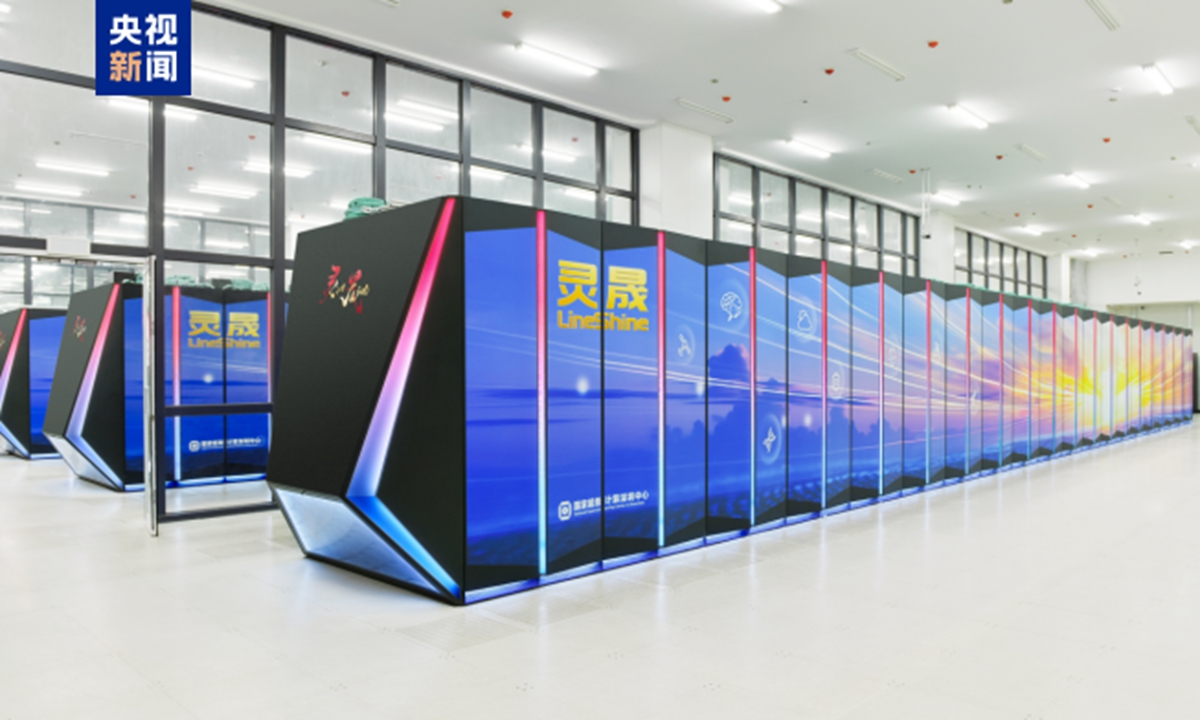
China's fully domestically developed "LineShine" supercomputer file photo: China Media Group
China's fully domestically developed "LineShine" supercomputer ranked first on the global TOP500 list with a sustained double-precision performance of 2.19EFlops (10¹⁸ floating-point operations per second), according to the ISC 2026 conference held in Hamburg, Germany, on Tuesday. The ranking marks China's return to the top of global supercomputing after nine years, China Media Group (CMG) reported.
Chinese experts said the achievement represents more than a performance milestone. They said LineShine's breakthrough and practical applications mark a major step forward for China's supercomputing industry in overcoming foreign technological constraints and building an independent, controllable hardware and software ecosystem.
At the ISC 2026 conference, China's National Supercomputing Center in Shenzhen announced that its new-generation "LineShine" supercomputer has achieved a sustained performance of 2EFlops, becoming the world's first supercomputer to surpass 2EFlops in sustained performance. The system is said to outperform leading E-level supercomputers in the US and Europe, marking China's return to the top of the global supercomputing rankings, CMG reported.
Performance leap
"LineShine" is positioned as a full-stack integrated infrastructure for scientific, engineering and AI computing, per CMG. At the chip layer, the in-house LX2 CPU integrates multi-precision and matrix acceleration capabilities, enabling tighter convergence of supercomputing and AI workloads, while also incorporating China's first domestically developed HBM memory, boosting memory bandwidth by 10 times compared with conventional CPUs.
The announcement has attracted widespread attention. US tech media Engadget said that "China's new machine was able to beat its US counterpart despite technology embargoes because it doesn't rely on GPUs like other leading models."
The New York Times quoted Jack Dongarra, an organizer of the TOP500 list, as saying that LineShine is "an impressive system." They upped us by developing a system that is not reliant on GPUs, he added.
Zhang Yunquan, a researcher at the Institute of Computing Technology under the Chinese Academy of Sciences, told the Global Times that the "LineShine" system's return to the top of the global rankings marks China's renewed leadership in the TOP500 list, following the success of the "Sunway TaihuLight" supercomputer. Unlike most current US supercomputers, which adopt a hybrid CPU+GPU architecture, "LineShine" follows a pure CPU-based integrated technical route built on the ARM architecture.
He noted that while this approach is more technically challenging to implement, it offers strong compatibility advantages in traditional supercomputing application scenarios such as scientific computing.
Chen Jing, a vice president of the Technology and Strategy Research Institute, told the Global Times that the most striking feature of the "LineShine" system is its pure CPU architecture, without the use of GPU acceleration cards. This, he said, reflects that China's progress in supercomputing is not driven by a single hardware breakthrough, but by comprehensive advances in system-level capability, including independent ecosystem development, architectural innovation, full-system integration, as well as improvements in storage and cooling technologies.
LineShine's test results were more than 20 percent faster than those of El Capitan, a system at Lawrence Livermore National Laboratory in California that has topped a twice-yearly ranking of supercomputer performance since November 2024, NYT reported.
China is no longer keeping a low profile and has returned to global "benchmark competition," Ma Jihua, a veteran tech analyst told the Global Times. He noted that earlier restraint was largely due to external sanctions and a cautious approach to disclosure, but with breakthroughs in indigenous supercomputing capabilities, China is now re-engaging in top-level competition, with performance reportedly ahead of Western systems by a significant margin.
He added that China's supercomputing sector has strong foundations, and although it has participated less in international rankings in recent years, capability development has continued.
Since deployment, "LineShine" has supported applications across atmospheric and ocean science, engineering simulation, materials science, drug discovery, brain science, scientific AI, and large-model inference.
"LineShine" reflects China's long-term push to build an indigenous computing system. By mid-2025, China ranked second globally in total computing power, with 14 national supercomputing centers approved, official data showed. Experts said its TOP500 result marks not only a performance breakthrough, but also a shift toward a more integrated national computing infrastructure.
Breakthroughs amid constraints
China first took the top spot on the TOP500 in 2010 and traded titles back and forth with the US and Japan until 2023, when China stopped submitting its systems after years of chip- and computing-related export controls from the US, Reuters reported.
Engadget wrote that "there is no single dominant technology path to leadership-class computing," while Reuters reported that the Chinese victory on the list more likely shows that China wanted recognition for its chip design efforts, which is a change from recent years.
Chen said China is now able to build exascale computing systems without relying on US' GPUs, Nvidia's CUDA ecosystem, or specific Western interconnect standards, indicating that a system-level technological framework is largely in place.
However, he also noted that underlying constraints remain in areas such as architectural licensing, advanced manufacturing processes, and parts of chip fabrication, meaning China's high-performance computing sector is still transitioning from external dependence toward full system autonomy.
Chen said "LineShine" reflects a system-level innovation path similar to that of Chinese tech firms under external pressure, echoing Huawei's "Tau Law." Both have shifted from single-point competition to system architecture innovation and engineering optimization. He noted that "LineShine" relies on a pure CPU architecture to achieve exascale performance, while Huawei advances through chip design, algorithms, and advanced packaging, with both representing a "change of path" rather than catch-up competition.
On January 4, China's National Supercomputing Internet Platform announced that its user base had surpassed 1 million, marking a key step in the shift of supercomputing resources from centralized supply to universal service.
Ma said China's supercomputing breakthrough should not be seen as a sudden "overtake on a bend," but as the result of long-term technological accumulation and capability rebuilding. He noted that this achievement represents not only success in technological innovation, but also China's institutional strengths and development model under sustained external pressure, underscoring the country's resilience.
RELATED ARTICLES