APEC Secretariat chief: China can help ‘middle powers’ play a greater role in shaping trade rules
By Zhang Weilan and Published: Nov 17, 2026 06:21 PM


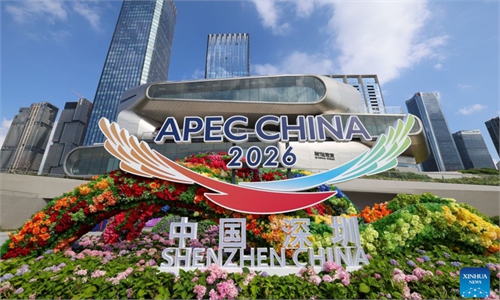
This photo taken on November 16, 2026 shows a view of Shenzhen, South China's Guangdong Province with APEC elements. China will hold the 33rd APEC Economic Leaders' Meeting in Shenzhen from November 18 to 19. Photo: VCG
China, as the world's second-largest economy, can help "middle powers" play a greater role in shaping regional trade rules, Eduardo Pedrosa, executive director of the APEC Secretariat, told the Global Times on the sidelines of the Asia-Pacific Economic Cooperation (APEC) meeting in Shenzhen on Tuesday.
The Asia-Pacific region needs space for new trade and investment rules to emerge amid rapid technological advances and shifting supply chains, he said.
Speaking at the APEC CEO Summit 2026 in Shenzhen, Pedrosa said that China's economic transformation and growing market size give it an increasingly important role in economic governance.
Pedrosa noted that a more stable global economy could come and that China could help "middle powers" take a greater role in shaping the trade rules. With the WTO, APEC and regional trade organizations now in place, Pedrosa said that there must be space for new rules to emerge and develop amid rapid tech innovations, and that "China can help open that conversation."
"China's rising middle-income population and expanding consumer base have made it a more dynamic and complex economy than when it last hosted APEC events," Pedrosa said.
He noted that China's economic structure is improving, a trend reflected in China's own development plans and the APEC Finance Ministers' joint statement, which called for stronger economic cooperation to address global imbalances and risks to global growth and financial stability.
As an important part of the 2026 APEC Economic Leaders' Week, the ongoing APEC CEO Summit 2026 has drawn more than 2,000 business and political representatives, according to Xinhua News Agency. They come from 21 APEC economies and 13 non-APEC economies, including Britain, France, Germany and Switzerland.
This year's APEC gathering, under the theme "Building an Asia-Pacific Community to Prosper Together," will focus on three major topics identified by China — openness, innovation, and cooperation.
Discussing China's priorities as APEC host this year, Pedrosa said that businesses will find the agenda important for their operations across the Asia-Pacific, especially as the economies face fragmentation, supply chain pressures, and rising energy and food prices. APEC member economies should work together to address these challenges, he said.
According to Pedrosa, innovation, led by digitalization and AI, is important for making production processes more efficient which will also improve public health care. He highlighted the importance of inclusive development, ensuring that technological advances will not leave anyone behind.
Speaking of future development, Pedrosa said that, although companies compete for customers, they are also cooperating to make supply chains more efficient.
"The current trend is shifting from the previous emphasis on 'just-in-time' to keeping a buffer in case things go wrong," he said. "In this way, supply chains will become more stable and resilient to risks, and some smaller countries will have the opportunity to participate in global supply chains."
The APEC business community can prosper by balancing competition with cooperation, especially as businesses look for more efficient and resilient supply chains in an ever-changing global environment, he said.
RELATED ARTICLES