China, other APEC economies reach nearly 50 economic, trade outcomes, with focus on innovation
Digital fields account for half, signaling focus on innovation: analysts
By Ma Tong and Published: Nov 16, 2026 10:33 PM

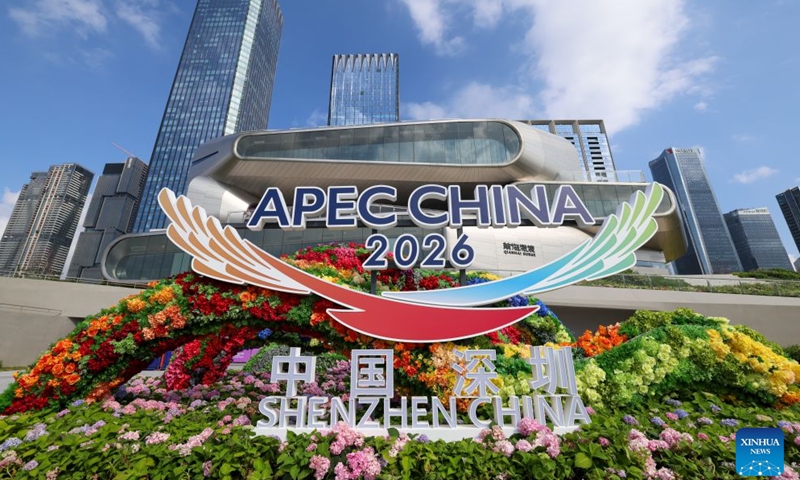
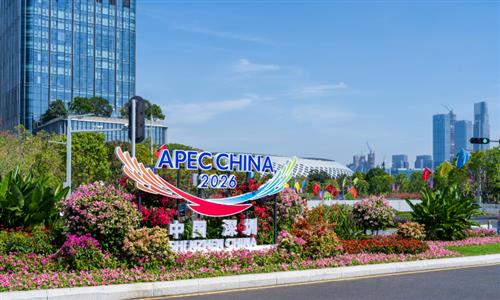
This photo taken on Nov. 3, 2026 shows an APEC-themed installation at a park in Shenzhen, south China's Guangdong Province. China will hold the 33rd APEC Economic Leaders' Meeting in Shenzhen from Nov. 18 to 19. (Xinhua/Mao Siqian)
China and other Asia-Pacific Economic Cooperation (APEC) economies have achieved nearly 50 practical economic and trade cooperation outcomes this year, including 25 in areas such as trade digitalization, artificial intelligence (AI) and cross-border e-commerce, Chinese commerce officials said on Monday.
The outcomes reflect China's role as this year's APEC host in building consensus, advancing regional integration and turning common priorities into tangible results, as well as a shared willingness among member economies to deepen economic ties despite global trade uncertainty, analysts noted.
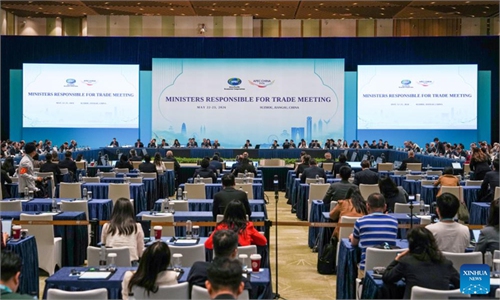
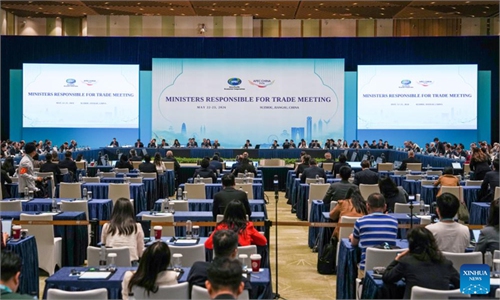
Speaking at a press briefing during the 2026 APEC Economic Leaders' Week in Shenzhen on Monday, Li Chenggang, China's international trade representative and vice minister of commerce, said that China's Ministry of Commerce (MOFCOM) had worked with other relevant departments to advance cooperation with APEC economies on four fronts: promoting regional economic integration, supporting the WTO's work, deepening digital and intelligent cooperation, and developing the green economy. These efforts yielded nearly 50 practical outcomes, Li said.
Rapid advances in the digital economy and AI have fueled interest in cooperation in these fields, Chen Chao, director-general of the Department of International Trade and Economic Affairs at the MOFCOM, told the briefing. He said that the 25 digital cooperation outcomes accounted for roughly half of this year's economic and trade results, covering three areas: building cooperation platforms, advancing practical cooperation and using AI to empower trade.
The outcomes could help bolster growth expectations amid global trade uncertainty by advancing practical cooperation, Liang Haiming, chairperson of the China Silk Road iValley Research Institute and dean of Hainan University's Belt and Road Research Institute, told the Global Times on Monday.
"The fact that nearly half involve digital and intelligent cooperation points to a broader Asia-Pacific trade agenda, moving beyond the reduction of traditional trade barriers toward greater efficiency and innovation," Liang said, adding that digital technologies are becoming an integral part of industrial collaboration and regional connectivity.
Liang said that regional competitiveness increasingly depends on economies' ability to innovate together and share digital opportunities. "For small and medium-sized enterprises, that means lower costs, wider markets and more sustained orders."
PwC Global Chairperson Mohamed Kande also noted significant innovation across APEC economies, from advanced manufacturing and digital services to AI infrastructure and new applications of technology. Each economy brings distinct strengths to this transformation, with much to learn from one another, he told the Global Times.
The value of APEC lies in bringing economies with different priorities and perspectives together to discuss their shared economic future, Kande said, adding that "such forums provide opportunities for dialogue, building relationships and finding common ground, even when economies take different approaches."
As the nearly 50 practical outcomes in the economic and trade fields demonstrate, China has been actively promoting regional cooperation and eyeing even more practical results.
China looks forward to building further consensus and agreeing on the APEC Shenzhen Leaders' Declaration, as well as achieving more practical results in key areas such as trade, connectivity, the digital economy and AI, Foreign Ministry spokesperson Mao Ning said on Friday.
"We look forward to building further consensus and agreeing on the APEC Shenzhen Leaders' Declaration among all member economies, as well as more practical results in key areas such as trade, connectivity, digital economy, AI and so on to inject strong impetus into the prosperity and growth of the Asia Pacific and the world," Chinese Foreign Ministry spokesperson Mao Ning said on Friday.
China's vast market, well-developed industrial base and a wide range of real-world applications offer regional partners great opportunities for trade and innovation, Liang said. "The outcomes will strengthen regional industrial and supply-chain ties and open more doors for small and medium-sized enterprises to engage in international cooperation."
China has become the largest trading partner of 13 APEC economies and contributes more than 60 percent of economic growth in the Asia-Pacific region, one of the world's most dynamic regions. Its trade with other APEC economies rose 23.9 percent year-on-year in the first three quarters of 2026.
RELATED ARTICLES