APEC trade ministers’ meeting bears fruitful outcomes; Suzhou Statement injects new growth momentum into Asia-Pacific economy: MOFCOM official
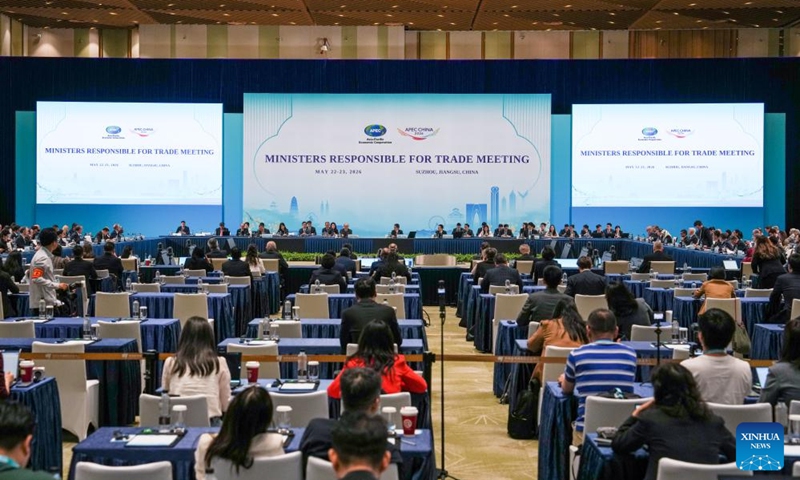
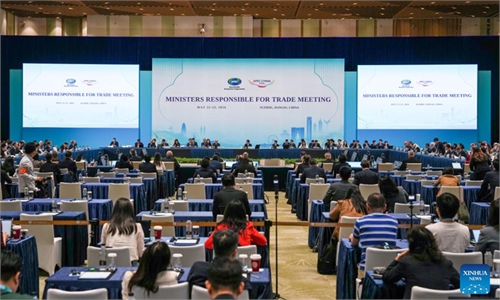
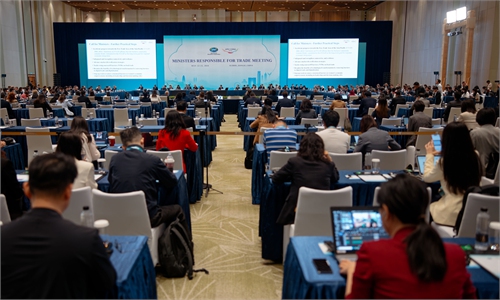
The APEC Ministers Responsible for Trade Meeting opens in Suzhou, east China's Jiangsu Province, May 22, 2026. Aligning with the theme of the APEC 2026 "China Year" -- "Building an Asia-Pacific Community to Prosper Together," the two-day meeting will discuss a range of priority issues, including regional economic integration, support for the World Trade Organization, digital cooperation, and the green economy. (Xinhua/Li Bo)
The just-concluded APEC Trade Ministers' Meeting held in Suzhou, East China's Jiangsu Province, achieved multiple results and consensus, with 2026 APEC Ministers Responsible for Trade Joint Statement (Suzhou Statement) and APEC Roadmap for Innovative, Competitive and Resilient Services, achieving fruitful outcomes, an official from the Ministry of Commerce (MOFCOM)'s Department of International Trade and Economic Affairs said on Tuesday, according to the MOFCOM's website.
The Suzhou Statement announced at the event, which was hosted by the MOFCOM on Friday and Saturday, marked the first ministerial-level outcome document of China's APEC host year, and it was also the first time in 12 years that a statement has been named after the host city of the meeting, said the MOFCOM official.
The successful adoption of the Suzhou Statement sends a clear signal that economies are committed to pursuing win-win outcomes through cooperation, injecting new growth momentum into an Asia-Pacific economy that is moving forward under pressure, said the official.
At present, the global economic recovery remains weak and demand continues to be sluggish. As a key engine of global growth, the Asia-Pacific region urgently needs to form a clear and unified direction for cooperation, with all parties working together to tap into growth potential, according to the MOFCOM.
The Suzhou Statement focuses on emerging areas such as digital trade, green and low-carbon development, supply chain connectivity, and the upgrading of services trade. It has consolidated cooperation consensus among 21 economies and set out key priorities and implementation pathways for regional economic and trade cooperation.
The MOFCOM official said that the joint statement is expected to help fully unlock the potential of regional economic and trade collaboration and better leverage the Asia-Pacific's vast market scale advantages, offset downward pressures on the global economy, and provide solid support for the region's sustained and stable economic recovery.
Meanwhile, against the backdrop of rising unilateralism and protectionism and severe challenges to the global economic and trade governance system, the Suzhou Statement has put forward an Asia-Pacific approach to addressing these difficulties.
All parties reaffirmed their commitment to advancing regional economic integration and the establishment of a Free Trade Area of the Asia-Pacific (FTAAP), and to actively responding to the need for reform of the World Trade Organization.
They also emphasized the importance of taking into account the differentiated needs of developed and developing economies, and upholding inclusive, universally beneficial development based on equality and mutual benefit.
The meeting, held in Suzhou, a modern and open city, also fully showcased China's achievements in opening up to the outside world.
When asked about the consensus reached at the meeting on regional economic integration and the establishment of a Free Trade Area of the Asia-Pacific, the MOFCOM official recalled that during China's APEC host year in 2014, all parties reached the Beijing Roadmap for APEC's Contribution to the Realization of the FTAAP.
Over the past decade, members have carried out policy coordination, capacity building, and information exchange around the vision of an FTAAP, continuously advancing the process of regional economic integration and significantly promoting deeper regional connectivity and development.
Against the backdrop of a complex and severe international economic and trade environment, the consensus reached by APEC members to continue advancing Asia-Pacific regional economic integration is particularly valuable, the MOFCOM official said.
The outcomes of the meeting include advancing cooperation in digital trade and green development. The APEC Trade Ministers' Meeting reached broad consensus on deepening digital cooperation and promoting green growth, which is expected to create a more favorable external environment and broader space for cooperation for China's digital and green industries.
As the most dynamic and trade-intensive region in the global economy, the stability of supply chains in the Asia-Pacific has a direct impact on the pace of global economic recovery, said the official.
At the meeting, the consensus reached on supply chains sent a clear signal to the international community that APEC economies choose "connectivity" over "fragmentation" and "cooperation" over "confrontation," the official said, noting that this is of great significance for building a more resilient, efficient, and inclusive Asia-Pacific supply chain network.
RELATED ARTICLES