APEC CEO Summit draws 115 Fortune Global 500 firms
Shenzhen CEO summit offers ‘common ground’ amid geopolitical divisions: expert
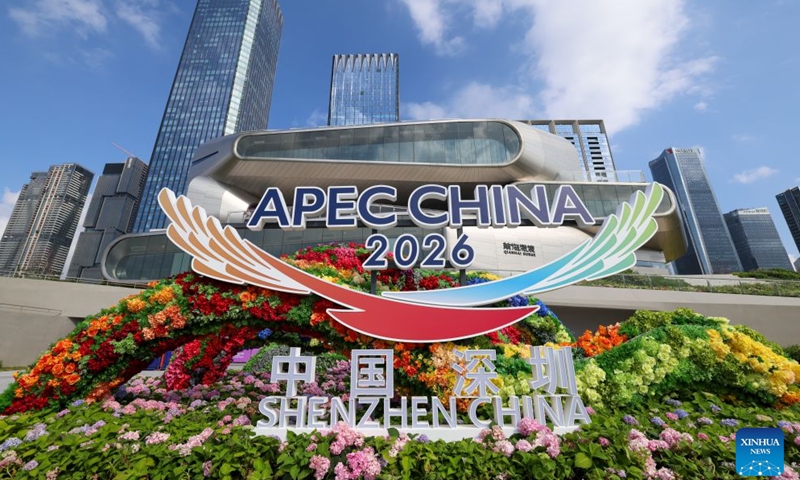
This photo taken on Nov. 3, 2026 shows an APEC-themed installation at a park in Shenzhen, south China's Guangdong Province. China will hold the 33rd APEC Economic Leaders' Meeting in Shenzhen from Nov. 18 to 19. (Xinhua/Mao Siqian)
Representatives from 115 Fortune Global 500 companies will attend the Asia-Pacific Economic Cooperation (APEC) CEO Summit in Shenzhen, South China's Guangdong Province, on November 17 and 18, the China Council for the Promotion of International Trade (CCPIT) said on Sunday. This turnout reflects businesses across the region seeking new opportunities and stability for cross-border trade amid rising protectionism.
The summit is expected to host more than 2,000 participants from business, government and the media. Twelve leaders of Asia-Pacific Economic Cooperation economies will attend the APEC CEO Summit 2026. Heads of international organizations and business associations from economies including the US, Russia and Japan are also expected to attend, a spokesperson from the CCPIT said.
The breadth of participation highlights one of APEC's strengths, Hu Qimu, a professor at the Maritime Silk Road Institute of Huaqiao University, told the Global Times. It brings together the world's two largest economies alongside both developed and developing economies at different stages of growth. "Industries at different stages of development, markets of different types, and economies of varying sizes can all find opportunities for cooperation," Hu said.
China's APEC host year focuses on openness, innovation and cooperation, under the theme "To Prosper and Win the Future Together." The CEO Summit agenda will address critical topics such as the proposed Free Trade Area of the Asia-Pacific, connectivity, the digital economy and sustainable development. These discussions build on substantial trade ties. In the first three quarters of 2026, China's trade with other APEC economies rose by 23.9 percent year on year to 24.07 trillion yuan ($3.6 trillion), accounting for 60.3 percent of its total foreign trade, customs data showed.
This will mark the third time China hosts the APEC Economic Leaders' Meeting, following Shanghai in 2001 and Beijing in 2014. Former Singaporean foreign minister George Yeo told the Global Times that holding the meeting in Shenzhen was "symbolically important." He noted that it underscores China's commitment to reform and opening-up while also highlighting the development of the Guangdong-Hong Kong-Macao Greater Bay Area.
For businesses, Hu noted that bringing policymakers and executives together provides an opportunity for economies with different development priorities to identify overlapping commercial interests.
Firms eye China
US companies make up the largest group among participating firms from outside China, accounting for nearly one-fifth of the total, according to the CCPIT. The South China Morning Post reported that Google and Boeing have confirmed places in the US business delegation. The CCPIT said in September that Amazon, Walmart, Apple, ExxonMobil and Microsoft were among the US companies that had applied to attend.
Recent earnings reports show the scale of the Chinese market for these companies. Apple's net sales in the Chinese mainland, Taiwan, Hong Kong and Macao reached $17.54 billion in the fiscal quarter ending September 26, up 21 percent year on year. Walmart reported $7.42 billion in net sales in China for the quarter ending July 31, up 28.2 percent. Boeing has identified China as a significant market for commercial aircraft in its latest quarterly filing.
He Weiwen, a senior fellow at the Center for China and Globalization, told the Global Times that the strong presence of US companies at the summit can be attributed to two factors. First, the size of the US economy within APEC accounts for the representation of many of its largest companies. He noted a similar pattern at the China International Import Expo, where US companies have maintained a large presence for several years.
What is particularly noteworthy this time, He said, is that the two countries' leaders have set a direction for a more constructive and stable relationship, encouraging US companies to engage with their counterparts. They are coming to Shenzhen "to look for more business opportunities," with an eye on both the Chinese market and the wider Asia-Pacific region.
The summit will also attract companies from 13 economies outside APEC, including the UK, France, Germany and Switzerland. Among Asia-Pacific firms, Thailand's Charoen Pokphand Group has applied to attend. Its listed food business, Charoen Pokphand Foods, reported that higher earnings from associates following the restructuring of its feed and swine operations in China helped lift third-quarter net profit attributable to shareholders by about 1 percent year on year to 5.23 billion baht ($154.39 million).
Hu said the appeal for businesses across economies lies in the concentration of some of the world's most dynamic markets in the Asia-Pacific. Companies from different industries can use the same forum to find partners and explore opportunities across multiple markets. Yeo provided a Southeast Asian perspective, saying that ASEAN values its friendship with China and that China understands the grouping's desire to maintain ties with all major powers. That flexibility allows Southeast Asian economies the room to pursue commercial ties with a range of partners.
Business policy input
At the fourth meeting of the APEC Business Advisory Council (ABAC), business representatives from China and the US jointly proposed strengthening Asia-Pacific supply-chain cooperation, while Chinese and Canadian representatives submitted an "AI plus" proposal, Wu Meng, head of the CCPIT's international cooperation department, said on Sunday. These proposals demonstrate how businesses can collaborate across borders and bring shared concerns to policymakers through APEC.
"Maintaining the integrity and resilience of supply chains across APEC economies is in the interests of businesses," He Weiwen said, warning that political pressure in Washington to restrict technology flows could fragment supply chains that extend well beyond China and the US, ultimately affecting businesses in Southeast Asia as well. A joint proposal from the two business communities, he said, shows that companies still see value in keeping those networks connected. In his view, the CEO Summit can amplify this shared interest, providing a stronger voice as governments consider trade and technology policies.
Against the rise of trade protectionism, China has put shared prosperity at the center of the Shenzhen meetings. The theme "To Prosper and Win the Future Together" reflects this emphasis on mutual benefit. The business community will have a concrete way to contribute, as ABAC presents recommendations directly to APEC leaders, and the CEO Summit will draw on the council's work and its own discussions to issue a Shenzhen Initiative.
"Across the Asia-Pacific, it is easier to find common ground on economic and trade issues," Hu said. APEC provides members with differing political positions the opportunity to make progress. Closer ties among producers and suppliers can in turn give those economies a greater stake in keeping trade channels open. Hu said keeping the discussion focused on economic cooperation is particularly important when geopolitical disagreements complicate the ability to reach consensus.
For the wider Asia-Pacific, He said, the Shenzhen summit offers businesses a platform to advocate for the maintenance of connected regional supply chains as trade barriers rise. "This summit is a positive force. It can help counter the trend toward geopolitical fragmentation," He said.
RELATED ARTICLES