From CIIE to whirlwind diplomatic engagements, China delivers development opportunities and stability amid global turmoil
Events highlight resolve to keep market open and pursue mutually beneficial cooperation: expert


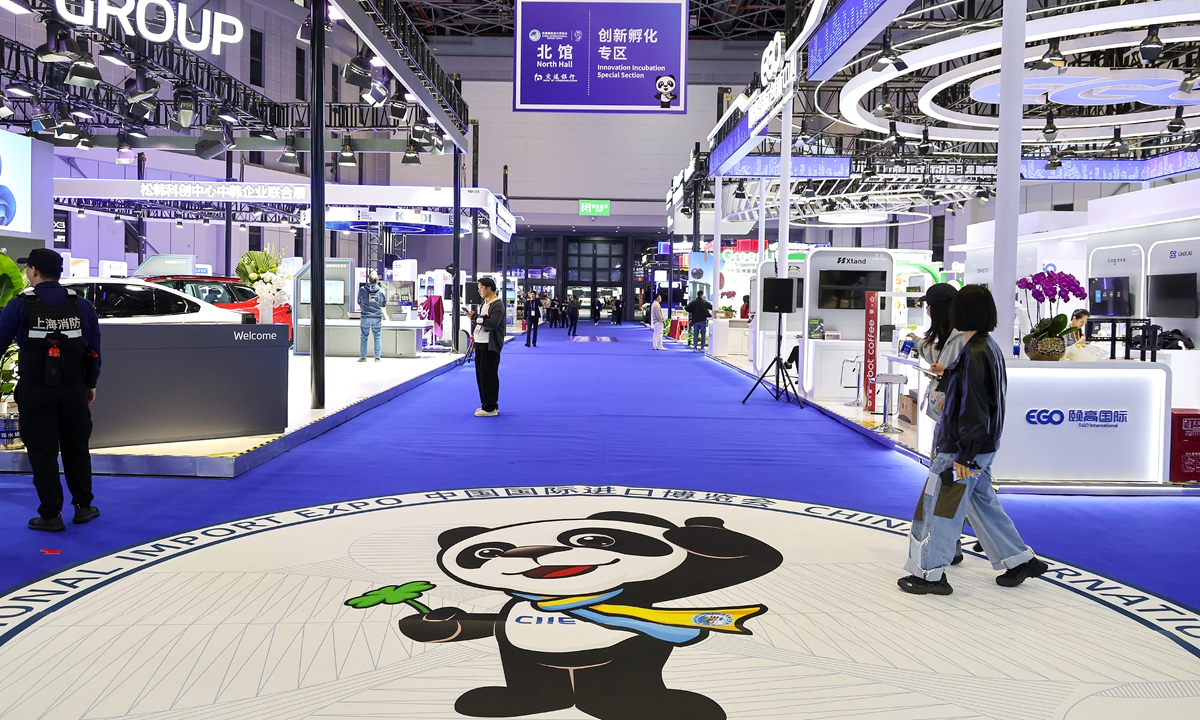
CIIE Photo: VCG
Analysts said that China leverages pragmatic bilateral diplomatic consultations and multilateral platforms to coordinate trade cooperation and regional security agendas. It delivers development dividends and stabilizing momentum, signaling its commitment to multilateralism, open cooperation and win‑win outcomes with all countries.
Deliver new opportunities
The ninth CIIE will be held from November 5 to 10 in Shanghai, bringing together exhibitors from around the world. Launched in 2018 as the world's first national-level expo dedicated to imports, the CIIE has become an important gateway for foreign businesses seeking access to China's vast consumer and industrial markets.
According to China's Ministry of Commerce (MOFCOM), this year's expo is expected to attract 4,142 overseas exhibitors from 148 countries and regions, including more than 2,000 first-time exhibitors. Overall, 162 countries, regions and international organizations will participate.
Companies from the US, Germany, UK and France will occupy the largest exhibition areas. Meanwhile, the expo has expanded support for the world's least-developed countries, increasing the free exhibition space allocated to them by 17 percent from last year, when more than 160 companies from 37 such countries participated.
"The CIIE has become an inspiring platform for us to exchange, listen, learn, and work with our partners… What I especially appreciate about the CIIE is that it brings together government, industry, researchers, entrepreneurs, and companies from around the world," Bill Anderson, Chairman of the Board of Management of Bayer AG, told the Global Times on Wednesday.
"Bayer is deeply committed to continue fostering innovation and collaboration in China," he added.
According to Huo Jianguo, former head of the Chinese Academy of International Trade and Economic Cooperation under MOFCOM, the CIIE fully demonstrates China's resolve to keep its market open and pursue mutually beneficial international cooperation. As unilateralism and protectionism repeatedly batter the international economic and trade order, the CIIE has become an irreplaceable global public good within the world trade system.
He noted that the expo reflects China's stance in pursuing trade balance, rebutting some Western smears regarding China's trade surplus.
"China does not aim for sustained trade surpluses or focus solely on expanding exports. Rather, it taps into its huge domestic market to steadily deliver development opportunities worldwide," Huo remarked. "By taking the initiative to boost imports and cooperating with trade partners to reinvigorate global trade, China puts into practice its vision of common development."
For 17 consecutive years, China has remained the world's second-largest importer. Also in the first three quarters of 2026, the country's imports rose 22.3 percent year-on-year, significantly outpacing export growth, the Xinhua News Agency reported.
According to the People's Daily, China has contributed around 30 percent to global economic growth for years. It has signed Belt and Road cooperation documents with more than 150 countries and over 30 international organizations.
Following the CIIE, China will host another major multilateral economic and trade event in November. Shenzhen, in South China's Guangdong Province, will host the 33rd APEC Economic Leaders' Meeting from November 18 to 19. The theme of this year's summit is "Building an Asia-Pacific Community to Prosper Together," while China has identified openness, innovation and cooperation as the three priority areas for this year's APEC cooperation.
While co-chairing the 37th APEC Ministerial Meeting via video conference with Minister of Commerce Wang Wentao on Tuesday, Chinese Foreign Minister Wang Yi called on members to uphold mutual respect, deepen solidarity, foster an open environment and sustain the momentum of integration.
Wang Wentao said that China will always stay committed to promoting high-level opening up. He added that the APEC parties should continue to contribute practical and effective "Asia-Pacific solutions" to the development of the Asia-Pacific region and the world at large.
Saravoot Yoovidhya, CEO of Thailand's TCP Group, told the Global Times on Wednesday that the APEC economies constitute a key source of exhibitors at the CIIE. By continuously unlocking opportunities of China's vast market, the expo has become a vital gateway for Asia-Pacific exhibitors to expand into the Chinese market and deepen regional cooperation.
As a champion of regional cooperation and a major engine of the global economy, China brings much-needed certainty to Asia-Pacific cooperation and prosperity. An open, inclusive and mutually beneficial environment for regional cooperation delivers stable institutional expectations for multinational enterprises like TCP Group, he added.
Anchor of stability
Foreign dignitaries including Gabonese President Brice Clotaire Oligui Nguema and Austrian Federal Chancellor Christian Stocker are among the foreign leaders attending the CIIE in Shanghai.
They join the recent wave of foreign dignitaries from Europe, the Middle East and Southeast Asia to visit China.
Analysts pointed out that peace and development are the common aspirations of all countries. This latest surge of China's home-based multilateral and bilateral diplomacy integrates trade, diplomatic and security agendas, offering a rare source of stability for the global community.
"China pursues proactive, unilateral and institutional opening-up. The development it advocates goes beyond sustainable development and emphasizes shared development," Wang Yiwei, a professor at the School of International Studies at the Renmin University of China, told the Global Times on Wednesday.
Amid today's shifting global landscape, many countries are seeking deeper cooperation with China, attracted by its commitment to openness and inclusiveness, the expert noted. "This stands in sharp contrast to the closed, exclusive and internationally irresponsible approach of the US, as well as the trend of rising protectionism in Europe amid populist pressures."
Meanwhile, in carrying out international cooperation, China consistently adheres to the principles of non-interference in internal affairs, non-alignment and not coercing other countries into taking sides, delivering rare security and predictable expectations amid a turbulent global landscape, he added.
RELATED ARTICLES