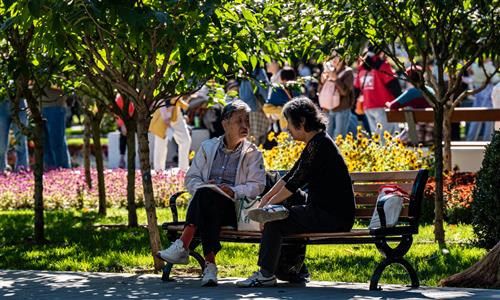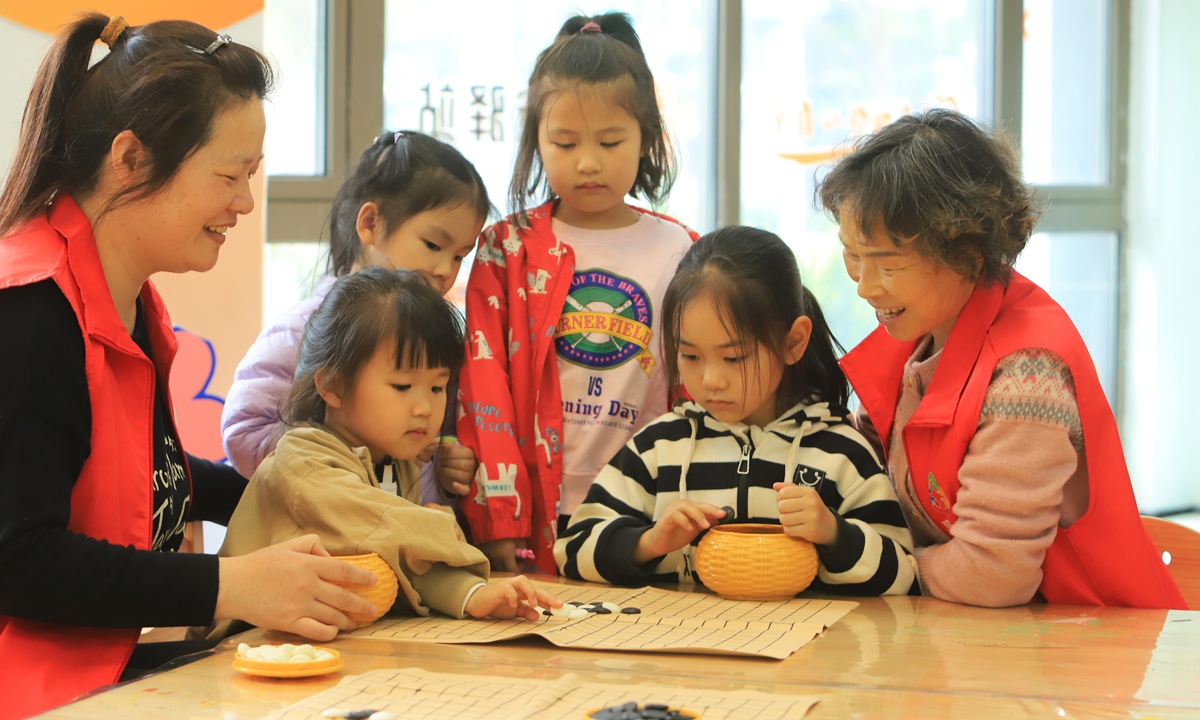
"Shared grandmas" play with children at a community center in Taizhou, East China's Zhejiang Province, on April 24, 2026. Photo: VCG
A "shared children" home-based elderly care program launched in Changsha, Central China' Hunan Province, has sparked widespread public discussion. Under the program, which is subsidized by the government, co-funded by individual users and operated by professional service providers, elderly residents can pay as little as 199 yuan ($30) a month to access a range of home-based services, including housekeeping, assistance with medical appointments, bathing support and companionship, according to media reports.
In fact, similar programs have already been rolled out in several places across China, including Southwest China's Sichuan, East China's Jiangsu and Shanghai, and Northwest China's Shaanxi.
By the end of 2025, 323.38 million people in China were aged 60 and above, accounting for 23 percent of the country's total population. The number of people aged 65 and above reached 223.65 million, representing 15.6 percent of the total population, according to the latest data released by China's Ministry of Civil Affairs in July.
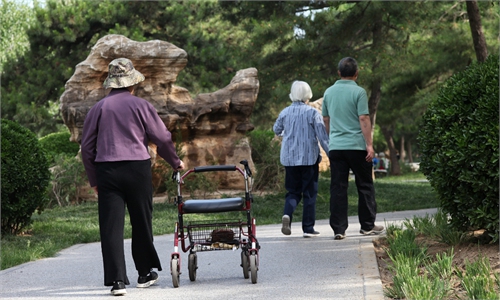
As China's population ages, the "shared children" model is emerging in various regions as a new way to meet the growing home-care needs of seniors living alone or apart from their children.
According to Peng Xizhe, director of the Fudan Institute on Ageing, as more elderly people live apart from their children today, relying entirely on family members for elderly care and emotional support is no longer sufficient, making the "shared children" model an important component of China's broader elderly care service system.
Various pilot programs across the country should be encouraged, but their services need to be tailored to local needs. Their viability, however, depends on the maturity of local markets and elderly residents' ability, particularly their financial capacity, to pay for such services, Peng told the Global Times on Tuesday.
Elderly care needs vary across regions, reflecting differences in seniors' lifestyles, dietary habits and living arrangements, as well as urban and rural conditions, Peng added.
The "shared children" home-based elderly care program launched by Wenyi Road subdistrict in Changsha has been running for a year and has served nearly 160 seniors. All caregivers are required to provide proof of a clean criminal record, complete training and obtain certification before taking up their duties. All services are documented, with elderly recipients signing off on the work, a staff member from the community told the Global Times.
The program targets seniors whose children are not nearby, who cannot afford to hire private caregivers or who prefer not to live in nursing homes. It offers more than 30 standardized, fee-based home care services at affordable prices, with multiple seniors sharing a team of caregivers to reduce costs.
"Shared" refers to cost-sharing, while "children" reflects the caring and attentive service expected of service providers. The initiative is designed to supplement family care, not replace children's legal obligation to support their parents, the community staff member said.
An elderly resident surnamed Zhang, who has purchased her "shared children" service twice, praised the service providers as reliable, attentive and considerate. She particularly commended a regular caregiver surnamed Yi for her gentle manner and willingness to help with everyday problems, from replacing faulty water pipes to repairing electrical switches.
According to Chen Gong, director of the Institute of Population Research, Peking University, China is entering a new phase of high-quality development in addressing population aging, focusing on institutional improvements, expanded and upgraded services, and greater public participation. A more needs-oriented elderly care system, with stronger family-based and grassroots services, is taking shape.
RELATED ARTICLES